

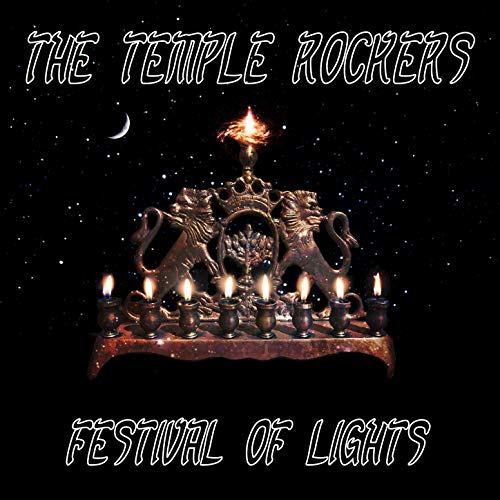
“There’s a Christmas site that did a review of it,” David Gould says proudly of The Temple Rockers’ new Hanukah-themed reggae album Festival of Lights. The former bassist of long-running reggae and festival favorites John Brown’s Body, Gould, who comes from a conservative Jewish family, has spent almost two decades studying the intersection of Hebrew and Rasta traditions. Throughout his spiritual journey, he’s recorded a number of LPs that weave together Jewish and reggae themes, prayers and melodies—including a few on John Zorn’s radical Tzadik label—and put together an all-star live band that brings together members of John Brown's Body, 10 Ft. Ganja Plant and Big Mean Sound Machine. When it came time to turn his attention to the Jewish festival of lights, Gould and his band reached out to veteran Jamaican singers Linval Thompson, Wayne Jarrett and Ansel Meditations and his own live outfit to rework classic and alternative Hanukah songs like “Days Long Ago,” “Rock of Ages,” “Who Can Retell,” “Almighty Light” and “I Have a Candle,” among others. He also reached out to Craig “Dubfader” Welsch to create a dub remix of the LP, the fittingly titled Festival of Dub, both of which have been released on Gould’s own Fresh Roots Records. The blend of cultures works incredibly well, even if Gould had to work out some Hebrew cheat sheets for his guest musicians. “I had the phonetic spellings on a big piece of paper,” he says with a laugh about the studio sessions. You have been playing reggae music through a Jewish scope for years now. What led you to finally release a Hanukah album? It started about 18 years ago; that's when the original concept came to me and I started recording this mashup of Jewish music with reggae music. I like to think of us as a reggae band more than a Jewish band. A lot of people focus on the Jewish aspect of it—and what do I expect? It's a Hanukah album. But, to me, it's more of a reggae project. I used to play bass with a band called John Brown's Body from 1997 to 2002. I toured with them, played 700 shows around the United States, came out with a few records on Shanachie Records when I was in the group. It was during that time that I had the epiphany that a lot of these melodies that I prized from my youth that were so beautiful, that I learned from going to synagogue with my family, were actually reggae tunes yet to be written. It was a musical epiphany, but after looking into it more, there's a real cultural connection, too, between the musics and the cultures of rastafarianism and Judaism, so it's exciting to me on many levels. I put out a record in 2001 called Adonai & I, and that was the first release on an independent label out of Ithaca, NY, called I-Town Records. Soon after that, I connected with John Zorn and his label out of New York called Tzadik Records, and they put out a dub remix called Adonai & Dub. Several years later in 2009, I put out Feast of the Passover and Dub of the Passover also on Tzadik Records. Dub of the Passover was mixed by Bill Laswell. So I knew that I wanted to do a Hanukah record and it was just about waiting for the right time, when the inspiration was there and the time was right. I started working on this a couple years ago, so it's nice that it's finally come to fruition. It's generally a 10- to 12-piece band when we perform live, with a three-piece horn section and a couple of singers, then guitar, bass, drums, organ, keyboard and percussion. This is the first album that's actually coming out under The Temple Rockers' name. The first album just came out as Adonai & I—it didn't even say whether that was the name of the group or the album but it was kind of both at the time. Zorn wanted me to come out with the records under my name, which I didn't really love to do but that's what ended up happening. For this project I wanted to have a group name as the focus. We switched our name to The Temple Rockers in about 2009 so it's been a while since we've been operating under that name. But we don't have any releases under that name. And we haven't done a tremendous amount of touring; we haven't done a lot of shows under that name either. It's kind of a new name so it seems like a new project to a lot of folks. The members of The Temple Rockers all have roots in the reggae world. Can you talk a bit about putting together this unique group of musicians and how you originally decided to approach this mix of original and secular music? The foundation of the group that plays live has always been playing with my brethren who I used to play with in John Brown's Body—the drummer Tommy Benedetti, the guitarist Nate Richardson and John Petronzio who wasn't in John Brown's Body when I was in it but joined afterwords. Those guys have been in the rhythm section for the group. Tommy didn't play the drums on this recording, but when we play live he's still the first man that I call. I played this music with them first when I started playing it, and they're some of the most inspired reggae musicians that I know in my circle. I always try to seek out the folks that can express themselves the best in the genre. Those guys I always seek out first. And it's really a team of people over time. The other consistent member is the lead singer, Craig Akira Fujita; he's the frontman of the group. He's an amazing entertainer and a great singer, and he also has a Jewish background. He's Japanese-Jew and his mom's a rabbi, so he has the upbringing. My sister, Lisa Gould, sings in the group as well. Not everyone in the group in Jewish—in fact, besides the three of us and a trombone player that plays with us every once in a while, everyone else is not. But once again, to me it's more of a reggae project. We don't have klezmer instruments, we don't have accordions and violins and such. It's the lineup of a roots-reggae band. I used to live in Boston, and that's when I started this project, so a lot of the players are from Boston or were at the time I was there and I still try to connect with them. Mark Berney is a world-renowned trumpet player; I still try to get him to play. Jared Sims, a professor of jazz at West Virginia University, he's a fantastic saxophone and flute player, so I always try and get him. This album, though, again, has some different players than usual. I sourced folks locally to where I live around Ithaca. The drummer, Matt O’Brien, is from the group Thunder Body; a couple of the horn players and the percussionist are from Big Mean Sound Machine, which is a band from the Ithaca area that does original afro-beat music; and Nate and John Petronzio were on the record, and a few other characters. John Brown’s Body doesn’t play anymore. They had their last show on New Year’s Eve in 2017. They’ll probably emerge again, but after 20 years they decided to call it for now. Digging a bit into the roots of this, you mentioned you grew up going to synagogue and is something that is of interest to you as a spiritual and musical inspiration. Can you talk a bit about your heritage and how music played a role in that and led you to playing bass and reggae? I grew up in Long Island in a Conservative Jewish family, not Orthodox or Reformed, but right in the middle; we did some things and not others basically is what Conservative means [laughs]. Follow some of the rules and not all of the rules. I went to Hebrew school at night, a couple nights a week, and I had a Bar Mitzvah, but we weren’t a super religious family. I didn’t love the constructs of organized religion, but I was really moved by the music. Still today, some of the deepest songs I’ve ever heard are these songs, these melodies. They always stuck with me even after my Bar Mitzvah when I moved on and stopped paying attention so much to following the Jewish path specifically. The music stuck with me, and I’m aware of my roots. When I discovered reggae music, it was a really cosmic moment. I went and saw Burning Spear after someone recommended checking them out and I was totally blown away by the whole sound of the music. It consumed me, honestly, and I just switched gears from what I was doing and started focusing on Jamaican music, collecting it, trying to get into a group playing it. It just became the soundtrack of my life. Also, it sounds like the soundtrack of the Bible, to me, or the Old Testament stories. They sound to me like reggae would’ve been playing in the air. There’s something about the two that match up so nicely. I’m not sure if it’s from listening to all the lyrics or telling stories from the Bible or what. I feel like it’s in the quality of the actual music itself, the sound or the vibrations of the sound; there’s something about it that’s very ancient, and that really drew me toward it. Later on, I had the revelation that this actually pairs up with this music. I think it makes a lot of sense because the Jews and the Rastas come from suffering and slavery in their heritage, and that informs the music that ends up being created in the culture; minor keys are a real theme. Outside of organized religion, there’s a huge cross-section of Rasta culture and Jewish culture—Bob Marley had worn a Star of David and reggae music is filled with Old Testament references. Through your studies, have you learned about where, historically, the intersection really first began? I’m not a specialist in this, but I could say that since Sheba visited Solomon, came from Africa and visited Solomon in Israel, there’s been a connection between Africa and Israel. The Rastas use the same book for their culture and rules and wisdom, even growing dreadlocks versus payots. There’s a real crossover there; Africans have long associated themselves as the lost tribe of Israel. If you look at the songs and band names and album names in reggae music, reggae’s the religious music of the Rastafarians; The Royals have an album called Israel Be Wise from 1978; Jah Woosh, Gathering Israel; there’s Israel Vibration, the band; Wayne Jarrett has a song, “Brimstone and Fire,” which is the story of Passover; The African Brothers do “Lead Us Father,” which is also the story of Passover. There’s this embedded crossover. And in terms of Passover, there is also just the story is the story of being in slavery and freed from slavery and oppression, and there’s so much in the history of the Rastafarian Jamaicans being brought over from Africa and everything. I think there’s a resonance there between the stories of the suffering and slavery that crosses over between the two cultures. That’s probably why. It’s a more epic story with a lot more parts than the story of Hanukah, I guess. You don’t hear a lot about—at least for me, I don’t even know which book I would cite to read the whole Hanukah story, but from the average upbringing of Jewish people that I know, you know that there were the Maccabees and there was a war. Whereas with Passover, you have the whole story of Exodus, a huge detailed story.
You’ve noted that while you were on tour, between stops you would go to local synagogues and communities and do research. Could you talk about that experience and some of the places you visited? I did that right when I had the revelation that there was this connection between the musics. I was on tour with John Brown’s Body at the time in Davis, Calif., and had a day off and rented a bike and rode to the nearest synagogue and photocopied the prayer book. I was just really excited to start writing the bass lines and horn lines for these songs. I couldn’t believe it had never been done before—at least I didn’t think it had; there are other artists that have taken this approach, but there aren’t a lot of them [laughs]. It’s definitely fringe. Can you walk us through the process of curating this set of Hanukah songs? I knew I wanted to do “Days Long Ago” and “Spin Dem” and perform them in our style, and I knew I wanted Linval Thompson to sing those songs. So when I decided to go ahead with making the record, 12 has been the magic number for me of songs I want on a record—all my records have had 12 songs on them—so I knew I wanted 12, and only came up with eight songs I knew in total from Hanukah that would fit the reggae style and would pass the test. I didn’t want to do “Dreidel, Dreidel, Dreidel,” for instance—I find it to be kind of cheesy—so that didn’t make it on there. I needed to find more music to flesh it out, so I did a lot of research online and sought out different recordings to find music that resonated with me that I felt like would be a good match with the Jamaican style to make the 12, basically. And that was really exciting and fun because one of my favorite parts about this project is creating—as a bass player I love writing grooves and drum beats, too, so to be able to have these songs that didn’t have bass lines and drum beats and horns and such, that’s just really inspiring to me as a musician from where I come from and what I like to do. One of the songs that Ansel Meditations sings, “Do You Know Why?,” is one of my favorite songs on the album and is one that I didn’t know before doing some research, for instance. You mentioned writing the music, so were there songs where you created new music in addition to classic lyrics versus other ones where you maybe stayed more true to the original arrangements in a reggae style? Which songs fell into each of those categories? Yeah. I stayed true to the melodies in all of them, so that really laid the foundations for the songs. After that, it’s about groove. Once again, “Do You Know Why?” I really enjoyed writing the bass line for that. If you listen to that song as I heard it, which was just vocals and piano or something like that, there’s no reggae in it at all. Arrangement-wise, I couldn’t name a specific song; they all stay true to the melody, then at that point, depending on the way it went, how I arranged it—I don’t know how to exactly differentiate. There are some guest singers from the reggae world, some legends. Could you talk a little about who you brought in to this and how you explained to them, for people who aren’t from a Jewish background, the spiritual aspect of it? Obviously they knew the reggae side, but how did that whole conversation go, and what was your takeaway from it? I feel very fortunate because I got three of my top five artists that I was seeking out to do the project, so that’s really exciting to me. Besides the creation of the music, probably my favorite part of this project was being able to connect with these guys, and I was at each of the sessions in person, we weren’t emailing anything. In fact, the project was almost entirely done on two-inch tape analog, reel to reel, so when I went to Miami to work with Wayne Jarrett, I had to bring my reels with me, like the old days. It was really fun to share the concept with them—it was foreign to them—then to give them the music and lyrics and have them work on it. They all really loved working on it and expressed how deeply moved they were by the music, and I made some friends. It was a great adventure to go to these folks. Ansel actually came to my studio and stayed with me for a couple days. So even having Ansel stay with me a couple days and getting to know him as a person and work on the music together, see how these guys work, was really rewarding and enriching for me because these are some of my musical idols. To be able to work with them, be in the studio, see how they approach music, like the phrasing and such, was really interesting. I gave versions of the songs to Wayne Jarrett with me singing them, the very straight way I know how to sing them, then he took the phrasing and made it his own, and that was really beautiful to watch. Same with Ansel, just making it his own, adding some of his own stylistic vocal signatures to it. Then Linval was on the spot what he did, and he didn’t get any of this in advance, we did it right in the studio. I played it for him, gave him the words, and we just did it right there, so he didn’t have time to prepare the way the other two guys did. So it was an adventure, that’s for sure. It was fun. It’s also challenging because they speak patois, which is a dialect of English, and it’s hard to pronounce some of the Hebrew. Especially the ch sound. It’s really, really hard for these guys, and it was frustrating and fun. Now looking back, it’s a laugh. But it was hard to get some of those pronunciations down. Zorn is a master of using Jewish melodies and themes as the springboard for a catalog of deep improvisational jazz music. What was your experience working with him? There was a little dialogue about how—because the sub-label of Tzadik that these came out on was Radical Jewish Culture—there was some dialogue between us, “Is this radical enough?” Just to be doing Jewish reggae stuff. Or does it need to be more radical than that? And Adonai Dub was a lot more radical. The remixes of each of the records was more radical, per se, than the vocal versions. But in the end, he let it go through just as my blend, rather than making anything too crazy about it. Then Bill Laswell, when he did his mix, he definitely added a bit of a sonic radicalism to it. Craig “Dubfader” Welsch is doing the remix of this album. He has a real sound. He’s a master of mixing.





