

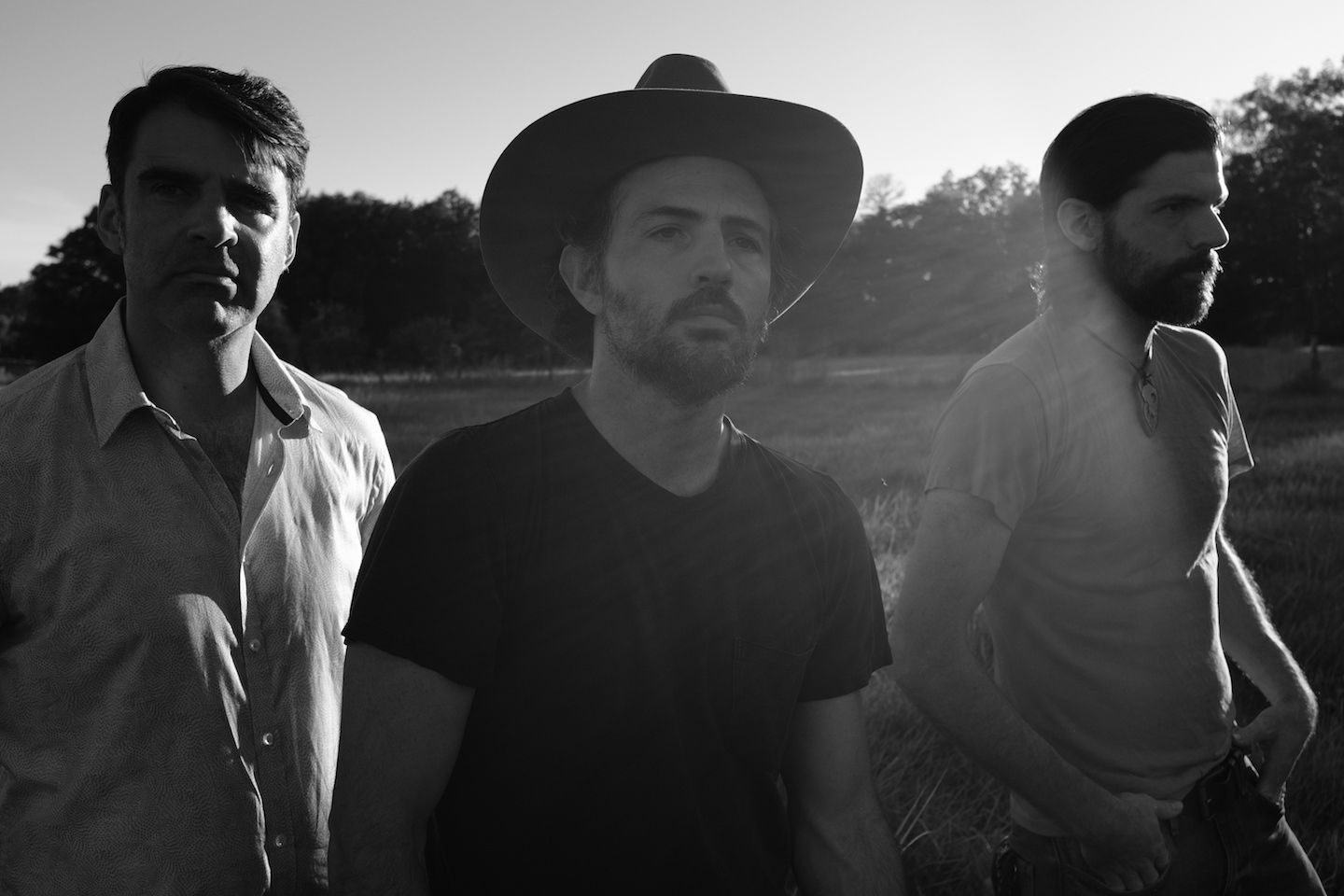
Like everyone across the globe, Seth Avett found his 2020 suddenly upended due to the COVID-19 pandemic. For him, his brother, Scott, longtime bandmate Bob Crawford and the four other musicians in the Avett Brothers that meant announced concert dates in the spring and summer were cancelled and rescheduled for 2021.
An attempt at some degree of normalcy found the Avetts performing a drive-in concert on Aug. 29 at Charlotte Motor Speedway. The sold-out show was considered a success -- fan interest was engaged by the pared-down line up featuring Seth, Scott, Bob and Joe Kwon and safety protocols did not make it a super-spreader event.
That has led to the Victory Lap, another Avett concert to be held this Friday, October 23 at the Speedway. For those who cannot attend, a livestream will be available. Fans can pre-order on nugs.net or nugs.tv, and then tune in to watch live on Friday at 8:30 PM ET, or watch on-demand within 48 hours after the event (HD Pay-Per-View: $24.99, 4K Pay-Per-View: $34.99; Avett Guild members will receive a $5 discount code).
Like the concert, the brothers returned to their stripped-down roots when they recorded and released, after a 12-year gap, the next in their Gleam series. The Third Gleam touches upon emotional and philosophical ideas of freedom and dealing with society's ills. Although it was recorded prior to the virus the new EP unintentionally became current for our times.
Our conversation touches upon Third Gleam and playing again as well as Seth's love of all musical styles including his current obsession with Homeboy Sandman, life during COVID-19, songwriting and the musical, “Swept Away: Inspired By & Featuring The Music of The Avett Brothers."
JPG: I've done a number of interviews recently and I always start with seeing how people are doing and how they're dealing with the pandemic. I interviewed Wayne Coyne of Flaming Lips and the band would have had a very busy summertime playing concerts. It also delayed the album American Head from June to September. How did you deal with it initially? Were you freaked out? Bummed out? Moved on from there?
SA: It was a little bit of all of it. The feeling, I think, for everybody, at this point, it seems like we've all been in it long enough now that there have been multiple discernible stages. My initial stage was one of just a massive gear change, digging into the dirt figuratively and literally. Built a couple of raised beds, planted things. Checked in with my local farmers that I could work out buying directly from; really had a mindset change in terms of what home life looked like.
On top of that, my wife and our little son, we lived in New York City. We lived in Manhattan when this started. So, we left and came down to North Carolina. It was a massive shift. I have this little house that I bought when I was in my 20s that I've kept over the years. It’s on the same land as my parents and my brother. That was waiting for us. Thank heaven. That was a place we could go. So, we left Manhattan and started living that home life and digging in.
We didn't have any COVID cases in our family. We were very lucky to hunker down early. So, what I was doing mainly was checking in with my relationships with my family and my marriage.
We had time spent with my little son and a lot of that was very beautiful. Economically, it's not great in terms of our future because there's really no end in sight. We don't plan on pushing the envelope in a way that's dicey in our estimation. So, economically not great. Spiritually, pretty healthy, to come up against something like this and in terms testing the strength and strengthening the relationships that are closest to us, there have been some advantages. But, on the whole. I would love for it to get back to a more normal kind of a template.
JPG: As far as taking a small step towards normalcy, the Avett Brothers played a drive-in concert back in August that was very successful and you're having another one coming up on Oct. 23. So, you have that going for you artistically and even emotionally for you and your fans.
SA: Totally. And that show was a great experiment. We had a lot of luck on our side and we had a lot of people on our side. They did a great job. I've never experienced a performance where there had to be more teamwork. We were doing something that could be criticized by some as dangerous. We believe that if we did it and everybody followed the guidelines that it could be a success on all fronts. I think that's what we all experienced. It was shown that it didn't spread. There were no super-spreader event type cases after or anything like that.
So, we can all agree that it was a success. It was a success to me because it meant that we had something to prepare for. I got to get back in tune a little bit with Bob [Crawford] and Joe [Kwon], which is important to me. For us and for all the people that came I really feel like there was just as much value in having something on the calendar to look forward to as there was in the actual show. It's really important. It's that open-endedness that really plays on people's psyche, and it plays on our happiness and fear. Knowing that date was out there added some buoyancy to our outlook to the future, and I think it did that for our fans as well. I really think there's a lot of value in that.
So, yeah, it was great. I'm excited about this next one and who knows what the next step is? If nothing else, John, this whole thing is a big huge reminder -- and I'm sure we'll all forget it very quickly after this whole chapter ends -- it's just a great reminder on what we take for granted. Just count those blessings, and being able to get together and enjoy art and music together is something I take for granted all the time.
JPG: That's true. As far as the concert itself, when you're talking about teamwork, in some ways it was probably more DIY than your previous tour playing to packed arenas. Musically, with that show being just the four onstage, I'm sure it wasn't done consciously but it corresponded with the Third Gleam.
SA: That's true. That's true. And that certainly wasn't planned when we were making the “Third Gleam.” The process of getting back into the Gleam with Scott was really more or less like we both felt, “It's time to do that." It felt right. That was, of course, pre-pandemic. When the record was coming out in the midst of the pandemic, it all just seemed to fit very well into this time.
We are in an age of simplifying in a lot of ways and we're not naturally given to simplifying but simplification is being forced upon us.
JPG: The first two from the Gleam series came out in 2006 and 2008. Then, there was such a big gap before the third one. Also, some of the reviews I read mentioned how this is back to your roots and pared down compared to your recent albums, which had more production and less simple arrangements. For you and Scott, was it a consideration in that sense? You've been doing these albums that have been fine-tuned. Now, it's time to do something with two guys, two microphones, two guitars.
SA: Yeah, totally. You know John, I read at one point in one of my student piano books. At the beginning there's an explanation. It always stuck with me. It said something about how all the great composers one of the things they have in common is that they really utilize the tool of contrasts. That always really stuck with me. Every time I hear some piece of music that has a lot of contrast in it like Dark Side of the Moon or Toxicity, that System of a Down record -- that's a super-wild, blaring example. Within a piece of music or within a record or within a career, if you look at Dylan or Tom Waits or somebody like that and you see these massive texture changes. I always feel that's really effective. Mozart knew that. Beethoven knew that. Chopin knew that.
In the context of a canon of recorded work, it makes a lot of sense. In more of a short term consideration, yes, the benefit of making full-on full-length records with the entire seven-piece band with Rick Rubin in California or in North Carolina, it is experimentation and a hope for limitless following of inspiration regardless of genre, regardless of texture. If a horn section is what’s needed, “Let’s add a horn section." If it's more strings or whatever it is, it's more synthetic sounds and we chase those things and we experiment, and it makes us really excited to find the best way to deliver a song or build it or deconstruct it. That's the benefit of that world. There's a lot of other benefits. The camaraderie, there's a lot of benefits, but at the center of this entire project is me and Scott in a room sharing songs with each other.
Each in the Gleam series is a collaboration in terms of half the songs I bring to the table, half the songs Scott brings to the table. But it's more or less an exercise in our brotherhood, of our trust. We don't really tamper with each other's work here. It’s really like, “Here’s three or four songs that are my newest and I feel excited about." and I'm like, "Great! I’ll sing on the chorus.” And I do the same thing.
So, simplifying the process of recording with just one engineer and just me and him. Simplifying the process of the cover art because it's the same cover with different colors. Simplifying the naming of it, the promotion of it. All of this stuff is like, “Let's get this thing back to its basics and just enjoy it and not mess with it too much and try to make it the most pure example of the musical side of our brotherhood.”
JPG: Your answer brought up several things. First off, I'm usually fascinated with band projects versus someone putting out a solo album. I always wonder, as a prolific songwriter, how do they come up with what is for what project. That applies here, too. I'm sure you and Scott are constantly, consistently writing songs. Do you put something aside for when you do another Gleam release while another song will be for the band or it always just the newest things you have on hand?
SA: I don't know, John. It's a little bit of both those things. We often will have a lot of confidence thinking, "I just know it.” This song, it doesn't have it and nothing can be done to it. And a lot of times we're wrong. The lesson that we’re always learning is that each song has to be treated as if -- How can I say this because I'm kind of realizing it as I’m trying to articulate it. Basically, when we set up rules for a song, it generally ends up being a mistake. When we set up rules for how we operate as songwriters, a lot of times it's a mistake.
So, there's always kind of a push and pull between agenda and being honest with what your heart is saying. Sometimes, I feel like, “It sure would be cool if I brought this up during soundcheck and started hearing whatever Mike Marsh started playing behind it on the drum kit.” But something in me might be wanting to hold onto it more for myself or some silly…I'll get in my mind, "I know this is for my solo record or this is a Gleam song.” That mysterious thing is just pulling me towards messing with it, just on that Tuesday in Idaho or wherever I am. I find that it's a mistake if I don't follow that because generally if you're a little more relaxed about it and do share them, the song will be benefited.
And that's the point. It's not about yourself getting benefited, it’s about the song getting benefited. For the Gleam, a song might speak to us in a way and say, "The lyrics here, the narrative here is really the only star.” I view the Gleam songs as songs where the lyrics are so dense or the narrative is so rich that there doesn't happen to be a lot of space for anything else. That's what drives it with the Gleam, but, otherwise, the answer to that is I really don't even know. It just goes song-by-song.
JPG: That's valid. One of the articles I read before doing this Scott mentioned how he embraces the unknown and to hear you, you embrace your instinct and wherever it takes you, which I think is great as a songwriter. At the same time, it’s interesting to hear the artists that you mentioned -- Pink Floyd and System of a Down – because it always makes me laugh in a good way to hear artists you and Scott listen to throughout your lives because they are so far from the Americana vision of what people may have of Avett Brothers. I'm curious about that contrast. What does that wide listening spectrum do for you and your songwriting and your approach?
SA: Oh man. I don't know, John. Does something ever strike you and you get washed over with so much appreciation for even getting to exist that you're like, “Man, I'm just not going to have enough time?” Do you ever feel like that?
JPG: Oh, yeah. All the time.
SA: That's the thing, Sometimes, it just breaks my heart because I can't resolve the time that I have here in this world and I’m overwhelmed by even, sometimes, the most mundane thing, just how wonderful it all fits together. I'm not sure how I can connect that but basically that is why I listen to so much music and I listen to so many kinds of music because I get so much from all of it. The idea of limiting that is to me like the idea of limiting those moments because there's just so much beauty. I feel like it's kinda more or less happenstance where a great artist comes from.
This morning, I've been listening to Homeboy Sandman. He’s a rapper from Queens. I don't know how long he’s been out there doing it but at least 10, 15 years maybe. He's just blowing my mind. I've been listening to him pretty actively for about five years. Just this morning, I had to turn the song off to ‘cause the interview is coming in and as soon as we get off, I'm going to go right back and listen to it. The point I'm trying to make here is that Homeboy Sandman being from Queens that just happens to be. His soul found his way into that body that got born there.
For some people hearing that's who he is, someone that has already decided that they don't like hip-hop would say, “Well, I'm not going to like that. I don't relate to a person that was born in 1980 in Queens that performs hip hop music." I find inspiration in every genre and I mean every genre. I find it everywhere and it just overwhelms me.
It just so happens that I'm most comfortable with an acoustic guitar in my hand, trying to write songs like Tom T. Hall. The interesting thing to me about that is if you're trying to write a song like Tom T. Hall but you're listening to Homeboy Sandman, what might happen then? And I am what happens then.
JPG: Songwriting on Third Gleam, the material gets philosophical with “Prison to Heaven" where the prisoner talks of escaping in the most complete manner possible or “Victory" where you and Scott sing “And from victory I accept defeat.” Also, I was listening to your contribution, “The Fire," and noticed that it's almost Dylan-esque in how every verse moves from one novel-like scenario to the next. Was that an influence or just how it flowed?
SA: Yeah. All of that's in there. One of those interesting universal coincidences that seemed to have happened with the release of this record and the timing of it, “The Fire," anyway, the thing it keeps reminding me of the importance of acknowledgement that there are more valid points of views than we can fathom. In each of those points of view that are in that song came from an actual experience in my life where I came across these characters. So, they're coming from real places and they're just six or seven of however many people there are on earth.
And I think this is a great time to be checking back into that for people to be realizing that all of these points of views are fair to have for the experiences that these people have gone through.
JPG: I meant to bring this up earlier when we're talking about our lives being put on hold. The musical, Swept Away: Inspired By & Featuring The Music of The Avett Brothers, was supposed to open in June. Did you get to see any rehearsals and what are your thoughts on a musical inspired by your music?
SA: I was living in Manhattan, so I was able to be present for a little more of it than Scott was. I was actually able to be there to put my two cents on some of the casting. It blew my mind. Even in its early stages, it was blowing my mind because what happens when you have a body of work, nearly 20 years worth of songs, examples from that 20-year period brought into a new story that influenced by an old real piece of nonfiction inevitably new meanings arrive because of the juxtaposition of the lyrics and the context that the lyrics are set in.
I literally had maybe two or three moments on the first read-through where I was speechless because of something that happened lyrically that had a new concrete meaning because of the locale, because of the setting that the characters were in, and it just blew my mind that that can happen. It's almost like taking a thousand-piece jigsaw puzzle and taking it all apart and putting it all back together and creating a new image. It's like, “How could that be?”
So, it's awesome. Whenever it can be released, I think it's really going to blow people's minds. What we think of when we think of musicals and Broadway type theater, we all think a lot of different things I guess, but there is an excitement and a brashness in a way. This is a good deal darker. Musically, it's awesome but it's very sparse, very dark. It’s gonna be beautiful.
JPG: It's nice to hear you sounding upbeat and in a good mood. When I was doing my research I saw your video announcement for Third Gleam and I was like, “Wow! Seth and Scott look really troubled.” [Seth laughs] Then, when you announced the August concert, you and Scott were smiling and fishing.
SA: We have our moments like everybody else. This morning, it's very beautiful in North Carolina. Maybe, if you call in an hour, I might be just as down as a person can be but...you gotta ride the wave, right John?





