

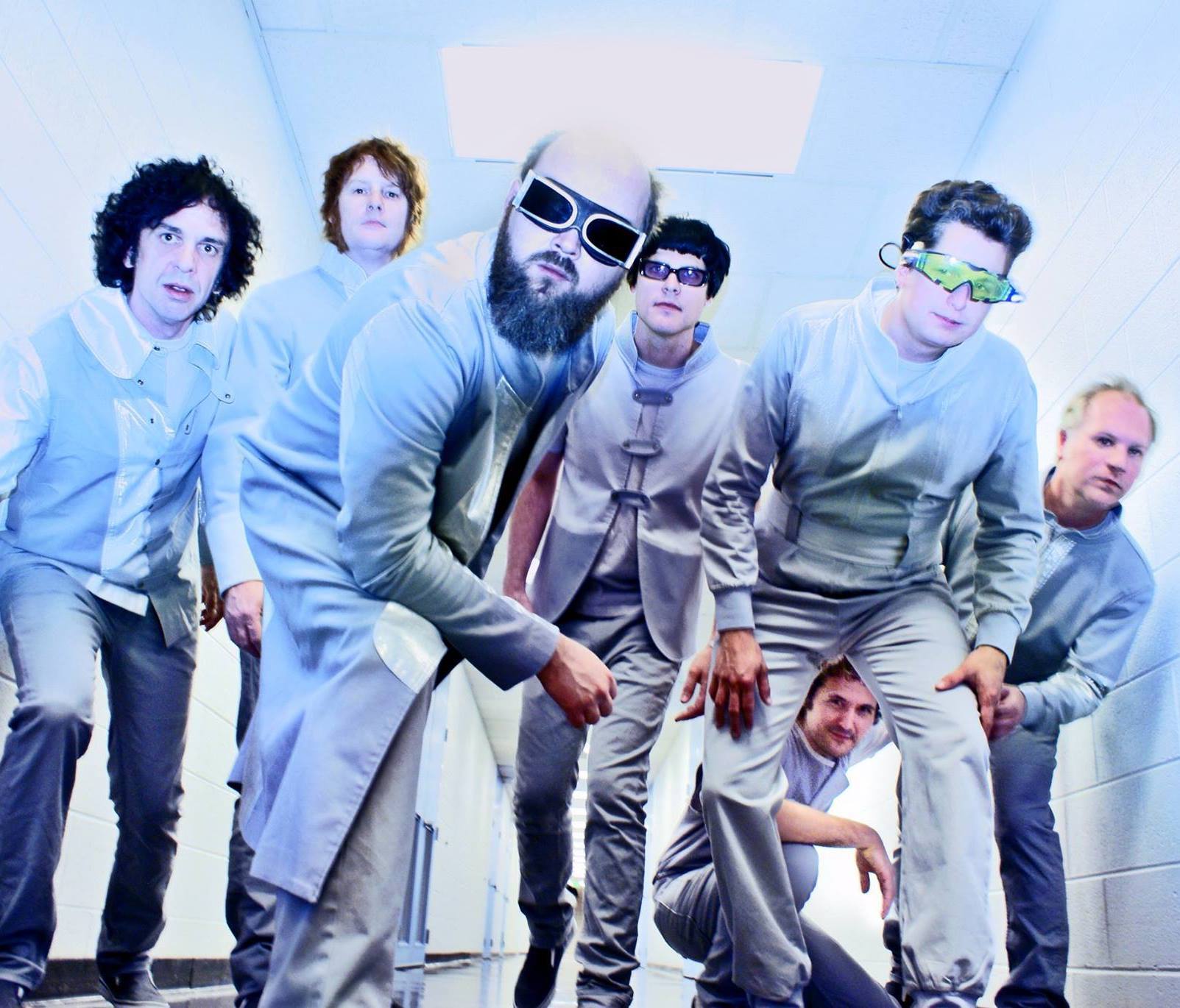
Image via The Apples in Stereo's Facebook page.
Sometimes all it takes is a well-placed cover. Despite being a band for over 20 years, The Apples in Stereo reached one of their largest audiences yet when Phish covered the six-year-old song “Energy” at Saratoga Springs, NY’s Saratoga Performing Arts Center on Friday night. The cover set off a flurry of tweets and text messages, and single-handedly turned a new scene of fans onto the seminal Athens, GA indie-art group’s music.
Robert Schneider, The Apples in Stereo’s founder and a key member of the critically acclaimed but commercially underground The Elephant Six Recording Company collective, heard about the cover within minutes of its performance thanks to a friend who happened to be at the show. The Apples in Stereo’s team spent much of the weekend bantering with their new followers on social media and probably racking up some new royalties thanks to an increase in Spotify hits. Like Ween and TV on the Radio before them, The Apples in Stereo suddenly became known to thousands of fans as the authors of a well-received Phish cover.
As in turns out, The Apples in Stereo’s connection to Phish is much closer than many listeners know. “Energy” appears on the 2007 album New Magnetic Wonder, which was engineered by longtime Pavement and Trey Anastasio collaborator Bryce Goggin. (He’s the man who produced Phish’s Farmhouse and Round Room, Page McConnell’s self-titled album and a slew of Anastasio projects). Schneider also produced, arranged and performed on Neutral Milk Hotel’s In the Aeroplane Over the Sea, whose title track Phish covered in 2010. He’s also a longtime fan of the Grateful Dead and psychedelic music history who has always seen the walls between jamband and indie rock as thinner than many realize. While he’s the first to point out that The Elephant Six Recording Company’s lo-fi techniques and punk vibe are worlds away from Phish’s expansive jams and tie-dye roots, Schneider was quickly able to trace their roots to a similar psychedelic source and shared love of orchestral arrangements and pop hooks.
Unfortunately, Schneider’s newfound attention comes as at sad time for The Apples in Stereo. Last year, The Apples in Stereo keyboardist and core The Elephant Six Recording Company collaborator Bill Doss passed away due to natural causes, and the band has remained quiet for the past year. While Schneider says the group is working on some new material, he is also pursuing a PhD program in Mathematics at Emory University and admits the band’s touring future is uncertain. A few days after Phish covered “Energy,” Schneider discussed the cover and his band’s future with Relix and Jambands.com
Lets’ start by talking about Phish’s cover of “Energy.” Were you aware they planned to cover ‘Energy” and, if not, when did you find out?
Yeah, I found out when everyone else did. I got a mass of emails from friends and fans on Facebook and I was pretty pleased about it. Also one thing I’d like to say is that I’m psyched that you’re calling from Relix because it’s an awesome magazine. I’m a lifelong fan of psychedelic music and being in a psychedelic band and part of a psychedelic musical collective, that’s awesome.
Phish often choose awesome things to cover. I think they covered The Beatles’ The White Album and The Velvet Underground’s Loaded. I mean these are some of the greatest albums ever. And so I’ve always seem them as a band who chooses their covers based on probably what they think is cool. So I thought that was awesome, I’m so happy. I liked their cover of it too, somebody sent me a YouTube video of it and it was awesome.
I was at the show and I thought that they did a great cover of it, and I felt they kept a lot of the character of your version of it but definitely made it sound like a Phish song.
Yeah, I thought that too. They kept the feel of our song while [making it their own]. Like even looking at the time signature of the videos, they basically sing most of the song by like a minute and a half. That’s when it goes into the big instrumental section in the song and I thought that arrangement was really cool.
From looking at my Twitter feed, there seemed to be a lot of back and forth and banter going on between your team and the Phish fans.
Right away when I saw the video, I made a post on Facebook just saying, “Thanks to Phish for their sweet cover,” or something like that. Basically a friend of mine emailed me and was like, “Dude, check out this video and your Facebook page,” someone had posted the video of them playing on my Facebook page. And I think that it was somebody who was at the show at that moment and emailed it the next day. So I was like, “That’s awesome.” Yeah, it wasn’t something that I knew about in advance but I was very pleasantly surprised.
That’s awesome. Have you ever seen Phish?
You know, I haven’t seen Phish. They sort of emerged about the time that I was probably like 20 years old or so, and at that time I was completely into nothing but just ‘60s psychedelic music and then the underground indie rock scene. And so, while I’m a huge Grateful Dead fan—although I missed the chance to ever see the Dead play— American Beauty was a really big influence on me as just a young musician and on all my friends.
I was in my world of making albums and producing my own brand of psychedelic music, and while I knew that there was this movement kind of happening around Phish—and I listened to their albums—I’d never seen them play. I know that their live performances are supposedly where they really are stellar. I always knew that I hadn’t really gotten to the soul of the band without seeing them play. At the same time, I’ve always seen them as being a very tasteful band. Also we recorded with an engineer who has recorded with them too so we sort of felt one degree of separation from them, musically. So I haven’t seen them play and I’m sure that it’s an awesome experience. I mean, I feel like they’re kind of carrying the torch of that sort of a show that the Dead left behind. I mean, I think that that’s clearly the case. It’s obvious to even say it. As the words are coming out of my mouth, it’s like, that’s obvious. I have a lot of respect for them.
I assume the engineer you are referring to is Bryce Goggin, who has worked with Phish, Pavement and your band. He’s definitely kept one foot in each of these psychedelic worlds.
Yeah. He’s amazing too. And if you met him too, you would really see why. Because both the indie world and the sort of jamband world have a number of things in common, but one thing that’s definitely in common is there’s sort of like a looseness and sort of like a lack of flipness to the scene. I mean, not just to the people but to the music and musicians and the sort of aesthetic. And if you met Bryce, while he’s like a very detail-oriented engineer, he’s like the most zen-like, mystical, guru kind of guy. And you’re totally like, “This is the most relaxed, competent and confident and yet, gentle person.” You can see the crossover between Phish and Pavement in this man’s personality.
He exudes looseness and relaxedness and gentleness, which I think is kind of like a characteristic of both the indie psychedelic scene and then the more jamband-based psychedelic scene. I mean, these two things are interesting because they exist side by side, they’re two modern brands of psychedelia that are out there. It’s almost like in the ‘60s when you had the British psych-pop, like Piper at the Gates of Dawn, and then you had simultaneously the San Francisco psychedelic explosion going on. They’re unified in their aspirations and yet musically they sound very different. And there’s a lot of crossover also in the listeners. I could see somebody liking The Olivia Tremor Control or the Apples and also liking Phish or the Dead or something like that without there being any conflict in musical taste.
I’m not sure if you know, but Phish has already covered another song from your family that you were involved in, Neutral Milk Hotel’s “In the Aeroplane Over the Sea.”
Oh that’s awesome. I played bass and wrote the horn arrangement from that song. And of course produced it. That’s awesome. That’s amazing, I’ll check that out! Multiple thumbs up to Phish. All three thumbs.
I want to talk a little bit about some of the projects that you’re up to now, but before we shift into that, for some readers who probably never heard “Energy” before, can you give us a little bit of background about when you recorded that song and where you guys were as a band at that point?
Yeah, totally. So the song is off of our album New Magnetic Wonder. It’s probably one of the poppiest songs on the record, and it was a song that I wrote for my son. One night I had put him to bed in his room and it was sunset and I went and sat out on the porch just outside his bedroom window and I was playing my guitar and I was watching the sunset in my backyard in Kentucky. I live in Georgia now but this was a few years ago. And it was just this beautiful moment. I felt all peaceful and happy, having put my kid to bed, and you have this sort of bonding right before bed and I felt all loving and the sun was setting. It was this beautiful orange light, kind of flowing through the leaves and permeating my yard, and I was playing my guitar and the song just sort of like instantly popped out of me. I kind of thought to myself… Well for one thing, I was aware that I was sitting outside of his window and that he could probably hear me if he just went off to sleep. And also the sunlight kind of shining across my backyard and also in addition to that, I’m into mathematics and physics, I thought, “I’m going to write a song about physics for my son.”
My take on mathematics and physics is fairly cosmic I would say and so I just felt like, “The world is made of energy,” kind of came out right away with the melody. I don’t know, really it came out kind of quickly. I was trying to write a song that would be like a big hug for my kid. So I had the kind of main part of the song which is the verse, that came out really quickly. I mean, the thing about the song is that sometimes you write a song to be poetry and sometimes you write a song to express raw emotions. And sometimes you write a song that is kind of an idea or a feeling, and this song was kind of like that. It’s not poetry, it’s an idea: The world is made of energy. That, and it’s going to be alright, those are the only things I wanted to say with that song.
You don’t want to clutter that up when you have a strong message like that. And so that’s kind of how the song came out. The next morning I was talking on the phone to one of my friends who’s also my manager, Dan, and when I got off the phone with him, this other part just came into my head about, “It’s going to be alright.” So the two pieces of the song happened very quickly but separated probably by about 12 hours from each other, the verse and the chorus.
New Magnetic Wonder was a very special album for us because it was an album where we had sort of set out to try to capture every aspiration that we had ever had as a band in one big album. It’s quite a long album and it covers a lot of ground, lots of sound collages. When we started our band, around the time of our first album, Fun Trick Noisemaker, I had this vision of this perfect psychedelic pop, indie rock album and this particular kind of sound. At that time, because I produced all of our records and we started out recording on 4-track and then moved on to 8-track for our first album, and then eventually I bought a 16-track analog tape machine. And then New Magnetic Wonder was a record that we recorded across different media – 8-track, 16-track, digital, some of it was recorded on a handheld recorder.
Our records are very different from each other. I would say that generally we finish an album and to move on to the next album we’re looking to do something very different from the previous album. So if you listen through the catalog of the Apples albums, every album is very, very different from the previous one because once we sort of wrapped something up, maybe there’s some loose ends that you want to pick up for the next album and maybe there’s some overarching stuff that you want to pick up in the future but not on the next album. You want your next album to be a surprise and you also want it to be an interesting experience where you’re really exploring yourself. You don’t want to just retread something that you already got good at.
So the point is that at the time of New Magnetic Wonder, we looked back over all of our albums and all of them felt like what the Apples feel like. None of them seemed to sum up everything. Like if you were going to say, “Here’s an album by my band. This is what we are.” We didn’t have an album like that. And so the point of that particular album was to be sort of a lengthy, psychedelic, indie rock pop album that could kind of cover all of our visions. And also that would kind of take the game plan of Fun Trick Noisemaker, our first album, and really expand on it. That being said, “Energy” is among the poppier and bigger productions on the album. There’s some stuff that’s super lo-fi on there, and it covers kind of a lot of ground. I think that in recording that song, I really wanted it to just feel like a big hug, a big warm arm of sunshine kind of wrapping around you and kind of encouraging the listener. Also in the production of the song, it starts off sparse and kind of folky, loose, kind of an R&B kind of feel, and then gets fairly orchestral from the middle through the end. It’s a song that really feels like a Phil Spector song or something. I really wanted to make a song that feels great. I mean, I think we have a lot of songs that feel great, at least I try to do that a lot, but with this particular song, I wanted it to be like perfect like sunshine bottled up into a little pop song. And something that like with headphones on for the listener who may be in another state of mind, that it could take them on a journey. And that’s particularly something that I think is very important to me as a producer, is that every song takes the listener on a journey.
It’s interesting, a lot of the hallmarks that you mentioned—whether it’s the orchestral arrangements or an exuberance that’s also tied to psychedelic music—are actually all reasons that I think Phish gravitated to that song. Those are also hallmarks of their music.
I totally see that. I totally agree.
You mentioned a little bit before that you are working on a new The Apples in Stereo album. I know it’s been a few years since you last released an album. During that time, you’ve actually been studying math and science in a PhD program. Can you talk a little bit about where The Apples are as a band now in terms of recording and performing as well as give us some information about your graduate program?
I would also like to say that the thing you said about Phish, the hallmarks of their sound and of our sound, it’s always mystified me a little bit that there isn’t more of a crossover between the various psychedelic scenes that kind of exist. I would say that Phish fans are among our fans. At the same time, the thing about a musical scene is it isn’t just about the music, it’s a cultural kind of scene too. And culturally, the Elephant Six scene is—at least on the surface and probably at the heart—very similar to the jamband scene even though musically it goes a little bit of a different direction. While there’s lots of jamming and lots of improvisation, the focus in Elephant Six is on production and there’s sort of maybe like a little bit more of a punk rock kind of quality to the approach, even if there’s not to the music. There’s a whole recorded kind of thing kind of built into our sort of aesthetic but, at the same time, one would imagine that Phish fans would love the Apples and love Elephant Six in general.
While Elephant Six collective is more underground than the jamband collective, there’s this movement of underground psychedelia that is just waiting for these kids to put on their headphones and trip out to. There’s sound effects, the music is permeated with strange sounds, guitar solos and sort of trippy gestures. It’s practically like dripping and oozing with psychedelic touches, not necessarily subtle ones. I mean, the Apples have a song about LSD on our first album. It struck me when you said that it’s kind of interesting because it’s almost like there’s this premade crossover that’s waiting to happen in the future.
You question sort of raises a question mark in our band because last year one of my best friends and one of my bandmates passed away very suddenly: Bill Doss, who was a band member in the Apples and he was also the leader of The Olivia Tremor Control, and he was also basically my lifelong best friend, my first musical partner, the person I made my first 4-track recordings with and had my first band with when we were teenagers.
So I guess the idea of playing and touring, I still haven’t quite come to terms with his loss. I don’t want to sound too heavy about it or anything like that, but I’m not sure exactly how to play out with our band after something so devastating. And at the same time, that’s not to put a bummer of a feeling on it, that’s more like me being honest with you as a person. So it’s a hard question to answer because we’ve got tons of songs, we love playing together as a group of friends that have been doing this our whole lives, and yet one of our family members is gone. It’s hard to imagine reassembling that family dynamic after something like that. Yes, you grow and you have to live your life and you continue to be creative and stuff, but you’re asking me in the year that I’m suffering from this painful loss so it’s hard for me to exactly answer your question.
It’s a little bit of a painful subject just because it’s hard to say what the future holds. We’re working on a new album, but our new album is a very, very, very strange album and it incorporates a lot of very experimental production techniques that I’ve worked out. It’s not a pop album, I don’t want to say too much about it yet, but it’s fairly far from being a poppy record. I mean, I’m not even sure how musical the album is. It’s sort of like a concept album, it tells a number of different stories, and it’s sort of based on… I don’t want to say too much because I want it to be interesting when it happens. But it’s a kind of unusual album, it’s kind of a deep album in concept.
I don’t mean deep like heavy, I mean like it’s multi-layered. It’s something that we’re all very involved in right now. It’s definitely a headphone album, possibly purely a headphone album. And I would say as far as touring and stuff goes, we are not sure. We’re sort of still emotionally coming together as people from losing our friend and also I’m in graduate school studying mathematics, which is like in itself, a super psychedelic thing to be doing.
Basically by day, my mind slips off into another universe with monolithic shapes and colors and sort of this other dimension or something like that. But also being a graduate student doesn’t leave a whole lot of time for touring. But I’ve played some acoustic shows personally, the band played—before Bill passed away—played last year at All Tomorrow’s Parties. And I’m playing some shows with Neutral Milk Hotel in the fall.
I played with [Neutral Milk Hotel founder] Jeff Mangum a little earlier this year. But where the band is as a live act right now is a little bit of a question mark. Which doesn’t mean that it’s questionable, it’s just we haven’t reassembled and played since our bandmate passed away. I suppose it’s as simple as that. It’s more like we’ve gotten together and hugged. Our new album is a pretty far out record and it’s dedicated to our friend Bill and among its heroes are Albert Hoffman and characters from Greek mythology. And without sounding overly pretentious or anything, we’re working on a pretty heavy album. But I think that people who listen to our music and maybe listen to noise music and that kind of stuff will think that it’s an interesting album.
And you asked about graduate school and that kind of stuff. I got into mathematics like maybe 10 or 12 years ago when I was fixing a tape machine in my studio. The thing is that as a record producer and engineer, I’d always kind of rejected modern technology as a kid. I hated the sound of digital stuff, I hated the sound of records that were made in studios, I hated music that came out of major labels. I was sort of like a punk underground, indie rock hippie as a young kid. And I exclusively disliked anything that came out of a slick studio. And like I said, I started recording my band’s albums and other Elephant Six stuff on 4-track cassette, moved up to a reel-to-reel 4-track then an 8-track, and by the late 1990s, I took a recording budget and I spent it on a 16-track from the mid-‘70s which is said to be the most warm, fat, awesome sounding tape machine in the whole world. And so as our band had built up in our sound, and I built up my skills as an engineer from recording with 4-track to many of the records I made like Neutral Milk Hotel, The Minders, the Apples albums, The Olivia Tremor Control, this is stuff that I did on an 8-track reel-to-reel. But I had gotten this amazing tape machine, it’s like the size of an old stove and as heavy as a piano. It came in a huge crate in the mail that was so big you could think there could be a rhinoceros inside of it. The problem was that the tape machine broke down almost every time you tried to use it. Also in addition for being famous for being super fat and warm, was famous for being terribly unstable.
So anytime you basically run the tape machine, it would blow out. So it came up that I had to learn how to fix the tape machine in order to use it. And the 16-track had this huge binder of thematics. It was literally the size of a huge encyclopedia or dictionary or something. So I had to learn a little bit about electronics to read these diagrams to fix the tape machine. I bought this book from Radio Shack about electronics and I opened it up and on like the first page of the book, it had this equation called Ohm’s Law. And Ohm’s Law says that voltage is equal to the current flow times the resistance. It’s the fundamental mathematical law of electronics, all electrical systems obey this law including presumably our own brains.
When I saw this equation there, to say it blew my mind doesn’t express with enough poetry and mysticism the feeling that was coming off the page when I saw this equation. This golden light was shining down through the mildew ceiling of my studio and as I sat there on the floor with all these diagrams around me, I had this religious experience and I realized that all the stuff that I thought was sacred in my 20s in life, that is: music, recording technology, tape machines, vinyl records, headphones, microphones, synthesizers, electric guitars, playing in my band with my best friends, which was sort of the glue of my childhood relationships and my adult relationships—because Elephant Six is a group of people who basically grew up together and are still best friends. We’ve been friends our whole lives. And so I sort of got this feeling coming from this equation that this was like the foundation of everything for my friendships to like The Beatles and The Beach Boys to like the gurgly sound effects I was getting out of analog synthesizers: you sing into the microphone, your voice gets transformed into an electrical signal, it goes through the wires, it goes through the compressors, it goes to tape, it comes back from the tape machine and you’re hearing it in your headphones, it goes into your brain, and your brain is firing off neural electrical charges and stuff, it’s like this whole cycle of making music that to me is like religion. Like was existing against this simple backdrop of this equation that only had like three terms in it.
It just blew my mind and I got really interested in mathematics. I taught myself math—I’m not a very mathy person. I’m an artist. I think maybe in productions and stuff there’s a lot of symmetry and patterns that happen in making records and the way that I make records that I would think are not mathematical exactly but are sort of pattern-based and interlocking like gears. There’s a feeling to that that feels similar to mathematics, but I got this sort of cosmic, kind of mystical feeling that mathematics was sort of the universe that my music and my friendships and the stuff that I thought was beautiful in the world sort of was floating around in. And so now some years later I’m in graduate school.





