

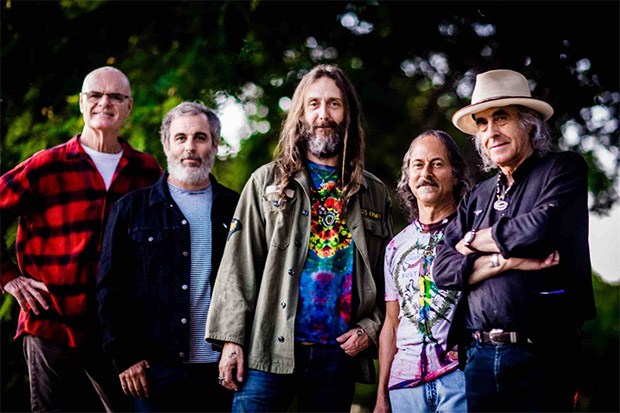
Barry Sless is enjoying a few hours off. Whether it’s as a guitarist with David Nelson Band, Moonalice, Phil Lesh and Friends, or Green Leaf Rustlers, Sless remains one of the more in-demand musicians in the Marin County, California scene. On this afternoon, though, he’s just getting back on dry land after a day of boating in Hawaii during a Nelson tour stop. He’s eager to talk about From Within Marin, the new live album from Green Leaf Rustlers, recorded over several 2018 shows by the famed Grateful Dead taper, Betty Cantor-Jackson. The Rustlers, fronted by Black Crowes singer Chris Robinson, came together rather informally a few years back after Robinson gathered together Sless, drummer John Molo, guitarist Greg Loiacono, and bassist Pete Sears for a night of jamming during one of the frontman’s 2017 Hootenanny Heroes appearances at Terrapin Crossroads. While their Rustlers performances have been sporadic in nature, they’ve been memorable, including a series of shows in the days following the death of Chris Robinson Brotherhood guitarist Neal Casal. Sless spoke to us about those emotional moments, as well as detailing the mission of the Rustlers and its repertoire, and perpetuating the ‘sound of Marin.’
The From Within Marin coverart seems to suggest this is music made by cowboys on the moon.
Cool. I like that. I’d say that would be a pretty good description of what we want it tobe; the country thing and the cosmic thing. The visual element relates to the auditory elements.
The album title is a literal allusion to where the record was recordedbut it can be interpreted as suggestive of a ‘Marin sound.’ Do you think there is a ‘Marin sound?’
There is a spiritof improvisation alive and well within Marin. If there was anything you would call a Marin sound I would say itprobably includes taking songs and stretching them out, jamming on them a bit. That's definitely kind of where I livemusically and physically. I have a lotof other influences, as well. But, alarge part of my style is influenced by that improvisational style of music.
Are the improvisations inspired from an expectation the audience hasbased on your work in other bands, the setting, or just a general sense offreedom the music itself inspires?
A little bit of allof that. Our audience would rather hearus go out on a limb, take chances, maybe even fumble a bit here and there- nothave everything be exactly right- than if we played something perfectly tight,rehearsed note-for-note every time. Ithink they want that spirit of adventure in the music.
Is that also what you look for when you play?
Absolutely. It’s all about the adventure.
How is your playing in Green Leaf Rustlers different from when youplay in other groups?
For me, how it’sdifferent is with the Rustlers I get a lot more opportunity to play pedal steelthan in most of the other bands that I’m in. I play about 90% pedal steel in the Rustlers, and in most of the otherbands it’s 90% and upwards of guitar.
And similar?
The spirit ofimprovisation. It allows us to takesongs- whose original versions are probably three to four minutes- and stretchthem. Sometimes that just means we keepgoing, building a solo until the soloist is done. Other times it’s breaking away from the formof the song; seeing wherever it goes; wherever the muse takes us. Not having a contrived idea of where themusic is going to go. Letting it bedifferent every time, and being loose enough, free enough to roll with that.
Was there a particular vision for what the Rustlers would be from theoutset?
Chris wanted to dosomething local. He’d moved to MarinCounty a couple of years before that. The vision for it was his. Oncewe get our hands on it, it becomes whatever the collective- the five of us-make it. Chris gives us plenty of freedomto be ourselves. Really, that’s whatit’s all about. He has a really wide,eclectic taste in music. I wouldconsider him a musicologist. He’sdefinitely into that 1970s country rock thing: Gram Parsons; the Flying BurritoBrothers; The Byrds; Doug Sahm; Waylon Jennings.
Are all the song choices for the repertoire coming from Chris?
Most of it iscoming from him. I’ll suggest somethingonce in a while. Greg will bring somesongs. I think Greg has one- “GrooveMe”- that he sings on the record.
How does the band determine the arrangements of the songs? A lot of them are reworked from theirstandard versions.
Mostly it’s a Christhing; how he wants to sing it; the groove he wants behind it. Chris illustrates the kind of feel he wantsto do and the band follows suit. Afterhe tells us the feel, the rest is up to us where we go with it. He’s wide open and free about that. He gives us a lot of freedom to interpretsongs the way we want to.
I think of three examples on the record- Johnny Cash’s “Folsom PrisonBlues,” the Rolling Stones’ “No Expectations,” and Bob Dylan’s “Positively 4thStreet”- as being samples of contrast, both from the originals and from eachother. That comes from Chris?
That was certainlythe case with “Folsom Prison Blues.” Itwas his idea to open it up and stretch it out like that.
What about “No Expectations,” which stays fairly close to the Stones’version?
That was the firsttime we ever played the song. Weprobably went over it in soundcheck that day and played it that night.
And Dylan is always tough to do well, without parody or straying toofar.
I thought he did agreat vocal performance on “Positively 4th Street.” It has such a passionate, soulfulapproach. He completely makes it hisown.
Did you have input into what performances were selected for the album?
What is on thealbum was up to Betty Cantor-Jackson. Itwas recorded pretty early in the life of the band. We were playing at Sweetwater in Mill Valley. She brought out all of her recording gear andrecorded a couple of shows. Chris justleft everything up to her; the mixes; the songs; everything.
When you see Betty show up with her gear, do you think differentlyabout playing knowing she is recording?
No. I try to not think about that kind ofstuff. Pretty much, no matter what thesituation is, I try to stay within my game. I try to not let outside things get into my head- whether it’s someonerecording, or it’s someone in the audience, or whatever. I just try to focus on what’s happeningonstage.
You have a long history of playing in bands with Sears and Molo. What I liked so much was the instant musical rapportyou seemed to have with Greg. Is thathow you are with everyone you play with or was there something unique to that collaborationwith him?
I’ve always triedto approach playing with other musicians that way. Just like you say: have a musicalconversation; give everybody a chance to speak. Somebody asks a musical question and somebody answers it. Just like we’re talking right now. It just sort of happens naturally. I hear some of that on the record. I can hear that it’s the beginning of usplaying together; getting to know each other’s styles; learning the spaces eachone of us gravitates to; where the holes are. That’s something that is pretty prevalent in the Marin music scene.
I believe you played Pappy and Harriet’s near Joshua Tree in the firstdays following Neal Casal’s passing. Canyou tell me what that was like?
Yes. He passed on a Monday. I saw him the prior Saturday at LOCKN’. And then we played at Pappy and Harriet’s onFriday and Saturday. Those shows werekind of surreal. Usually when the bandgets together it’s a really festive celebration. There was a darkness hanging over thatweekend. A lot of Neal’s friends and CRBfans from Southern California showed up for the gigs. There was a lot of hugging and crying andstorytelling.
Did you know Neal well?
I considered Neal afriend. We talked guitars a lot. We both played guitars by the same guitarmaker. I have five Scott Walker customguitars. Shortly after Neal started upwith the Brotherhood he called me up and asked about Scott’s guitars. I invited him over to check them out.
I think about that a lot- the role of the actual guitar in definingthat Marin sound. Do you think it hasplayed a part in creating a style and sound or is it coming from the individualplayer, and that player just happens to be influenced by the same things asother players in the area?
I think that’s agreat question. I think there are morepeople playing custom guitars. It’s notjust specific to the Marin scene or sound. As far as my ears go, the style of music I like to play, and the soundsI like to get, I’m looking for something that most standard, off-the-shelfinstruments don’t provide.
Fair to say a lot of that traces back to Jerry Garcia and his customguitars?
It’s fair to saythat a lot started with Jerry. He wasthe first guy that I was aware of that was playing a custom instrument thatsounded completely unique. I think thatdrove a lot of the custom guitar industry, honestly. A lot of players have been influenced by thatsound and that style.
What’s next for the Rustlers? Doyou think the band will write any original material?
Hard to say. There has not been a whole lot of serioustalk about that. At the inception ofthis it was meant to a be a low pressure, easy kind of thing. At the time Chris was still doing the Brotherhood. That was his outlet for more originalstuff. They’re on hiatus now. He’s doing the Black Crowes tour. I guess we’ll see what happens after he doesthe Crowes. Right now there is nospecific plan for what happens next. Ithink all of us in the band would be totally down to do some writing togetherand bring some original material into the project. We all have other projects that we do. We all keep busy. When Chris’ schedule lightens up and he’sready to play again, we’re all ready. Wedig doing it.





