

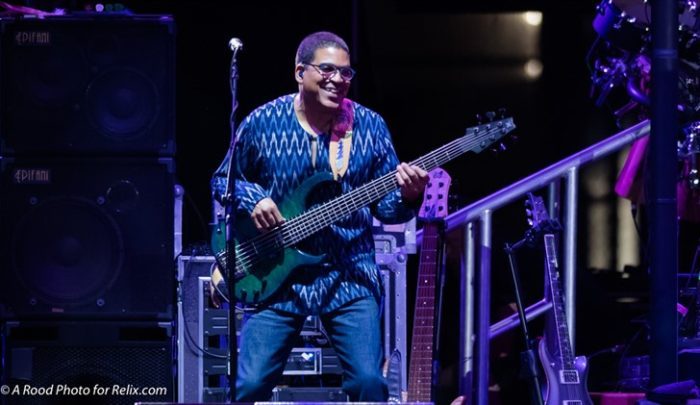
From his first days with Colonel Bruce Hampton’s AquariumRescue Unit and then the Allman Brothers Band to his current GratefulDead-centric Oteil & Friends shows with John Kadlecik and others, OteilBurbridge has been central to what we’ve come to know as jam band music—genuineimprovisational rock.
Which makes it no surprise that he’s the headliner of the upcoming (April 5-8) Skull and Roses Festival at Ventura Fairgrounds. After all, Skull and Roses was created to showcase all the various ways Grateful Dead music can be played, and Oteil’s bass playing is as far from the traditional roots and time keeping of routine bass playing as that of a certain Grateful Dead bassist. Burbridge, too, operates at a very high level of creativity, which seems to suit Deadheads just fine. So in celebration of the show, we asked Oteil a few questions.
What’s yourfirst musical memory?
My first snare drum at 5 yearsold. And probably the sound of Jazz. My dad was a music freak. It was hisreligion.
How did youcome to play an instrument? What or who moved you.
Music was ubiquitous in myhouse. Rhythm has always moved me. I was beating on oatmeal boxes and plasticbowls with wooden spoons at 4 years old. My parents quickly channeled thatenergy.
What’s yourfirst memory of hearing (or hearing about) the Grateful Dead?
In high school I became awarethat all the hippies seemed to be attached to this one band. I always had anaffinity for hippies since grade school. I grew up with a fair amount of theirkids. Monica Powell, an old school mate of mine, knew that I was really intomusic and she gave me a bunch of their records in an effort to enlightenme.
How did youcome to work with ARU?
I met Col. Bruce through thedrummer Jeff Sipe (Apt. Q258). Meeting Bruce was the first time I met an actualextra terrestrial. I started following him pretty much immediately after heguessed my birthday and was only three MINUTES off. Aug 24th at 1:57 am. He guessed2am….. I saw him do many more amazing things than that over the followingyears.
What impact didARU have on your playing?
Col. Bruce schooled me onAmerican folk music. Specifically Delta Blues, Bluegrass and I would alsoinclude some outer space music like Sun Ra. It probably would have taken me alot longer to become a fan of other extraterrestrials like James Blood Ulmer ifit wasn’t for Bruce.
How did youcome to work with the Allmans?
Butch Trucks called me one dayin 1996 about a side project that he was doing with Jimmy Herring and Derek Truckscalled Frogwings. When Warren Haynes and Allen Woody left the band, they calledme to join.
In youropinion, who’s your biggest influence as a bass player?
I’m the product of anamalgamation. And I’m as much influenced by drummers, from Elvin Jones to JamesGadson, as I am bassists. My biggest bass influences (early on) were VerdineWhite, Bootsy Collins, Alphonso Johnson, Jaco Pastorius and Stanley Clarke. I’mpretty sure Alphonso played with Bob Weir at one point. He’s a west coast guytoo.
To be honest,when I first really heard about you, you were with the Allmans and I assumedyou were a fairly straight-ahead blues bass player. A guy can be wrong,though… clearly you’re not. So how did you get where you’ve gotten?
The grace of God and the factthat fortune indeed favors the bold.
When did youstart moving into Dead Land? Was it Dead & Co., or somethingelse? BK3?
Definitely with BK3. I haveMike Gordon to thank for that. He told me that he was sure it was somethingthat I should experience this life. He was so right.
How did youcome to join Dead & Co.? Who called you?
It was Matt Busch, Bob Weir’spersonal manager, that first called me. He told me that Bob wanted to get aholdof me. I had played with both Bob and Phil Lesh in the Allman Brothers Band andwith Bill in BK3. Mickey was the only one I hadn’t played with yet.
What’s yourfavorite Dead song?
That’s impossible to choose. Icouldn’t choose my favorite ballad! I think if we played the entire TerrapinSuite it would be my favorite for a while. I got to do it once with JRAD. Justlearning it was so much fun. But honestly I have about 25 favorites at anygiven time.
Deadheads haveembraced you in a big, big way. What’s that like?
It’s an incredible relief, alittle scary, and extremely humbling at different times!
Have you playedat Ventura Fairgrounds before? Have you heard anything about the Deadshows there back in the ‘80s?
I have not played there before.I’ve heard about that venue but I can’t recall any specific stories. I learnmore Grateful Dead history literally every day. I’ll have to call Steve Parishand ask him what memories that venue triggers before I get there!
Bruce Hornsbyremarked that Dead songs had become “hymns,” kind of a basic part of theAmerican songbook. Do you agree?
One hundred percent. I used tostudy the “Real Book” which is a book of jazz standards. To me, the GratefulDead catalogue is very similar to that. It’s canonical. I’m proud to be a partof the lineage and excited to learn all the songs that I still don’t know! It’ssome of the best homework ever.





