

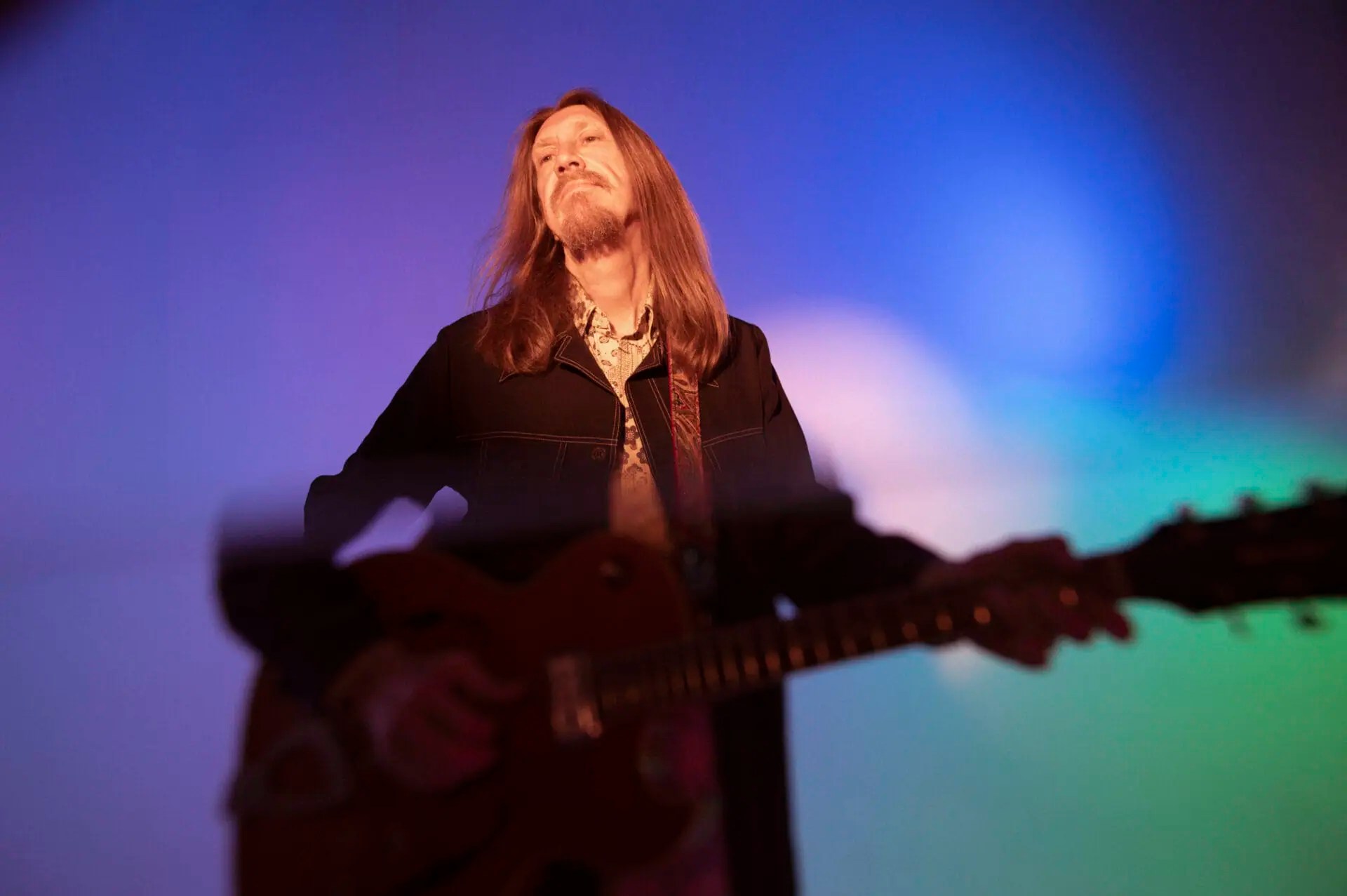
The thrill of songwriting and creating in the studio remains such a joy for Oliver Wood that he kept the process going after he completed the next Wood Brothers album. His second solo effort, Fat Cat Silhouette, is the result. Containing an intimate, loose vibe like a series of recording sessions with friends -- which it was – with lyrics that bear deeper truths about the human condition.
Produced by his Wood Brothers’ bandmate Jano Rix, the nine-track album features multiple collaborations including songs co-written with Rix, Seth Walker, Sean McConnell and Ric Robertson and guest performances by Los Lobos' Steve Berlin and Marshall Tucker Band's Marcus James Henderson plus a reworked version of "Have You No Shame," performed as a duet with Katie Pruitt, that was written by Donnie McCormick, one of Wood's mentors from his early years on the Atlanta music scene.
Wood will perform a few dates this week, including appearances at AmericanaFest and Healing Appalachia. He will return to the road with Wood Brothers later this fall.
JPG: With your solo shows and touring with The Wood Brothers, your life and career are often mapped out well out in advance. Is that a positive for you or is it constricting in any way?
OW: Well, it's a little bit of everything. It's definitely nice to know your schedule and then you can plan a family vacation or you can plan a break. And then, the downside of it is, for me, has been to overextend myself, adding solo shows. It’s something I want to do. I took the time to make this record. I enjoyed it.
The downside of what you're talking about is to not really be in that moment that's six to nine months in advance. And then, when you get there, you're like, “What was I thinking? I’m not gonna be home at all that month.” So, it's easy to overextend yourself and make decisions that haunt you a little bit later. It’s not necessarily all about being away from home, but mostly they are.
It's really exciting to make a record and to finish the record but because of the way the industry works your record comes out, if you're lucky, like six months later. Sometimes a year later. As nice as it is to put out a record, you've already creatively may have moved on, and by moved on I mean those songs aren’t your primary focus anymore. But, you still have to treat them like it's new music because it's new music to the fans in the outside world.
It's not that I hate doing that. That's one reason I did a solo record, this last record of mine. I had a blast making a Wood Brothers record. It's not going to come out for a long time because we have to wait for all the publicity to line up, for the vinyl to be pressed and things that take a long time. So, I just wanted to make another record. I just love making albums. It's a cycle. Then, when my album came out, like all of them, it's a bit anticlimactic. Not to say anything negative about it because I'm very proud of it.
I think it's wonderful and I realize the funnest part was making the album. I read stories about bands in the ‘50s and ‘60s where they cut Elvis's record, and the next day somebody drove it over to the radio station and then the next day they pressed it up for all the radio stations across the country. That seems like instant gratification. You're still connected to whatever you worked on because it's been days and weeks rather than months and years.
JPG: I’m glad that you mentioned that because it would drive me nuts if I had an album completed today and it just had to sit for months to nearly a year. It’s like I'm holding on to this big secret.
OW: I think of recorded music as a snapshot. You're capturing moments when you record songs. Although those moments may age really well, I get a thrill from listening to old records like old Wood Brothers records. It just takes me right back to that time and I love them and I'm proud of them and there's that feeling. But there's also the feeling, like right when you finish writing and recording a song, you just feel like, “Wow! I captured this as me. I captured me and all the people that were playing with it. That was us that day and it was magic and all the collaborators and everything.”
Then six months later, you're a different person, you've been reborn a couple times. You’ve evolved. It's a little bit like, “Oh, that's not quite me. I'm proud of it. I love it. That was me then. It was awesome.”
JPG: For myself, I used to have a perfectionist part of my personality. I would think, if the recording's sitting there all mixed, it would still be running through my head a month later, and I'd be like, “Can we go back in the studio? I want to add tambourine,” or “I want to take this track out…”
OW: Yeah. I know exactly the feeling you're talking about. You can always feel like, “I never quite finished that?” or “I never quite made it as good as it can be.” And actually, these last couple records -- both Wood Brothers and my solo record -- I learned, and I've been doing this a long time, I've learned to just let go of that and be like, “Okay. It is what it is. And it was a moment and it's over.” I feel like I've gotten better at that.
I also know it's not going to do me any good. Once the mastering happens, I pretty much don't listen for a long time. The next time I'm listening is because we're gonna play ‘em on tour and I need to learn how to play ‘em live, and that is actually refreshing because you take some time off and go back to it and learn it, it's almost like it's someone else's music. You're like, “Oh cool! Look at what these guys did with this song. We're gonna learn it. We're gonna play it. It's gonna be fun.”
JPG: Also, when you're playing it live, you're tweaking it a bit for the live situation.
OW: Yes. Oftentimes, it requires you to adapt it to being a live song. I think most of the stuff we record is pretty live to begin with. However, there are always things that you may have to adapt, and that's a fun challenge. It's fun to innovate in that way, innovate in a way that makes it a live song now.
JPG: Speaking of playing it live, is there any chance that a Wood Brothers performance would incorporate a song or two from Fat Cat Silhouette?
OW: So far, this has been a separate entity and my little vanity project for me to keep things going. So, that has yet to happen. There's yet to be overlap other than [Wood Brothers member] Jano Rix producing this record and often playing shows with me when I do shows.
That's the other thing. The Wood Brothers is such a full-time bread and butter…that's the foundation of my creative life and career. It takes up 90 percent easily of my energy. So, I guess the answer is those two entities have yet to cross.
I definitely do certain Wood Brothers songs when I do my solo shows. Most of them are songs that actually predate the Wood Brothers. I had a band called King Johnson that predates Wood Brothers. Some of those songs were songs that the Wood Brothers actually made more popular.
So, there's some conscious separation to separate it not in any negative way but just to, maybe, make it feel like it's a little something different.
JPG: On the Marinade podcast I heard you say: “I wanted to get outside my box and grace the uncertainty of what's out there.” You wanted weird guitar tones, more percussion less drums on your new album. Was that a desire before you entered the studio or was it something that as you started recording, you and Jano had an idea of, “Let's take this away or do this or…?”
OW: I feel like a lot of those thoughts are subconscious until you get down to it. Then, when you’re arranging a song in the studio it becomes apparent that, “I've heard that before. What can we do that we hadn’t done?” So, it becomes a conscious effort to make something sound…and really the Wood Brothers do this, too, where, when we're in the studio our goal is for what we're coming up with is to not fit in entirely with what we've done previously or with what other people are doing. There's this conscious decision to…you don't necessarily know what you want to do but you know what you don't want to do, and there's where the experimentation and the curiosity and, hopefully, the innovation comes in.
For instance, there were some songs where it was really intuitive for Jano just to play a drum set. I was really interested in him playing more percussion and less drums. Luckily, he was open to that, partly because I know how great…he is such an innovator and he's such a master, it's cool to catch him a little bit out of his box, having him play something weird. On my first solo record I was like, “Will you just play the chicken coop on this song?” (laughs), and he did, and he made some magic out of it.
It's like as guitar players, if you hand us a weird guitar or a new tuning or something where we're kind of uncomfortable, oftentimes, it forces us into an innovative frame of mind where we come up with something that we normally wouldn't have come up with.
With Jano alone, there were things where it's like, “That song really needs a shaker or something like that on it. Something percussion. What can we do that's not typical?” I joked and said, “Hey, can you do it with your mouth, like make a sound?” Next thing you know, he's in there with a microphone in his hand and headphones on and at the mixing board cutting these tracks of mouth percussion. I wouldn’t call it beatboxing. It was more like “percussion boxing” but it was cool, and he's imitating shakers and hi-hats with his mouth and it just was really cool and interesting.
There are several moments like that. Let's not put bass on this song. Let's make this tuba. There's a song called “Whom I Adore” that's almost like a fife and drum. Sometimes, you add certain elements in there and it goes to more something typical. When you sub something out with something less likely and a combination that's less likely to happen out in the world, that's when you break some new ground. It might be subtle that some people don't even notice but for me, it's really refreshing. So, you're just trying to turn yourself on by innovating and by innovating by being curious and stumbling on to things. I don't think of it as genius. I think of it like dumb luck and that’s what’s fun about it.
JPG: What’s the song where Jano does the mouth percussion?
OW: That’s “Whom I Adore.” That’s the one that has the tuba and the bari sax but it also has a big marching drum and there's a fife player. Marcus Henderson, who's my old bandmate from King Johnson, that was a rare time that we got together and wrote a song together.
Jano, not only does he do that, but if you're a Wood Brothers fan, you know about Jano's instrument that he calls a shuitar, which is the crafty guitar that he beats like a percussion instrument. It also has a pickup. So, he plugs it in to an amp through a wah-wah pedal; really stretch some things on that song just to put some fresh sounds into it.
JPG: The idea of experimentation, lyrically, were you trying to write differently, write melodies differently.
OW: Lyrically, I got into a real groove writing. I have this chair in my living room that I like to sit in, sort of a certain weird sideways way, legs over the arm of the chair. Every morning, I take my coffee, I sit by the window in this chair, and I write in a notebook. Sometimes, I just write almost like a journal and, sometimes, I try to write freeform and stream of consciousness, which is not easy for me. I just tell myself, the pen does not leave the paper until you're at the end of the page and just write whatever comes to your mind. Sometimes, I just sit and work on a song.
The whole idea, for me, is to be able to write without judgment and write with curiosity and be playful and not write something and cross it out and erase it or not try to fix anything. Just move ahead and write. Allow my subconscious to show itself, which is hard to do, for me anyway, and apply that to songwriting. So, there are exercises and then there are actual things that, sometimes, these little exercises turn into songs.
Sometimes, I found it was cool to just look around me or look out the window and see what I saw and just start writing about it without any theme in mind, purely just an image and then let my imagination take over.
So, for instance, the first song on the album is called “Light and Sweet,” and it starts out, “There was a sparrow/Sitting all alone/Outside the window/Talking on the phone/To his lawyer/About a deal/With his ex-wife/Or soon to be.”
It actually did start with a sparrow sitting out the window and I write it down. Then, I start creating a little human-like story out of this sparrow. What do you call it? Personification or something like that. All that was a gateway to starting the song and letting my playful, curious side write the song instead of my judgmental, logical side trying to control what it's about or coming up with a grand idea at the time of what the song is about. This is something I partly learned from reading about other big songwriters. I can't remember if it was Paul Simon or somebody like that said he tries to follow the song instead of lead the song, meaning, he doesn't try to paint himself in a corner by thinking he's in control of it. In other words, you don't know what it's about. You have no reason to judge it. You can trust that it's going to be about something because you have plenty to say, your subconscious has plenty to say, and have great ideas. You just have to trust it to do it for you. All you have to do is show up and follow it.
And that is really much easier said than done. It's really hard because you can get really excited about and proud of yourself for writing a cool line, and then, you're kind of out of the zone. You could judge negatively or you can judge positively and break the spell that you're in. So, the goal is to flow with it.
JPG: That part about just putting something down on the paper reminds me of when I was taught years ago by one of the Beat writers. The idea was to write anything on a blank page, and if you run into a mental block then just put XXXXs there and move on because you can always go back to that later during an edit and refine it.
OW: Yes. I imagine lots of creative writers or music writers, it doesn't matter what kind of writing you're doing, you're making something that’s not already there. That idea of trusting, first of all, your years of experience not only as a writer, but as a human taking lots of details and data and emotional depth and vocabulary and knowledge and all these things, and then opening the gate to let those things work. I think any kind of writer or artist has probably had that feeling where they just were curious and they started doing something and before they knew it, they had something that was surprising and interesting and cool and it came out, but sometimes, I don't remember where'd you get that or how did that happen? I have no idea. I was not in control.
You hear that from a lot of artists. It's like, “It just came out. It's not necessarily something I consciously controlled.” I had times where I sat in that chair and actually the title of the album Fat Cat Silhouette and even the abstract photo that's on the front of the album which I took of my fat cat sitting in front of the window, basically it’s silhouette. It's just an image to get me going -- “Cup of coffee/Fat cat silhouette/In my armchair” (lines from “Little Worries”) is actually literally written in there. And again, it was my launching pad to open things up. So, when you read about other songwriters, and sometimes they go on a walk or a drive or… Paul Simon would throw a baseball against the wall and catch it, just over and over.
You have this little thing that requires some motor skills, like taking a walk, you gotta make sure you're staying in a straight line. That distracts your logical, judgmental, part of your mind, which often gets in the way, sometimes, has to focus on walking and when that’s happening is when your subconscious comes out and makes things happen and solves problems and comes up with ideas.
JPG: Since there was experimentation as far as approaching the music, was there any experimentation in approaching the lyrics?
OW: I'm always going to be a student of the process of songwriting, and I've had both young people come to me for advice, “Can you teach me songwriting?” and I'm always honored but I'm also thinking, “I don't even have a handle on it. I don't really know how it works other than just the basics.” I'm a student of people who write songs and mostly the icons that we know, and then lots of unknown people. There's plenty of great songwriters nobody's heard of. I'm really a student of the process and ways that you can get out of your own way.
So, the whole thing about walking or driving or bouncing a ball against the wall and catching that really fascinates me. The whole thing about trying to consciously stay curious and follow the song, follow the muse, don't try to control it. Be playful. Be curious. I really was practicing that on this album.
The other thing was not to be judgmental and trust that what you wrote was what you were feeling and was/is honest. What we tend to do both with music and technology and with any kind of creative thing is we try to keep fixing it and making it better. Of course, with Pro Tools and computers you can do that as much as you want. My opinion is that you're generally taking the soul out of it because what you're thinking of as making something better, like refining something, oftentimes, is taking away the humanness and the magic that came out of you subconsciously. So, you're taking your conscious mind and crafting something that was so beautiful and innocent and natural.
You can certainly do that with lyrics, too. You can really overthink it. “That needs to rhyme with that. What am I saying here? What am I trying to say?”
For better or worse, I really tried to stick with a lot of my original ideas with the lyrics. Some of them might not make sense to some. My biggest hope is that they're ambiguous and they do make sense. They make you feel something. But it's personal. The song could mean something to someone and something to someone else, and that's my favorite kind of song. I love multiple interpretations. I love books versus movies because a book, you can put your own visuals to it, right?
A movie, they're telling you not only all the information but they're saying, “It looks like this.” But wouldn't it be cool if you could make it look like you wanted? Sometimes, an adaptation of a book when it's a movie can be disappointing because “That's not how I pictured that guy.” I like the ambiguity where someone can make their own story out of a song. I will say there's probably some lyrics in there that I could have crafted better, and I just said, “It’s good. I'm going to leave it. That's how it came out and that's what it is, and it is what it is.”
Something you said earlier, a quote, about there's no pressure on me to impress anybody. I just trust my instincts and put this out there and move on to the next one.
JPG: A couple things lyrically where the little things have deeper meanings. On “Little Worries,” it’s the idea of don't sweat the small stuff, things work themselves out, where the character, by the song’s end, realizes that and notices the cat having fun and…more so, because obviously, you're very much a thinking person the song, on “Yo I Surrender,” the two things that really jumped out at me -- the spiritual idea of surrender as well as the idea that was attributed to Socrates that “All I know is that I know nothing.” Were those intentionally in that song?
OW: Very much so. I think both the Socratic and [surrender] certainly overlap and are testaments to humility but also freedom, just letting go. Even to this process of writing songs and music, I surrender to whatever power it is that gives us creativity and to my own subconscious and capability as opposed to being judgmental and beating myself up worrying about what other people think. Just trying to be myself. Trying to be ourselves is the way to go.
That's what it felt like but you know what? There's also these elements of when you're writing music and you're writing lyrics, sometimes, you're writing lyrics and you have some music in your head. Like that was a song where we really wrote the music first and we wrote [“Yo I Surrender”] in the studio with Steve Berlin playing baritone sax and me and Ted [Pecchio], the bass player, and Jano on percussion and drums. We wrote the music with just a skeleton of the lyrics in mind. I sang a scratch vocal because I didn't even know the lyrics yet. Sometimes, the music and the timing, and the space of the music draws out a phrase; something about, “I don't know anything,” just that statement and where it fits in the music and how good it feels to sing it found its way in there.
I've been thinking about the word “surrender” a lot. Anyway, those things were inspired by the way the music felt and you read about that all the time. People like Paul Simon again. Paul McCartney will write some amazing melody and then find words; let the melody bring the words out. Sometimes, you'll hear about singers, Mick Jagger or Jeff Tweedy, any of these guys will go with a piece of music and sing gibberish over it and see what their subconscious brings out in the moment. Record the gibberish and then listen back and say, “Did I just say ‘surrender’ right there? Sounds like it but who cares? Let's use that.” It's one of those things where the music draws the words out, and the music mixed with whatever is going on in your subconscious, sometimes, makes a cool stew.
JPG: Mentioning Paul McCartney and writing melodies, I immediately recall that scene in the Get Back documentary where he's writing “Get Back,” and the words and music are just flowing out of him.
OW: Unbelievable. I had fun watching that. You're watching him come up with lyrics and, of course, they're so iconic at this point that we know them. I was yelling at the TV “California grass!” I knew [that line] was eventually going to end up there, and it was so cool to watch that process. How comfortable he was with it. He didn't care what he said. He just was trying stuff, and all those guys, John Lennon too. Those guys were so good and they just knew to trust that something would come out. They didn't seem worried about it at all.
JPG: So amazing to watch that.
OW: It’s especially amazing because…I think about this, too. It's been said by several people -- you only have one chance to make your first album, meaning you're only that innocent and uninfluenced once. And then, once you put something out and have some notoriety, even just a little, you're not the same creative person. It's hard to be the same creative person because now you feel like, “People are gonna hear this and they're gonna expect it to be as good as that last thing” or “They're going to expect it to sound like this or like that.”
So, it takes bravery and balls just to ignore those messages in your head and make something new like you're a kid again, like you're making your first thing again.
That's another thing I thought about a lot during this record is how can I be innocent when I make this? Part of it is just not giving a shit, which is hard to do on purpose. You can send yourself positive messages like, “I'm just gonna trust that whatever comes out. is honest and I'm not going to question it and try to fix it so other people will like it.”
JPG: When you are sitting down, looking out the window, are you specifically writing material for what is meant to be your solo album or a Wood Brothers album or do you let the muse take you wherever?
OW: That's a good question. So far, I haven't really differentiated between them as two entities -- Wood Brothers and solo. I just think there are cycles that you write in and after we finished the Wood Brothers album, I continued writing songs.
Plenty of the songs on my new album are collaborations with other writers. At least a handful of them are. That’s stuff that I do even during Wood Brothers sessions. I'm home for a few days and such is in town or Seth Walker's in town or whoever. We get together. We write a song, put it on the back burner. Since it's such a collaboration with this other person, it doesn't put it necessarily in Wood Brothers territory.
I think it's all about timing. So, if I'm working on a song and the Wood Brothers need songs, that song's gonna go to the Wood Brothers. I've yet to withhold things. Sometimes, it's the level of collaboration outside of the band, which I love to do, because we really are close-knit writers within the Wood Brothers. We don't use outside people for writing that much. Occasionally, we have. For me, I like writing with other people just to grow and to connect with other creative people. I find that it makes me better and those songs by then default either they'll go on someone else's album who I collaborated with or on my album or both.
The song “Grab Ahold” on this new record is a song that I wrote with my friend Seth Walker, but we did that years ago. He put the song out on his album at the time, which I was producing. I always loved that song so much and was so attached to it. I said, “Someday, I'm gonna record that song. So, that was actually the one old song that was a collaboration, early Wood Brothers days, but it was, again, with somebody else.
Both of these solo albums that I've done since COVID are really timing things. There are things where I was on a roll and I just wrote a bunch of songs. Then, I got five, six songs in and I'm like, “You know what? Let's do a few more and we'll make an album.” It's never a grand plan to start from scratch and make an album. It's more like a buildup of songs, and the songs could be during the time.
Currently, I'm writing songs on my own but also with Chris and Jano for the next Wood Brothers album. It's likely there will be leftover ideas or I might get inspired right after we're done and I might get back with some of my favorite outside writers and the process will go again.





