

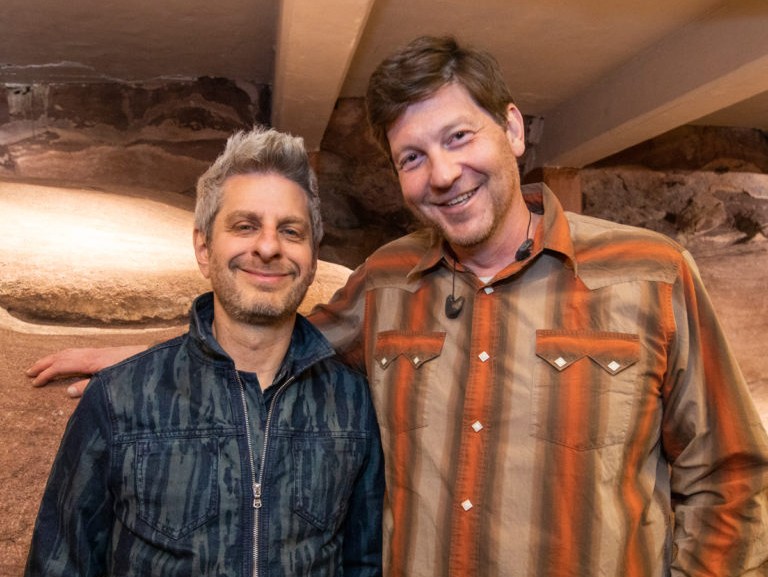
Ask Rob Derhak how he’s doing and the bassist, singer, and founding member of moe. will quickly transition from answering about himself to talking about how well the quintet is playing these days, nearing three decades of making music together. He’s eternally grateful for all the love and support family, friends, and fans extended to him, during what he describes as “medical issues” but in actuality was a serious bout with nasopharyngeal cancer. He’s feeling so well he admits he’s grown tiresome of the question, wanting instead to discuss moe.’s current tour with Blues Traveler and G Love, and the band’s annual moe.down fest. Still, there is the reality of aging, as an individual and as a group, that Derhak’s health scare has framed in a new light. Hours before returning the road, Derhak spoke about getting older, as well as the present state of moe, the band’s faithful fans, and the balance of collaboration and competitive drive.
Tell me about thistour with Blues Traveler and G Love.
When our manager brought it up, I was like, “F---,yeah. That sounds awesome.” We haven’t really done anything with G Love,and I think we really only played with Blues Traveler a couple of times. I think that we’re close enough and differentenough in a lot of different ways that we can make the shows really interestingand fun to watch, and people will like to go to them. Blues Traveler came up with the idea—theycame to us—and our manager saying we could get a full summer tour doing a lotof outdoor shows. I thought, “My God,that sounds ideal. That’s what we’vebeen wanting to do for a while now.” Iwanted to jump right at it.
I feel like the jamscene has broadened in recent years so much, particularly in the form ofelectronic music, that it started to drift away from the guitar-based rock thatwas at its core. Do see this tour as arenewal of sorts for that style of music?
I don’t know. It’sall subjective. For me? Yeah, sure. But there could be other people not interested whatsoever; who just wantto see electronic music. From myperspective, I feel the EDM thing kind of going down a little inpopularity. There was a little bit of alull in jamming, guitar-based music. Itseems people are getting more interested in listening to that again. The crowds are getting bigger, I’ve noticed,for us, anyway. I feel in a morecomfortable place in that situation than, say, Coachella.
Speaking offestivals, you just finished up another moe.down fest. How did you feel about this year’s installment?
Not only did we play every day a bunch of different sets, wealso put as many of our side projects in as we can. It became a real, sort of, familypicnic. That’s something we’ve alwaysliked about it. It’s not to say we wantto make it very selective and keep it small, but the idea of having it be moremoe.-centric, and just a few other bands we’re not associated with, kept itreally family-oriented; with the hardcore moe. fans. We’ve made a serious effort to build thatover the years. moe.down is a reward forthat. And we have these other eventsthat aren’t music related—a lot of them go to charity—like a golf tournamentand a lacrosse game I do that goes to American Cancer Society. A lot goes back, also, to the community thathosts moe.down; to the library and the schools.
How’s your golf game?
I have a really big drive, but then my game pretty muchfalls apart after that.
You mentioned thehardcore fans. When did you first realizeyou had your own fans, and not just, say, a curious spillover from the jambandcommunity, or from an association with other bands like Phish?
That’s interesting. There have been a couple of tiers to what we’ve done. When we first started out we had noassociation with jambands. First of all,that wasn’t even a thing. It was when westarted playing the Wetlands that they came up with the term jambands. We initially had our own little group of fansup in Buffalo before anyone there had really heard of Phish or BluesTraveler. We also didn’t have as much ofan improv edge as we do now. I’m not goingto deny the fact that we were influenced by Phish. That was when we went from an alternativeband to playing in front of some Deadheads. Then there was a real shift somewhere down the road, and it kind of goesback to the very first moe.down. Thatwas when I realized this is really our own thing.
Do you feel like youraudience has been able to age with you?
The same audience has been there. Some have aged out. Then, we go through a wave of younger peoplewho are interested, and then a wave of people younger than that. It’s not like the audience is one person orone group of people. It’s fluctuatingand changing, literally, and we’re still doing our same thing.
In order to have thatturnover, does that mean you have to keep one eye on what’s contemporary andthe other on what’s classic?
What we’ve always been about is exploring the stuff thatinterests us; making music that doesn’t necessarily sound like another band asbest we can and as original as we can possibly make it. It doesn’t necessarily make us comfortable inwhat we’re doing because we’re constantly trying to do different things. I try to write without any pre-conceivednotion. I want to make a moe. song butwhat does that mean? And a moe. song canmean something different to each member of the band. The best way to work it, I’ve learned, is totake an idea as far as you can, then bring it to the band, and try not todirect them too much. They put on theirown feel and it becomes more band-oriented. We just kind of want to do what we want and ram it down people’sthroats. (Laughs.)
I can’t think ofanother year whose 50th anniversary has been celebrated andrevisited more than 1969. You’ve been atthis for almost three decades. Do you asa band talk about making it to 50 years as a group? And what that means?
We do think about that sort of thing. We’ve had our management and our lawyerssaying we really need a band agreement for contingencies. We’ve made it this far—our 30thanniversary is this winter—and we still have not had any band agreementsofficially made. So, what happens if oneof us dies, or quits? We still havenothing to guide us through that, because it’s too difficult a subject for usto talk about or agree on. Vin (Amico,drums) and Jim (Loughlin, percussion) are coming up on 50, and the rest of usare 50, which blows my mind.
In what way?
When we first did Furthur tour in the ‘90s, which seems likeyesterday, I remember celebrating Bob Weir’s 50th on the road. How am I now the same [age] as he wasthen? 50 seemed so old to me. But, it’s not. It just seemed that way in my late 20s.
But now that you are50, how do you see playing into your senior years?
It’s hard to imagine what we would do. What if (when I’m older) I’m in Vegas playinga show and I need a triple bypass or something? You start thinking about that. What does the future mean to the band? It’s clear the older you get you have to slow down. Unless you’re the Rolling Stones, who can beflown in a Lear jet, and there’s a week-and-a-half between each show, withevery convenience. Living on a tour buswith 11 other people for five weeks straight is not the kind of lifestyle a65-year-old man is going to handle. Asfar as replacing other guys in the band, I can’t even imagine doing that.
I saw Little Feat afew weeks back—a band you and I are both fond of—and they are celebrating 50years together. But Lowell George, theirfounder, has been gone for 40 years, and their founding drummer, RichieHayward, passed away nearly 10 years ago. Could you ever see moe. as a band with a “new Al” or “another Chuck?”
It wouldn’t feel right for me to do that. I think if I still wanted to play, maybe ifone of the other guys was gone, we’d do like a different thing, like the guysin Little Feat. They don’t do LittleFeat very often. But, they play togetherin duos and trios. I would think thatwould be more of a route I would go. AndI would still play the songs I wrote. It’s hard to look into the future and say I wouldn’t ever do this orthat because sometimes, honestly, it could come down to money. My perspective now is that I wouldn’t go outas moe. because it really wouldn’t be moe.
I feel like artiststhat reach a milestone mark of 25, 30, 40 years tend to have a cycle ofevolution that follows: they want to prove something to their audience, thenthey want to say something to their audience, then they want to feel somethingwith their audience. Would you agreewith that?
I don’t know if we’re exactly broken down like that, but Ifeel like we’re at a point where maybe we do want to feel something, but it’sthe culmination of trying to say something and prove something to everyone andourselves. And trying to make thegreatest experience we can possible. It’s all of those things tied together.
You see it more ascumulative, rather than individual segments of development?
I definitely agree that when we first started we were reallyout there to prove something. There’s nodoubt about that. But, I feel like we’realways trying to prove something, to tell you the truth. I’ve always been a pretty competitive person,about everything. When I first started Iwant to be a top bass player. I wantedmoe. to be the top money-making band in the world. Now I’m trying to prove, personally and as aband, that I can make music that is relevant. I want that relevance to carry over, to make the shows inspired andemotional. I want to make songs thatmake people feel.
How does thatcompetitive spirit get channeled when you are sitting-in or collaborating likeyou will be in a designated collaborative set each night on this tour?
This is my mindset when I go onstage for a collaborativeset: Everybody on that stage is a newband. So, I’m competing then with other bandsout there, not with the people onstage with me; to prove that this band is anamazing band. A good example of that iswhen we just played Red Rocks. We had(Phish bassist) Mike Gordon come up to play with us and it got down to a pointwhen the two of us were playing at the same time; we were jamming. And people (online after) were calling it abass duel. That was the furthest thingfrom the truth. I was listening to whathe was doing, and he was listening to what I was doing, and we were trying toenhance that and play off each other. And make it a great sounding thing.
I feel like moe. gotin just under the wire as far as being a band that worked their way up throughthe clubs, got signed, went into the studio, made albums, hoped to get songs onthe radio, and toured relentlessly in support. There was a certain pageantry to it that has been replaced by streaming,and downloads, and viral clips, and Internet stars, and ad placement. Which do you prefer, as you have been livingand working through these changes?
I’m still pretty old school about music. More than 50% of the time I’m putting analbum on a turntable, listening to one side, flipping it, listening to thewhole thing. The stuff that gets mejazzed is the full experience of the band. People like to say just put out a song. I know it’s the way it’s done now but it doesn’t make me happy. I still want to put out an album. I still want to play a set of music that hasa beginning, middle, and end. For methere is that pageantry, and there’s still that magic, in a whole piece ofmusic.ent 2;\lsd





