

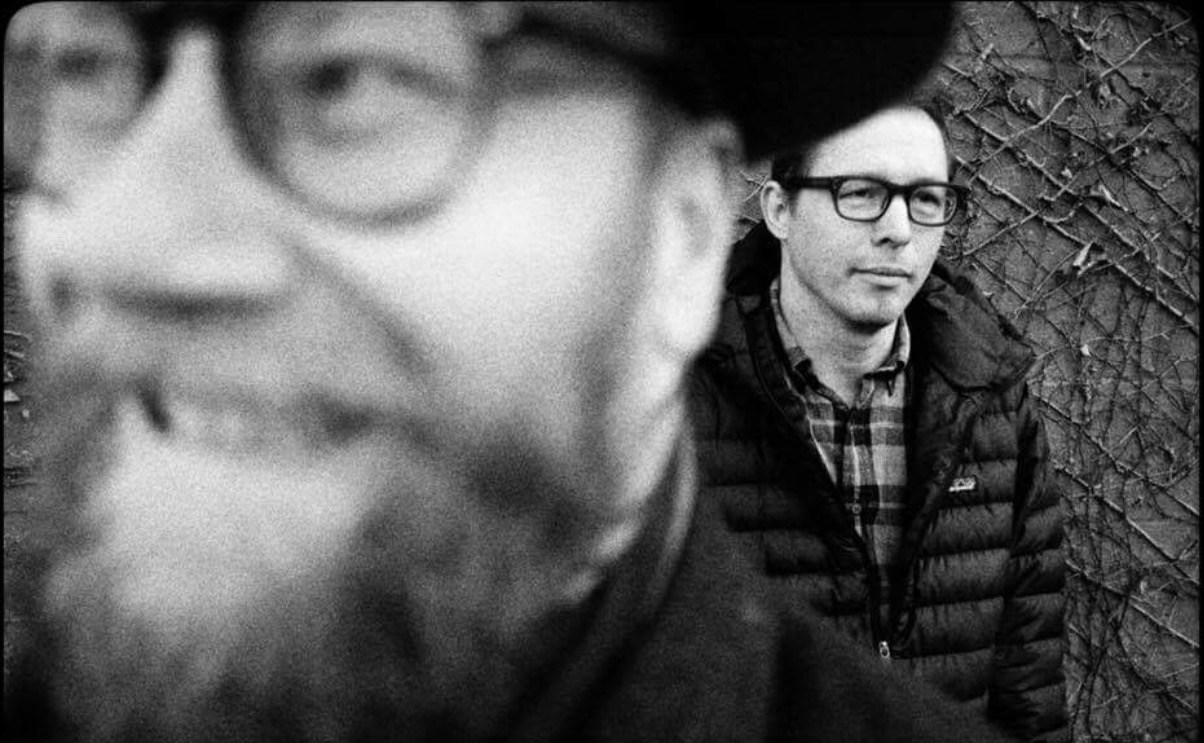
For 12 years Mike Doughty avoided the songs from Soul Coughing, the jazz, funk, hip hop sampler-heavy outfit he founded. If you read his memoir, The Book of Drugs, you'd understand that performing that material could reopen the emotional scars he acquired as part of that quartet between 1992-2000.
On the crowd-funded, Circles, Doughty rerecorded those numbers as he originally intended. That process exorcised enough painful associations to that period in his life that he incorporated his past songs with his newer solo tunes onstage, even playing full Soul Coughing albums at select gigs.
Feeling inspired to revisit that band’s sonic palette again, he initiated a reunion but was rebuffed. Undeterred, and with hundreds of songs on hand thanks to an ongoing Patreon account that involves Doughty writing a song a week, he teamed up with his longtime cello player Andrew “Scrap” Livingston.
The duo, under the Ghost of Vroom moniker, created a full-length album of funky, hip hop and sampler-heavy music with producer Mario Caldato Jr. (Beastie Boys, Jack Johnson) that was meant for 2020 release. Due to the COVID-19 pandemic and the inability to support it with a tour it got shelved.
Rather than remain inactive, Doughty and Livingston used the events of this tumultuous year as the basis for the three-song EP, “Ghost of Vroom 2,” which has been released despite both musicians still staying safe in their respective homes.
We discuss the two releases during a Zoom call that finds Doughty at his Memphis home and Livingston in Brooklyn.
JPG: It's Wednesday. So Mike, have you written your song of the week yet?
MD: Well, yes, I have. I wrote the Song of the Week last week. Minutes before you called, I was working on this piano thing. I don't know if it's good for me or if it properly sits behind another artist's vocal. So, I was sitting here working on this dumb thing and I was like, "Why am I working on this? I need me songs.”
August was experimental trap month where I did all these YouTube tutorial stuff about making trap beats and how to mix it and the sounds and how to do that triplet on the high hat. I spent the entire month getting up every day and doing these trap beats. Then, I also wrote my weekly songs but I feel like I should be working on those songs every day, not mess around with some cockamamie beat or piano part that's not going to make it into anything.
ASL: Those things feed.
MD: Yeah, I know. It's true. You've got to chase your fascinations. But, I have tracks and tracks and tracks and tracks and I've been trying to do vocals but I’ve been distracted.
JPG: Now, Andrew, are you the same way, disciplined and you're working on stuff all the time?
ASL: There's days that I consciously choose not to work on things, and I feel like that's part of my process, too. On those days I usually go for an extremely long drive. I like drive to Long Island. Maybe Mike has this too, but I find if I work on anything then other things happen. If I practice the cello and sight-read Bach, the mistakes I make will lead to me writing a song.
MD: Right.
ASL: That happens a lot and I have some days where it's composing for two hours, cello for two hours, bass for two hours and guitar for two hours. Most days it's really amorphous and it leads to different things. I made this thing where I wanted to do a really simple Mozart rip-off piano riff on this little keyboard that I have that only plays an octave-and a-half. So, it’s really limiting. And I just did it. I kept changing the time and mess with the perception of time. This is just a two-and-a-half minute thing that may never be used for anything but I don't regret doing it. (laughs)
MD: I get up. I try and be sitting at the computer with an instrument of some kind super-early and super-soon after waking up. Generally, whatever I start working on, even if I intended to start working on something else, I'm always like, “I'm just going to do this for a minute. I'm just going to play this guitar for a minute and then that I can work on this thing.” Before I know it it's five in the afternoon.
JPG: With all the changes that have come into our worlds because of COVID, from venues shut down to not being able to tour -- the disruption of our lives -- has that changed your relationship with work or would you be writing and creating every day at home anyway?
MD: I would be doing that anyways but Scrap and I have gotten into this excellent groove of improvising with improv gigs and we open for ourselves wearing disguises sometimes. We think that's going to be a part of the Ghost of Vroom thing and improvising and getting super-out and super-weird and going atonal and arrhythmic and then bringing it back to super-rhythmic. Going out and coming back and going out...I keep thinking, “I'll just book a gig at [Bar] DKDC." or “Why don't I get a gig in New York and then we can do…?" I keep thinking about that and then, obviously, you can't do it. For me, that's the major bummer of this.
ASL: All the stuff that we were talking about -- the way we work and being able to improvise with each other and add those things where we open up for ourselves and then come back and play the main set -- it's so fun that they both complement each other.
I’m not sure but this may be one of the longest times we've gone in 15 years without playing music together in person.
MD: It has been! I went to Electraphonic, Scott Bomar’s studio [in Memphis], just getting some piano thing down. Obviously, he was behind the glass and we wore masks but it was two miles west for the Mississippi and it was the furthest west I've been since March.
JPG: Have you experimented and tried to do a regular performance or an improv performance via livestream or use your Patreon for such an event?
MD: I haven’t, personally, found an effective way to do that, but Ghosts of Vroom is us working not so differently than we usually work when we record, which is we'd come up with parts and then assemble that. Scrap does a thing that's like a very straight version of what the bassline is supposed to be. Then, he'll do a very out version of what the bassline is supposed to be and he'll send me six tracks of weird noises on the cello neck and all kinds of craziness. Then, we assemble it. (laughs)
JPG: I do want to get to the collaboration aspect but let's pull back a little and get to the introduction of it because Mike, it seemed as if you were eventually coming to this day. You were starting to bring Soul Coughing songs into your sets and then doing full album shows from that band’s catalog. I know you did “Ruby Vroom” and “Irresistible Bliss.” Did it just come to the point after you didn't hear from the other guys in Soul Coughing that you said, “Screw it! I'm going to do this myself?”
MD: Well…a number of things happened. One is that Scrap and my collaboration just became a band and it stopped being he was doing my gigs and it was like our gigs. So, doing these songs every week, I started experimenting and I found a YouTube rip of the Scarface [Records “Classic] Beats and Breaks” album from the 90s, which was eight-bar snippets of all these famous drum clips. Completely illegal. Nothing was licensed. Everyone had to have this record though and use it as a reference.
So, I downloaded that off YouTube, shitty Lo-Fi versions. Started looping those. I've been doing stuff with some rappers, guys from Unapolgetic, A Weirdo From Memphis being one of them. I just started enjoying what they did and how they did it.
I started messing around with rapping. Now, those guys are pros, the other guy I've worked with just hand him a mic and he'll go for like 20 minutes and me it takes eight hours to write 16 parts.
The other thing was I started writing upright basslines not just for Scrap but because the only good sound of the iPhone version of Garage Band for the bass sounds is the upright bass sound, the upright bass patch. So, I just started writing all these upright bass lines.
Then, I became attracted to the sampling and started playing it in the early ‘90s way that people played the sampler where you're triggering stuff live, you're layering loops into Ableton or Logic and arranging them but playing it almost like it's a Mellotron.
All of those things combined and I realized it was much more like a Soul Coughing sound than the singer-songwriter world that I’ve been doing for years.
JPG: In your case Andrew, when you're hearing about this stuff and you were working from Mike’s basslines, were you told to do whatever you want, that this is just an idea, and give it something extra?
ASL: I try to stay true to the spirit of the bassline. Mike's so prolific that I feel he has naturally gotten to where he writes idiomatic basslines to be played on the cello, which is a specific thing. When you're playing cello it's a different mindset than playing bass. There's an interesting thing that happens. Forgive me if this is over technical but the giant neck of an upright bass has one timbre and when you're doing it on cello, you cross a certain point where at the lowest register of the cello it's like a really resonant upright bass. Then, as soon as you get above that first octave, the timbre changes. Mike knows that intrinsically now, so it's really fun.
The GarageBand bassline, I put some Scrap "sauce" on it or whatever. The thing about both of us, even the different things that we do, we do a lot of music together. One of my favorite things is often when we get done with a tour -- say we toured for a month-and-a-half or two months -- I usually spend a couple of days in Memphis with Mike and we have these days where we're in his home studio, “Here’s the beat. Here's the bassline,” just making stuff. Often, it's such a great way to cap the tour. You played all this music. Now, you're being creative. Now, let’s see what seeds sprout.
MD: What's become a very central part of the Ghost of Vroom aesthetic is every track has an ending dream. After the song ends there's this weird ethereal area or it changes rhythm or changes texture. It came from Scrap. When we were making, "Ghost of Vroom 1" a year ago and it's not out yet. That's why we made “Ghost of Vroom 2” and I love that. He was like, “I've got this weird, Chopin-esque piano thing I want to put on one song.” Then, he did that. And he was like, “I feel like every song could have one of these.” So, we worked to do these things, like a song ends and suddenly it's in some weird area. Then, it goes back to the next song. We could do this really interesting journey with keys because it's idiomatically written mostly in C and D like cello and bassline keys and then it'll go somewhere weird. It goes to F or G or wherever, and then it comes back. That's huge.
ASL: When we finally get to do all this stuff live, those moments, our little dreams that we built, is really going to be a joy.
MD: One thing we're doing right now, I keep calling up the manager and saying, “We need to reach the stoners and the weirdos. We really need to find those people because this is their shit.” We've made a bunch of cartoons as videos, so that's a start. I think weirdos and stoners like cartoons. By the way we're both ultra weirdo stoners and neither of us smokes weed. So, it’s like an aesthetic.
ASL: I think I'm a permanent honorary chronic burner even though I haven't smoked weed in a lot of years but that's always been my aesthetic.
JPG: It just sticks with you. With all the technical musical references, I understand much of it but my sister who graduated with a music degree would probably go off for another half hour with you.
MD: What we're trying to explain is that we're improvising with freaky noises. It’s not just soloing. It's like taking it out sonically and then bringing it back to this rhythm arc. Going out, coming back. Going out, coming back...
JPG: I noticed at the end of "Chief of Police" it sounded like an electric typewriter. I used to use one of those. I loved it. It was so loud.
MD: I have a repair guy in Chicago who was a career IBM Selectric repairman. He only works with IBM Selectrics. He refuses to repair ones that have..There's two kinds -- one has single space and double space. He refuses to work on them. It has to be single space, double space and space-and-a-half.
They're these huge 60-pound things. He was like, “Oh, that one. That's great. That's a 7 million serial number. And the platinum's really blah, blah, blah, blah. But that's garbage. Throw that away."
JPG: I'm so mad that the college I went to was getting rid of a bunch of those typewriters and I didn’t get one.
MD: They're all over eBay. This guy, Chuck Furrer, he's amazing. He's like the Jedi of repairing just IBM Selectrics.
JPG: We'll get to the actual debut album in a second but you’re in Memphis and Andrew you’re in Brooklyn. So, for this EP were you emailing stuff or using Dropbox?
MD: Oh yeah.
JPG: And then, did you just send off a selection of ideas to Mario Caldato Jr.? How did he come into this?
MD: First, all the songs that I put up on Patreon, they were so topical. Our manager had said, “Please, please, please, please don't put out the album until you can get on the road again." Then, this happened, I was like, “This is an EP and it's got to come out and it's got to come out now.”
So, first I set the drums, just the loop and bassline. Scrap sent it back with a relatively faithful version of the bassline. Then, he would send a version that the fills were really straight. Then, one where it was really weird and then he would send me seven different tracks that are weird noises. I'd put that together. Send it to Lil Pepper. She is our drummer Madden Klass. She lives on Long Island. So, she just went down to the basement and recorded the drums, straight takes. It's live drums. It's not loops. Then, Logan Hanna, a guitar player in Memphis came over and sat on the far side of the room, wore a mask and I just put a cable out for her. She plugged in and recorded the guitar parts. I assembled everything then played the sampler parts. Did the vocal. Then, we just sent it to Mario to work the magic. So, this was making a real record. This wasn't some half-assed home recording that was stretched into a thing. This is a thing.
JPG: Just to make sure. Andrew, were you playing the basslines on the cello or do you have an upright bass and you played them on that?
ASL: I did them all on cello. One of the songs I tried to do on upright bass. I haven't actually played upright bass with Mike in many years. You can do them on upright bass but it’s not the same.
JPG: Sounds like upright bass. That's why I asked.
MD: It was written with the upright bass on the GarageBand, the basslines were. The cello sounds...you know the Fania [Records] salsa records in the '70s? There's this [instrument] called a Baby Bass. It's this weird early electronic upright bass and it's more (demonstrates vocally with a bouncy salsa bassline versus a lower range bassline). For that, I found the cello bass akin to that. He began playing long sawed notes when he started playing cello with me and then eventually he turned into a bass player. It's such a unique and eccentric sound. Functionally, it really is an “upright bass.”
JPG: Also, making sure on this, the three songs that encompass the EP, they were written for your Patreon.
MD: Yeah. They are up there on Patreon in cruder form.
JPG: The songs that make up the album, are those on Patreon as well?
MD: Yeah. Pretty much everything was up on Patreon. There was one thing that's Scrap and I did at an improv gig. The bassline was improvised and the vocal was improvised and it was like, “That sounds like the last song on the record.” I turned that into what it was but everything else was in bits and pieces on the Patreon. It was very Soul Coughing in the sense that there were all these different songs. Every song had one or two good parts.
So, I grouped the 90 BPM songs together and the 120 BPM songs and the 80 BPM songs and then took all the good parts and stitched together these kind of Franken-songs. “Super Bon Bon" was written like that. "Rolling" was written like that…"Collapse." That was a lot of that process.
JPG: What's interesting with your lyrics is that you get into these repetitive phrases and also with numbers like “Casiotone Nation" with Soul Coughing and now "1918” with Ghost of Vroom. Is there something about you and chanting or affection for repetitiveness?
MD: The number thing, I think that comes directly from “Schoolhouse Rock!,” the influence, Bob Dorough – “Rufus Xavier Sarsaparilla,” "Conjunction Junction." When I got to New York, as an 18 year old in the late ‘80s, there was a lot of great house music and techno music and they had a maximum of 12 words apiece in them. I just loved that feeling of a part evolving like a James Brown riff in the sense of it stays steady and the song evolves around it. I love that kind of pulse thing. The nature of the human voice is you can say something over and over and over again but it still is different every time; these little microscopic ways. Small changes that in the context of something that's very transient, steady, become huge changes. That was what that was all about. Sampling. Sampled vocals. I started trying to be a sampler when I got into hip hop and failed in an interesting way.
JPG: I don't know about failed but you could have a day where you feel that way.
MD: Failed in the best possible way.
JPG: Failing upwards and onwards. Andrew, when that happens, does that give you the idea to lock into your rhythm or do you want to take it in a different direction and start to go out there and do fills or something? What does that inspire for you?
ASL: We're such a live thing. We both love performing a lot. One of the things about the whole time we've been working together is we throw each other punches because that’s just what happens. There's a lot of songs that don't really have a set of anything and even the ones that do I play with his voice a lot. We've done so much that I can't even remember to articulate how but I know that we do question-and-answer stuff all over the place.
JPG: This EP is called “Ghost of Vroom 2.” When I first heard that, I thought, “Did I miss the first one?” Then, I started thinking that maybe you were being clever because there are two of you. Then, I read that this is your debut release but it is actually your second recording and you are just confusing people.
MD: Yeah. It was July when it was finished and the single came out in late August. So that was some pressure put on a manager, “Hey bud, guess what? (laughs) We’re putting out an EP next month.” "Ghost of Vroom 1" is complete. Cover art complete. It's a done deal. We're gonna have to put it out before people can get back on the road. We've both been working on and we have a headstart on "Ghost of Vroom 3.” So, putting out two before one that's defensible. Putting out three before one, it's a little untoward.
JPG: At what point did you get hold of Andrew and say, “Hey, let's work on this,” and at what point did you decide it was done and you called your manager and said, "We need to put this out."
MD: I send Andrew Patreon stuff, sometimes. “I want this to sound more lifelike. Can you redo this bass with the cello?" or, like he said, at the end of the tours we’ll sit down and concoct a bunch of basslines, some of which I've written, some of which are improvised with future songs to be written around.
I called up everybody. Started with Andrew and then saw if Lil Pep was available and then Logan Hanna, and it wasn't complete before I went to the manager. I didn’t just throw the pie in his hand and tell him to put it in the glass case. He had ample warning. He knew we were making it.
JPG: Timeline-wise, I wondered if it would change at all because you're sending stuff back and forth. I imagine for the album you might have sent some things back and forth but at some point you were in the studio together.
MD: The album was made entirely at Mario Caldato’s house in Eagle Rock, Los Angeles. We did the basics with a drummer named Gene Coye, jazz drummer based in LA. Then, we went instrument to instrument to instrument improvising. I improvised guitar parts. We invented rules for the album, which was I was the guitar player and the sampler player and Scrap was the keyboard player as well as the cello player. So, he would put down the bass cello and then he would put down sawing parts and noisy parts. Then, he would go to the piano and then he would go to the Hammond [organ] and then he would go to some weird K-Tel keyboard that Mario had laying around and then to the clavinet.
So, we just improvised and improvised and improvised. Handed it to Mario and he chose. He didn't do a lot of cut and paste. It was mostly like, “Of all the improvised parts in this particular section -- this chorus and this verse -- these are the parts that hang well together.” So, he would make those choices. Occasionally, it'd be like, “What happened to that one organ part?" and he’d put it back in, but he really was the maestro.
ASL: That was probably the most fun making of a record that I've ever had because every day…even the first day we made so much progress so fast that it was just one of those things that's right. I have a belief that you hear the vibe that’s in the studio comes through the record, and it was really a discovery, fun. It was a good vibe. I can't wait for people to hear “Ghost of Vroom 1."
JPG: As far as the artwork for "Ghost of Vroom 2.” In the video for “1918" it looked like one of the Spy vs. Spy characters appeared in it. Even the band artwork reminds me of that. You remember them from “MAD” magazine?
MD: Sure. Well, the idea is like the plague mask. That's what it is. It's not Spy vs. Spy. I didn't realize it looked like that.
JPG: I thought of those characters due to a couple spots in the “1918” video. Those are black crows on the cover of the EP?
MD: No. It's a two-headed monster, one head is a riot cop and the other head is a plague doctor.
JPG: Was that referencing something during the 1918 influenza pandemic?
MD: The lyrical current running through it is about not just the unrest, not just the plague, but the feeling of paranoia, the feeling of disruption and the feeling of disunity. We worked with Tony Aguero, a graphic artist. I sketched out literally something -- I can't draw -- it was a triangle and there was a head here with a triangle sticking out of it and a head here with a gas mask was sticking out and I was like, “Can you turn this into a real image?" He's been doing a lot of apocalyptic looking work lately, looking like 17th century German woodcuts but about TV and gas, all of the crazy stuff. So, he turned it into a thing.
It is of the moment. That is why I wanted to get it out. I would have put it out in a day if it was physically possible.





