

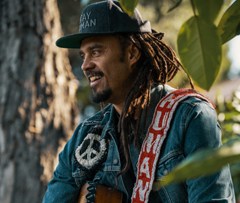
The transition from angry young man to a wise, optimistic adult can be difficult. For Michael Franti, it took time in therapy, recognizing the changes in society and developing a more mindful existence through his yoga practice to accomplish this.
That doesn't mean Franti has gone soft. Far from it. He remains committed to activism and promotes humanitarian causes that include his Do It For the Love Foundation. His aim remains the same -- bringing people together in a joyful manner and inspiring them while pushing for a quality of life that’s better for all.
His thank you to fans who contributed to his video for “How We Living" reflects his attitude. “It’s an important time we are living in and we are grateful for the community of people around the world who are committed to making the world a better place. I encourage you all to keep looking deep, asking the questions and showing up with mindfulness, passion and optimism!”
His latest album, Work Hard & Be Nice, continues the musical path that developed around the time of 2008’s All Rebel Rockers, which was led by the single, "Say Hey (I Love You”). On tracks such as “Good Shit Happens” and "Start Small Think Big" and the title track, he acknowledges the drawbacks in daily life that can create a negative mindset but turns that mindset upside down by fixating on the brighter side of life. His charismatic gift results in intoxicatingly feel-good music that's never overbearingly sentimental or idealistic.
In our conversation, a decade since our last one, we discussed being stranded at his Soulshine Bali hotel and yoga center due to the Indonesian COVID-19 lockdown as well as his purposeful move towards promoting optimism, different attitude towards corporations now and reflections on touring with U2 and his musical hero Billy Bragg. This takes place a couple days after his last Soul Rocker House Party of the summer. The livestreamed musical event featured Franti along with local musicians and others who live nearby or work at Soulshine Bali. He plans on having additional house parties on Sept. 19, Oct. 30, Nov. 21.
JPG: We haven't done this in a long while. Last time we spoke it was for Jambands back in 2010. A lot has changed since then. First off, you're in Bali now. Did you leave the U.S. when you found out that all concerts were being canceled?
MF: We own a hotel here called Soulshine Bali and it’s a yoga retreat center. We were here, my wife and I, leading a yoga retreat at the end of February. We were planning to stay for the first two weeks of March. When we heard everything was starting to quarantine around the world, we decided that we were gonna postpone our tour that was to start in April until May. That was what we thought, “By May this is all gonna be cleared up.” (laughs)
Then at the start of April, the Indonesian government shut the whole country down. All the ingoing and outgoing flights have been shut ever since that time. So, technically we've been stranded on a tropical Island here, and there hasn't been any way to fly home yet.
JPG: That's crazy. I guess there could be worse things, but still...
MF: We're super-blessed. This has been, of course, a crazy time for everybody. Just speaking of the hotel, one of the reasons that I built it, the first reason is I love yoga and I wanted to create a place where people could hit the reset button in their life. The second reason that I built it was I thought if everything all goes completely dead with music at any point in my life, at least I'll have the hotel to rely on. Little did I figure in global pandemic (laughs) as one of the things that would potentially shutdown the music and it's completely…we lost every single booking for our entire year at the hotel. So, it's literally just been me, my wife and my two-year-old son at the hotel.
JPG: I watched your Aug. 15 livestream concert. Who were the people that joined you, the musicians and dancers?
MF: The different musicians are local and I’ve jammed with and the dancers are some guides who I know, men and women, who have been in one of my music videos who live in Bali, who I invited over to come see the whole thing, but I wish they were all staying.
JPG: I thought some of them were people from town and some that worked at Soulshine Bali and others that were staying there.
MF: Yeah. They are people from close by.
JPG: So, Indonesia still has a strict lockdown…
MF: Yeah. The only tourism in Indonesia now is within the country – Indonesian travelers -- but most people here have very little resources to do any kind of tourism like that. So that squashed all that business, and then there's no foreigners allowed into the country right now unless you're a government agency or doing relief work or some kind of environmental science or something like that but no tourism at the moment. It was scheduled to reopen on September 11th but they just pushed that back again to at least January 1st.
JPG: So, you still have no opportunity to go back home to San Francisco.
MF: No, unless we can figure out a way to fly to a neighboring country like Australia or something like that.
JPG: You have Soulshine Bali, and I've always wondered, what is it about Bali that appeals to you and how has it changed you?
MF: Well, the first time I came to Bali I fell in love with the Balinese culture. People here are so incredible. That was in 2007. Bali is an island of creative geniuses, and what I mean by that is everybody, whether you're a banker, shop owner or something like that, everyone does some form of art. Everyone either carves wood or makes jewelry out of gold or silver or creates batik or does stone cutting…As you travel the island, each village you go through has a different craft that they make.
The second thing is that they have this system called Banjar and it's a way that they organize their society. So, within each village, you'll have groups of 75 families who will make decisions for their community. And it's all done by consensus. So, there's no majority rule. They have to all agree on what they're going to do. They're planning a new road to be built or there's some holiday that they're celebrating, everyone gets together and contributes towards that celebration of that holiday. And they do a lot of ceremony. It’s Hindu culture. Every two weeks there’s a massive ceremony that goes on.
They all really work together and they're all super-creative and just very kind people. I fell in love with the culture. It's a beautiful tropical Island here, so that's great. I thought it would be a good place to buy a little piece of land and, hopefully, build a little vacation home. So, we built five rooms with a yoga studio on top and it was like, “If you build it, they will come." Sure enough, we started getting teachers bringing in groups of students here. Over the years we kept putting the money back into building more rooms and we are up to 32 rooms now.
JPG: When you're describing the Banjar, it sounds, and the way the people get together, it sounds like a Native-American situation with the group of elders and the rest of the tribe getting together.
MF: Yes. It does. It’s very traditional. The most important thing about it is that everyone participates and the Banjar system is more influential than the federal government here. They police themselves. There is a national police force that would deal with any kind of violent situation like that but in terms of just dealing with everyday things that happen in the community, the members of the community rotate to take turns on being the security for the community. It's really remarkable.
JPG: Have you been there long enough that you're able to attend one and voice your opinion?
MF: Because our hotel's located in this village called Mas, the mayor of the Banjar that we're part of -- he was at the show and he was one of the people dancing there. So, we have a very close relationship with him, and we do stuff, too. Right now, we're doing a donation to the community to buy food because probably half the people in the community have lost their jobs since the quarantine and a majority of people either grow rice or work in tourism. People are still growing rice but the tourism side of it is completely shutting down.
JPG: Segueing to the new album and your viewpoint of promoting optimism. Does being there and doing yoga and being part of that community inspire you from being an angry young man of the past to an optimistic older man now?
MF: Yeah. I feel like my whole life, I feel like even everyday, still -- I kind of talk about it in the film Stay Human -- everyday I wake up and there's this voice in my head, that's cynicism and there's this other voice in my head that’s optimism. It's a constant battle.
Yoga has been one of the things that's helped me to train my mind, to focus on optimism. A friend of mine was talking to me about the various thoughts that we have and I forget how exactly how she laid it out, but she was like, “If you have a negative thought about the future that's fear, If you have a positive thought about the future that's optimism. And if you have balanced thought about the future that's planning.” The same thing goes for thoughts about the past. If you have a negative thought about the past, it can be regret. If you have a positive thought about the past, it can be a joyful memory.
It's something that you can learn, train your mind to do, to go to that part of the brain that says, “Okay, even though we've got a lot of challenges ahead of us, who knows how many months can turn into years before we can do another concert again or we'll have another guest at our hotel but I'm still gonna do everything I can to plan for that future so that when it's ready to hit, we're golden.” So, during this time, there's been moments when I or my wife, us as a couple, have drifted into that other side where it's like, "Aw man, we're fucked. What are we going to do? How are we going to earn a living? When are we going to be able to travel again? What if one of us gets sick?" So, every day, we get up and it's how do we refocus our mind to that optimistic side or at least that planning side to make sure that we're preparing ourselves, keeping our body healthy and keeping each other's spirits.
It's been very challenging and that's a reason why all the years that I've been making music that I've done it is that I wanted to make music that helped people to get through challenging times. I write them from my own experience trying to get myself up in the morning.
Everyday we have a dance party and almost everyday we listen to my music (laughs) at our dance party. We wake up in the morning and put on some music in the bed and we either jump on the bed or jump on the floor and dance with my son and get our blood pumping, and then go, “Alright, how are we going to start today? What do we got ahead of us? Let's get up and face it with optimism.”
And the second half of it with this album, Work Hard & Be Nice, has been working hard. That's what we're doing now. We just decided rather than roll over with the hotel, let's just do everything we can to repair rooms, build new things and tweak our restaurant menu, keep our staff employed at halftime. Even though we don't have any guests we're still paying people because we believe in them. So, we're just trying to figure out a way through.
JPG: I can identify with that fight between optimism and cynicism. My wife, who is a yoga teacher and owned a yoga studio, she's more of the optimist, trying to get me to always look on the bright side. I'll even admit, the first time I listened to “Work Hard & Be Nice,” I was like, "Ugh, Franti’s doing that positive stuff again. Where's a “Yell Fire!" track on this album?” Then, I listened to it a few days later and it felt right and lifted my spirits. So, that's music and the power of your mind, I guess.
MF: You know what? I was at the Byron Bay Bluesfest years ago and George Clinton was performing there and we were sitting on a panel together and he said, "Funk is just the blues sped up.” I was really intrigued by what he was saying. Then he said, “Let me explain it. The blues, you talk about your sadness, "My baby left me or I ain't got no money” and then you speed it up and we celebrate because we've gone through the sadness and we've come to the other side of it.” I thought that was really remarkable and just spot on way that I view music.
If you listen to my songs that are really joyful songs, they never start off being joyful. I always talk about the shitty stuff that's happened and then how do we get to the other side? A good example of that is “Good Shit Happens” -- “I love my crazy days, but it might not seem that way today."
I talk about all the challenges that I'm going through on a day-to-day basis but I can get to this other point and this other place in it. That's why listeners have come to my music over the years and it's what I try to do. I don't have a lot of really super-sad songs, maybe “Nobody Cries Alone” on the last record (“Stay Human II”). I don't have a lot of really sad songs because I'm trying to fix that part of me, and I guess that's what I've learned through yoga is that there's a way to find that joy again, and there's a way to find that optimism and still be in the fight, and still be in the struggle and still be raising my voice politically. It doesn't have to just be from a place of anger or sadness. It can be from a place of empowerment.
JPG: When you're writing the lyrics, do you consciously, when the words are flowing and they may come out angry, do you let them develop and shape them into a way that they do shift to that roller coaster of emotions from bad to good and inspirational?
MF: Yes. Usually what I've found...this is just me after going through years of therapy, literal therapy with a room and a couch, that I've found that when I'm angry, they is almost always some other emotions that’s underneath it. "What is it that I'm fearing right now? How is it that I've been hurt in some way and that now my anger is lashing out to cover that? What is it that's causing me pain and is now showing up as anger?"
There's definitely things to be angry about in the world. I still express that and I still feel like it's important for us to be out there and being mindful of everything that's happening in the world that should piss us off but I've also chosen to be on the side of mindfulness. That's the big difference for me. I've been an activist my entire adult life and I remember when the Gulf War had just started, a group of us who went out on to the Bay Bridge in San Francisco and we blocked the Bay Bridge with signs saying Stop the War.
The news media came out and they talked to us and we were like, “Yeah, we're against the war.” And it got covered on the news that protesters blocked the bridge to stop the war. Then, when the second war in Iraq came around, protesters went out on to the bridge and blocked it and it just got reported as a traffic item. (laughs) It was like, “Protesters on the bridge blocking traffic. There's a one-hour delay. Details at six.” So, you gotta figure out ways to change your tactics and your strategy with the time that you're in. As a messenger or whatever message it is, it's basic, and as an activist you have to understand that your strategy is as important as your passion.
Sometimes, the passion gets in the way of the strategy and then you end up doing more damage to the movement then you do good in trying to change hearts and minds. You gotta reach people, the right people, the right message at the right time.
JPG: Going with that thought, you also need a good slogan such as Work Hard and Be Nice or Stay Human, Good Shit Happens…Defund the Police. Not so good.
MF: I agree with that. Even though I'm totally down with the theory of defund the police but, really, what we're trying to say is "Defund the police so you can fund…" It should really be “Reallocate our resources" so that we can fund things in the community that really create community safety and looking at community safety holistically like when people have jobs, they don't hang out on the street corners. When people have good schools they go to, they tend to want to find ways that they can engage within the community. That's what that movement is all about. And you're right. It's got a bad name right off the start.
JPG: I use the hashtag #ReformThePolice or now I can use #ReallocateThePolice. I always think of a kind of lineage as far as politics and music when I was growing up, artists such as The Clash, you, Billy Bragg...It's interesting to see the changes over time. Billy is, I don't know, exhausted, but you've found another way to approach it, which I guess is healthier and less depressing than giving up.
MF: Billy is one of my biggest heroes. It's funny. I rarely have an opportunity to really talk about Billy because he's not as known in America whereas in England, he's like patron saint. (laughs) Billy's favorite band was The Clash, and my favorite band was The Clash, too, when we met in 1988. My band, the Beatnigs, was invited to go on tour with Billy. So, here we are, this group of radical revolutionary poets banging on metal. We had grinders that we were shooting sparks out over the audience and then Billy would go up there with one Telecaster and it’s just him onstage. The thing that I was so moved by Billy was not only his analysis of politics and the world, which he was so great at bringing humor to it and insight at the same time.
In a way you have Lenny Bruce or George Carlin, and maybe at their best moments Chris Rock, Richard Pryor and Dave Chappelle. I feel like Billy's up there with those kinds of minds, of people who can bring humor to politics. Yet he would write songs about how much he missed his girlfriend or how in love he was or he'd write songs about sexuality. It really had an influence on me. I was like, “Man, maybe if you really want to reach people, you’ve got to talk about more than just the way things are fucked up. You've got to talk about the way things could be.”
Then, a few years later, we went out on tour with U2. U2 was known as this super-political band. This is when I was in Disposable Heroes of Hiphoprisy, another upfront, radical political hiphop band. So, we’re on tour with U2 and there was this journalist from some UK magazine or newspaper, and they were sniffing around the tour and trying to dig up dirt on U2. Here, I was the leader of this really political band and this guy sat down with me for this interview and he's like, “Do you think U2 has sold out? Now, they're playing stadiums. They used to be super-political upfront. Now, they've moved away from that." I was like, “You know, 50,000 people come to these shows every night and they’re from all different walks of life, all experiences and by the end of the night, they're all singing together arm-in-arm, they're high-fiving strangers. With whatever they came in, they go home feeling happy and a little bit better prepared to face whatever's next in their life. They come out and they look like they've grown a half an inch. If you can you name a politician that can do that for 50,000 people every night on tour I'll vote for him or her."
I really believe that there's something to that power of being able to…everyone who loves U2 knows what Bono’s stance is on political and social issues. He’s somebody who's tried. He tried to work with George W. Bush to bring development to Africa, and I admire that. I admire that spirit of somebody who's willing to say, “Hey, I'm here to deal with issues and not just candidates.”
That’s ultimately how we get stuff to move in our society. When we look at the Black Lives Matter movement, now people all across the country are starting to look inside their hearts and say, "How am I showing up for this in terms of systemic racism in our society and racism in the hearts of individuals? How am I showing up as not only someone who says, “I'm not racist," but that's showing up as an anti-racist and what am I doing to fight racism in the way that we would fight anti-Semitism or that we'd fight misogyny? How are we showing up for that?”
That's really an important thing that I've learned in the last four years. There's people who come to my shows who I am diametrically opposite from in terms of their politics but I try to have an open heart to them. I try to listen to where they're coming from and at the same time try to be as courageous as I can be and speaking my truth but do it in a way that other people who might be different from me can understand and go, “Well, yeah, I kind of get that part of it. I don't agree with all of it but I get that part of it.” I feel that's how we move the needle.
JPG: I was thinking there were other political bands that I was missing. So, I missed U2, which should have been obvious because they were political from the very beginning. Speaking of Bono and working with others, I saw the YouTube clip of you doing “My Lord" and bringing him, Don Henley and Jeff Skoll onstage at the Skoll World Forum on Social Entrepeneurship (www.skoll.org). The audience is filled with people in suits, possibly fancy haircuts, you know what I mean, and you’re playing in front of this crowd. So, is it that kind of thing of reaching out to those who are well off in life that see that there's another side, other than another Rolls Royce...?
MF: The Skoll World Forum is an interesting event because it does bring together people who are from the philanthropic world. Jeff Skoll was one of the founders of eBay. It brings together people from the philanthropic world who are very well-to-do with frontline activists and people who are out in the world doing work with NGOs (nonprofit organization that addresses a social or political issue and operates independently of any government) in some of the most challenged places in the world, like the White Helmets of Syria who go into buildings after they've been bombed and pull civilians out of them. That was a really mixed group of people there. It was at a gala at the end of the week of the conference, which is done every year.
But, to answer your question, again, you're trying to hit the right people with the right message at the right time. So, whether I'm playing in a prison or whether I'm playing at a private event for a corporation, which we often get invited to play, I'm always trying to bring a message that reaches where they're at. For any kind of a corporate event, I always do research on whatever brand it is that I'd be performing for beforehand. I choose them very carefully and if it's totally whack, I don't go into their space but when I do I go there with a message of, “Look at the incredible things that your company is doing to have impact." Some companies aren't doing anything to have impact or much to have impact and I talk to people about that. “What ways are you showing up to have impact?”
It’s amazing how much things have changed. Since the last time you and I talked in 2010, it seems like every company in the world now is trying to find a way to have impact in their community or with their audience and it's really a good thing. I used to be somebody who complained that corporations were just taking money and not doing anything and now I see corporations and brands who are doing incredible stuff and are leaders in their area. You take all the different brands who are committed to doing things, it adds up to a lot. Rather than just being against corporations, I try to encourage them just to show up.
JPG: There is a different way now. It is almost confusing if one's ‘90s self looks at what is happening right now; the complexities and entanglements of everything, good and bad.
MF: In the ‘90s, it seemed so clear. I had this song “Rock the Nation” and the lyrics “Give the corporations some complications.” It was really about activism and saying as Mario Savio said, “Let's put a wrench in the machine.” That was a saying from the Sixties that had carried on up into the '90s.
Now it's like, “Let's try to use the machine to do good stuff in the world and to give back and to make sure that the environments that people are working in within those brands are healthy for everyone who is involved.” That's a welcome change. It's a different time now. And it's a testament to everybody who marched, and it’s a testament to every person who protested and everyone who wrote a song about it that these changes have occurred.





