

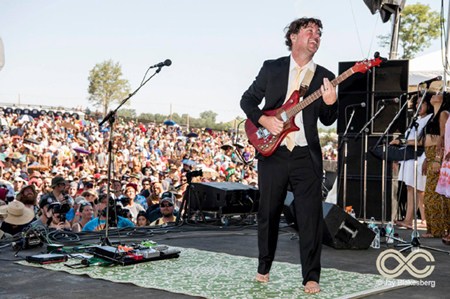
Keller Williams is among the more ambitious solo artists in the jam community, often incorporating layers of looping guitar into his performances for the kind of on-the-spot, in-the-moment improvisation craved by fans of the genre. Yet, Williams is equally skilled as a vocalist and complementary member of several ensembles- Keller and the Keels, Grateful Grass, PettyGrass, and Grateful Gospel, among others- that allow him to indulge in covering some of his favorite music. This May, Williams will bring Grateful Gospel to the inaugural BeachLife Festival in Redondo Beach, Calif., and close out the month on the other coast with a two-night stand at Garcia’s at the Capitol Theatre in Port Chester, New York, while in between touring the U.S., hitting Summer Camp, DelFest, and the Revival Music Festival on Memorial Day weekend. As we spoke, Williams was also completing the mastering on a forthcoming solo album, and projecting plans for a new Keller and the Keels record later this year.
You’ll be playingwith Grateful Gospel at the BeachLife Festival the first weekend in May, andfinishing the month in New York with solo shows. How do you go about deciding on your schedule,between playing headline dates and festivals?
I have a wonderful team in place. Everyone does their part, and I know myplace: to show up on time at the airport, possibly with more time than I need,start the show on-time, and play the contracted amount. That’s what I do. Everything comes to me as it happens. So I’m not sure how it came about for me tobe on BeachLife, but I’m very excited. I’m very excited to hang out with Stu Allen, who will be filling in forJohn Kadlecik. Stu’s a fantastic guitaristout of the Bay Area. And to play withthat band- we don’t get to play that often- I’m excited for that. Grateful Gospel is notoriously a Sundayband. We’ve never played on any dayother than Sunday. The idea was to workit into Sunday morning or early afternoon slots at festivals. A lot of festivals have legit gospel groupsthat play [that slot]. That’s where theidea comes from.
I’m thinking it maybe a challenge to prepare to play with Grateful Gospel because you’re with theminfrequently and only on Sundays.
I definitely want to sneak in a few rehearsals, especiallyfor the singing aspect. Grateful Gospelis a big harmony-based thing focusing on the spiritual side of Jerry and theGrateful Dead. The real magic comes withthe singing. To rehearse a few times isreally, really important. This is areally beautiful, spiritual, uplifting thing I’m going for.
And you said StuAllen’s filling in?
For a morning gig, we need to be there the night before orclose by, at least. I don’t think we canpull that off with John’s schedule. Stuhas played in the band a few times and it’s fun to change it up. John will be on the Lockn gig in Virginia.
You played with Johnnot too long ago, correct?
I just recently hung out with him in Alaska. Did two shows where he supported, and thenwe’d do a third set together. It was alot of fun. A duo, with my looping rig-it got freaky. It went places notplanned. It was really interesting.
Is it a difficult togo from the solo world where you have so much control to collaborating?
(Collaborating) brings me joy, excitement, andadrenaline. After doing what I do for solong, and being limited to the powers that I have over these instruments, andthen to bring in someone with more powers, and more licks, and more avenues togo down, but is also open-minded enough to play this track that I’ve justcreated in front of them- that makes me giddy. I get goosebumps thinking about it now. I know what people to target when it comes to that. The challenge comes when maybe I’m sitting-inwith someone else’s band, and I’m worried about stepping on someone’s vibe.
You have developedsuch a comfort level with your solo performance, particularly incorporatinglooping into your approach. When you hiton something that works, that resonates, is it hard to resist the notion oftrying to get to that place again the next night or the next time you jam withsomeone?
I don’t think can ever really re-create some kind of improv. Improv is improv. You can re-create the beat and the key andmaybe the scale you’re using, but the vibe is always going to bedifferent. Sometimes when you listenback to things that go to the places we went, they can be starting blocks forideas for songs. But, my think recentlyis to write into my setlist things like, “wing it,” or “make ‘er up’er,” or “gosomewhere.” It creates a space to becreative. John and I definitely didthat. I have a lot of trust in him. To communicate with someone without words isa beautiful thing in music.
The Sunday lineup atBeachLife includes Willie Nelson, Ziggy Marley, Grace Potter, and BluesTraveler. Are you one to take a look andsee who you are performing with at festivals?
A lot of times I don’t see lineups until I get there. Unless, of course, there is a request forsit-ins or to build a band. Like withGrateful Grass, I can look at the bill and see who would connect with thismusic and would want to do it. I alwayslook at who is before and after me. Ihave a lot of respect for bands of the older generation. So, if I’m at a bluegrass festival in betweensome heroes I definitely don’t drop as many F-bombs. Other than that it is usually a pleasantsurprise when I get to see bands. It’sdifficult sometimes to force yourself to leave [a festival] because there is somuch good music going on, but I have to stay in that professional vein and bugout which means not seeing as much as I’d like.
Grateful Gospelaside, does when you are slotted to perform play a role in comprising the set,regardless of what other artists are on the bill?
Absolutely. It’salways about the environment, too. Fourin the afternoon at some festivals could be straight-up lawn chairs. The whole lawn chair crowd calls for aslightly different setlist, like lyrics with storytelling. The later sets, you want to bring the‘up.’ You don’t want to feed theyawns. You want to bring the power, thedance, the funk, the groove, and the comedy. Every environment is different. You never know. You need to bringwhat the vibe that’s going on calls for.
On your website youlist nearly a dozen musical configurations you participate in. How do you keep it all straight in yourhead? Especially when you are playingthe music of other artists like the Grateful Dead or Tom Petty?
I always play on the weekends. When I know that there is something coming upI’ll start mentally preparing for that on Monday. With certain projects there is a limitedamount of songs that the project knows, so I’ll focus on those. The solo thing is like the day job; I can goin and out of that all the time. I lovethe shows when it’s a solo set first and some kind of project second. That’s really exciting for me.
What’s exciting aboutit?
I get to jump into creating music and energy with otherhumans. When you play solo as much as Ido, I get really excited about making music with other people. The real reason I do it, I think, is so Iwon’t stagnate in one place. And peoplecome to the shows. And promoters bookthe shows. I wouldn’t be able to do anyof it if people didn’t come to the shows or promoters didn’t book them. I have a deep love for this music; to releasethese tunes constantly going around in my head saves my mental health. It saves me from a room with pillowed walls.
There is a strongelement of bluegrass in your music. Would you say that was the basis for you in developing your style?
I was a fan of the music on the acoustic side of it. That really turned me on. I think that’s where it came from. I got so absorbed with the Grateful Dead as ateenager. Then I found MichaelHedges. So there’s new age acoustic solomixed in with all these Grateful Dead songs. I discovered Old and in the Way,and that’s kind of where me performing bluegrass came from, in my late teens,early twenties. The idea was always toplay in bands; rock the drums. When thatdidn’t happen the solo thing came around and bluegrass fit in kind ofeasily. I don’t think I’d be talking toyou now without the love of bluegrass. If you look at it, dance music began with a dude on stump playing afiddle, so it’s kind of the beginning to everything.
And in Africa, thereare equally separate rhythmic dance roots that originate there and migrate toNew Orleans, among other places, where Bill Monroe hears jazz musicians andnotices the similarity between what he’s doing and what they’re doing. This suggests the potential for a connectionbetween bluegrass music and a lot of 20th century American rockartists that you cover, like Tom Petty and the Grateful Dead, as well.
It’s an extremely natural connection, especially with TomPetty, and especially with the Grateful Dead. They are both rock artists, but they are also based in that Americanatype of songwriting.
I look at yourschedule and I see first week of May in California, last week of the month in NewYork, and around the U.S. at various festivals, criss-crossing the country. Do you still enjoy all that traveling?
I treat it as a gift. I play music for free. I just getpaid to deal with airports, and lack of sleep, and being away from my familyfor three-and-a-half days a week. I usedto have to go out three weeks at a time. I definitely could not do that now with my family life. This schedule is a working yin/yang for mylife.mily:





