

***
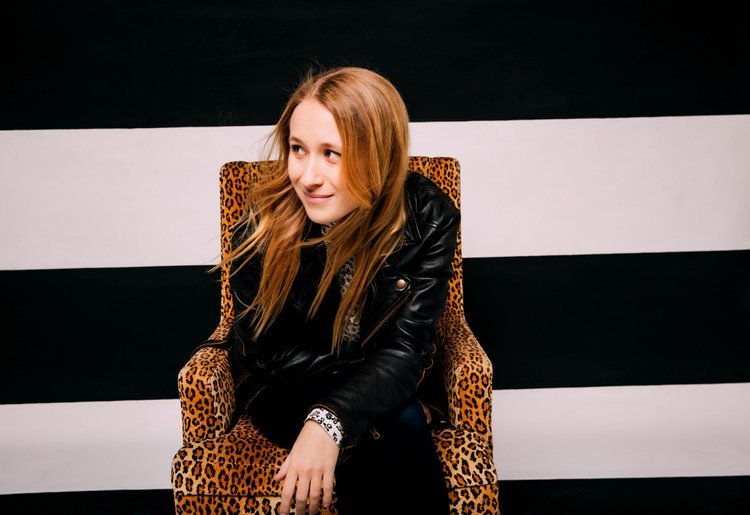
Anyone who’s seen Karina Rykman perform, whether fronting her electrifying trio or holding down the low end with Marco Benevento, knows the infectious energy and sheer joy she brings to the stage and to life in general. These have propelled her along a unique path, from skateboarding city kid soaking up music like a sponge, to developing her own voice as an instrumentalist, songwriter, and bandleader. Along the way, she spent years learning the ropes of the music business from the inside, toured nationally as a teenager, and developed a reputation as a must-see live act, blending psychedelic rock, indie synthpop sensibilities, and deep-groove improvisation.
In the last year alone, she’s shared a stage with My Morning Jacket, opened for Dave Matthews and Tim Reynolds in Riviera Maya, and made headlines for not being Beyoncé. And she’s about to hit another milestone: headlining her biggest NYC show yet at Webster Hall. We caught up with Karina to trace her journey through the New York scene and beyond, exploring the experiences, friendships, and creative partnerships she’s made along the way.
MH: You’re days away from headlining your biggest NYC show yet at Webster Hall. As a lifelong city kid, what’s your relationship with the venue?
KR: Oh man, it’s so iconic to me. I’ve seen so many incredible shows there – the list is a mile long: Kurt Vile, Remi Wolf, TV On the Radio, Lianne La Havas. And some of the underplays I saw there completely blow my mind: Metallica, Soundgarden, Nine Inch Nails. The first show I ever saw there was Chromeo in 8th grade, and I just saw Neal Francis in March.
And with all those shows, outside of an amazing sit-in with Vansire in March, I’ve never played there, not once, not even in an opening band. So, headlining feels insane, dude, literally insane. It’s so surreal.
MH: Prior to Webster Hall, your biggest show was last year at Racket, right?
KR: Yeah, we sold out Racket last year, and it was amazing. Immediately after, they were like, “You want to do Webster Hall?” I was like, “Yeah I do! What?!?” And they were like, “Yeah, like, duh.” Holy shit! Them telling me that based on my sales at Racket, they believed I could play Webster Hall...okay! And look at us now. It’s a huge milestone, representing that growth and the belief the promoter has in us based on the fan support we’ve built.
MH: What was it like coming up as a teenage musician in New York City?
KR: I never had a lesson, but I could learn from friends and teach myself stuff, and I was lucky, lucky, lucky to find my community, my people, just through music. Growing up in my building, many kids my age were friends...we would just call each other and be like, meet downstairs in 5 min. We would go over to each other’s apartments, and my friends would show me just enough so that I would feel comfortable enough to sort of sink or swim in setups with people who were far better than me, way older, and way more schooled.
I joined a rock collective starting in 9th grade, and all of a sudden, all my friends are just as obsessed with music as I am and I’m in five bands! All we wanted to do was learn as much as we could about Music, with a capital “M!” Jazz, metal, jamband stuff, hip hop, old stuff, new stuff. I wanted to be able to converse with anybody about any kind of music. That’s where I learned how to be good at the instrument...you were responsible for learning all these songs in a week to rehearse: if you didn’t know your shit, you were letting down the whole group. My ability now to learn a bunch of songs really quickly was ingrained in me from that. That united so many like-minded kids...we all formed our own bands from that. Everybody was just jamming and doing stuff…I played so much and with so many people in so many formations. And we were fervently going to see live music, getting pummeled at a Primus show the night before the SATs. (That’s a true story!)
MH: You also dove into the music business early, moving from internships to becoming GM at a concert promotion company while still in your 20s. What motivated that deep dive into the industry side, and how did it inform your perspective as an artist?
KR: I was doing anything to be around music. I had my first internship the summer between 10th and 11th grade at Vector Management. The next year I interned at Relix, where I met Pete Shapiro and so many people I’m still friends with and do work with. The following summer, between 12th grade and NYU, I met Jake Szufnarowski from Rocks Off...I told him I’d love to be his intern. He said, “Cool, you start tomorrow.” That turned into a full-time job, and I worked for that company for seven and a half years and became the GM very quickly. I was throwing myself into things, wanting to meet people, do stuff, be around music, learn the business, learn everything...cut to eight years later, and I’m running the show. It’s an amazing thing, really. It definitely informed my perspective, understanding how things work from the promoter and booking side.
MH: What were some of your early band experiences?
KR: My 8th-grade punk band, False Arrest, was big. That was my first band, and we used to email promoters to book shows, basically lying as 13-year-old kids about how big a crowd we could bring. Then when I was 17, I joined the Sound of Urchin, and suddenly I’m on stage at Irving Plaza trading licks with Bill Fowler.
MH: Was that scary?
KR: There were moments of fear for sure, but I learned how to get past that at a young age. I was pretty fearless looking back, and I think that served me well. I put myself in situations where every single time you’re getting better, and you’re learning, and you’re part of the conversation. It was important for me to feel a part of a conversation and a part of a community. That’s what it was, and that’s still what it is. My friends, regardless of whether they’re professional musicians or not...we jam, and we pick up guitars, and we play shit, and we teach each other shit. It’s really amazing. I feel lucky that this is what I fell into because it’s a universal language.
MH: Your parents are both university professors. How did they feel about your pursuing a creative path?
KR: Even though what I do is far from academic, my parents very much recognize that my interest in music is much like their professional interests. My parents really figured it out: they’re so obsessed with what they do. They worked so hard to get to where they got, and even in their late 70s, they still want to do it, which I think keeps them young. So I think they were super stoked that I had found my thing because it was very apparent that music is what I cared about.
MH: What do you think it was like for them when you wanted to go on tour as a teenager?
KR: People would ask them, “Oh, you’re going to let her go on tour when she’s 17?” And they’re like, “Well, yeah, try to stop her.”
MH: OK, so after four years or so with Urchin, you joined Marco Benevento’s trio?
KR: Yeah, joining Marco’s band changed everything. It was a pivotal moment. I was such a fan of Marco’s music, and the gig was a big deal for me. It happened because Dave Dreiwitz couldn’t continue touring with Marco when Ween came back in 2016. Dave insisted to Marco that I should be the one to fill in for him, and the rest is history!
Playing with Marco is the most positive environment that exists, as far as I’m concerned. I’ve toured with him for nine years now, and there’s nobody who makes it as fun or as incredible as he does. I really stand by that. Marco is an incredible human, and it’s an incredible gig because he very much wants me to be myself on the instrument. From the start, he has always emboldened me to be myself on stage. I don’t have to pretend to be coy or anything I’m not. I want to take what I’ve learned from Marco’s tour, ethos, and vibe, and bring it to my band, which will disseminate to the audience. Marco’s vibe transcends time and space in the joy department, just making people feel good and happy to be there.
Without guys like Dave and Marco, I would probably be working in the music business rather than being creative with my music. At age 22, it just fell into my lap, and they put me in the driver’s seat. I worked tirelessly to learn all the music and not let Dave down. Relationships and people believing in you are huge.
MH: You mentioned learning from Marco how to create a vibe; like his shows, yours are so joyful. How do you cultivate that sense of joy and connection with the audience?
KR: I feel like I communicate with my fans a lot online and at the merch table after every single show. I do not skip that; I hold that super dear. People feel like they know me even when they don’t. At this level, it’s beyond cool. Having this sort of open relationship with the community is awesome. People say, “Hey, you’re going to play this tonight?” and I say, “Oh, is that what you want to hear? Awesome!” and try to figure it out. It’s really a nice thing. That jam and jam-adjacent community has this relationship with its favorite bands that is both entitled and also fucking awesome. I feel very emboldened by the fan base, which is super special. They make me feel like I can do anything on that level, and they’re here for it.
MH: OK, so you’re playing with Marco and studying at NYU in parallel. When did you start your own trio, and how did it develop?
KR: I knew Adam [November - guitar] and Chris [Corsico - drums] from NYU, and we started jamming and then played out with completely improvised music. And I love that that’s where we started. For years, we didn’t play a single song, and all we did was improvise together. I think it gives us this unique communication background with each other. We listen to each other. We’re all very chaotic, but we’re all very good listeners at the same time. That foundation makes it easier to communicate, especially in the writing process or figuring out how things convey themselves live. We talk to each other through the notes and the beats.
Our first real gig was for the Freaks Action Network benefit in December 2017. It was all improv, and people seemed to really like it. Even in 2018, with not a song to our names, we co-headlined Brooklyn Bowl with Fruition and played sold-out Phish and JRAD after-parties. It was insane.
MH: How did you gain such traction playing festivals and selling out shows before having much recorded music out? How did you navigate building a reputation primarily as a live act first?
KR: It’s crazy. Literally, we got booked to open for Khruangbin at the Capitol Theatre before I had a single song out in 2019. I just feel like I had a reputation of being a live instrumentalist that people wanted to see from playing with Marco. The name brand recognition was already there before I had recorded music, which is crazy: it worked in reverse. We played moe.down, our first festival, in 2019. We played Hulaween that year, opened for Guster, headlined Brooklyn Bowl in the fall of 2019...I was booking everything myself – no manager, no agent. These were just my friends I jammed with. It was just pushing forward and seeing what happened.
Then as the pandemic lockdown started to ease, we wound up booking private gigs, between our reputation as a live band and my engaging so much with my fans online. It felt like my band was at the perfect level, and me being approachable, people were reaching out saying, “Hey, how much would it take for you guys to come set up on my back porch and play?” We probably played close to 20 private gigs the summer of 2020 in the Northeast, just fans reaching out. It was sort of the right moment for that. It was sick and kept us playing. It strengthened our bond as a trio, just being able to play in those intimate settings, and it definitely deepened the connection with those fans who hosted us or attended. And our set at Peachfest 2021 was a major inflection point.
MH: What was it like to transition into writing songs?
KR: I love it: it’s so important to me. “Plants” was my first single, and it’s an instrumental vibe. Then came “Elevator,” my first song with lyrics, where I leaned into an indie pop direction. It’s sort of an intoxicating feeling to have songs, and people sing them back to you. I had released six or so tunes when I reconnected with Trey Anastasio, who’d been keeping track of my work cheering me on from the sidelines. Long story short, he wound up co-producing and playing on my first LP, Joyride, which was absolutely surreal.
MH: And what’s it been like to balance songwriting, playing songs, and straight up improvisation?
KR: I’m obsessed with songs, but I’m also obsessed with improvisation. My ears are almost too wide. There’s a nice split now: you come to the Karina show, you’re going to see songs, and a lot of stretching out. Those moments where there’s no roadmap, where the safety net is chopped from under you and you have to sink or swim, are super important to me. We create something larger than the sum of our parts in those moments, and then you go back to hopefully a massive hook that everybody sings along to. It’s incredible to have both.
MH: What’s it like getting tunes together for album 2?
KR: Now we have something to compare it to – Joyride – and it’s an incredible thing. I already know I’m wildly proud of album two, and it’s not even done yet! I’m deep in the sauce right now, working so hard to get the strongest 9-10 tunes together. I have maybe five to six definites at this point. Some are more shoegazy and almost heavy, some are super anthemic poppy tunes, and there’s an undercurrent of psychedelia throughout. I want to make a product that seems like one work of art, and the tea leaves are revealing themselves.





