

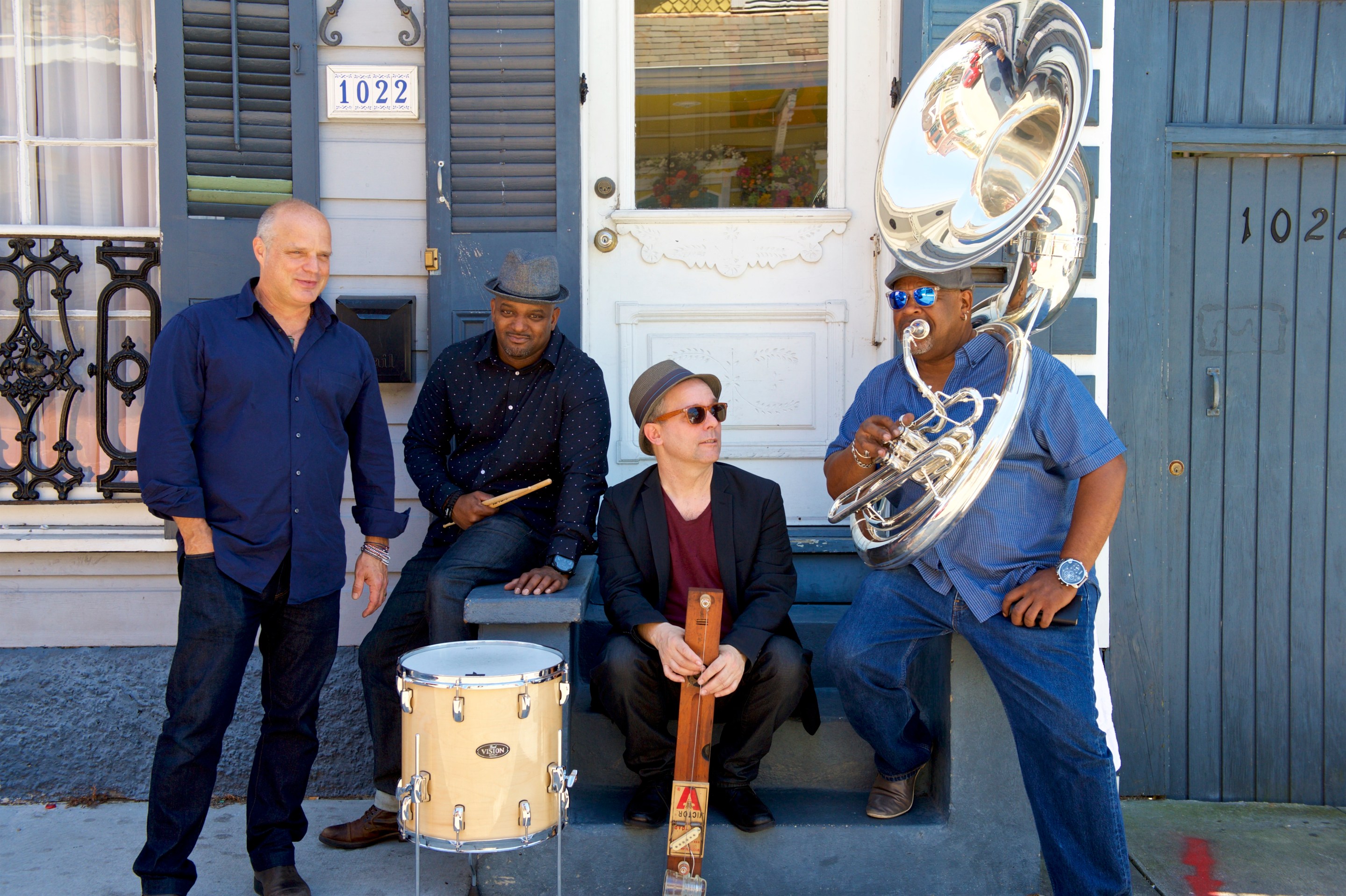
“There’re so many people on their laptops making really cool music that’s intentionally lo-fi and there’s a place for that and it’s incredible,” John Medeski says about his thoughts on the current DIY studio trend. “But for me, recording acoustic instruments and live music, I like it to sound good.” As he freely admits, these days Medeski is somewhat in between worlds, a household name in jazz, jam and music critic circles, but still hustling to release quality music that floats outside the mainstream. This fall he’s bouncing between myriad projecting, ranging from Medeski Martin & Wood’s first album in four years, the Alarm Will Sound collaboration Omnisphere to his first extended run with his New Orleans-inspired act Mad Skillet and his continued interests in the New York Downtown experimental music community. Mad Skillet—which also features guitarist Will Bernard, Dirty Dozen Brass Band sousaphone player Kirk Joseph and Dirty Dozen and all around New Orleans drummer Terence Higgins—will spend much of the fall on the road in advance of their first studio collaboration. The keyboardist has also been busy behind the scenes with MMW, quietly working on a new studio collection that will likely include a film component. He’s also remained active in the jamband scene, playing gigs with scene titans like Phil Lesh and Warren Haynes, who led an all-star band featuring Medeski at Port Chester, N.Y.’s Capitol Theatre in early October. Before heading on the road, Medeski offered a state of the union on MMW’s future plans, Mad Skillet’s goals and his continued mission to find “instant music.”The lead track on the forthcoming Mad Skillet album just premiered over on Relix.com.You have been bouncing between a number of projects this fall, but your main focus is your new Mad Skillet band. Can you start by giving us a little background on how that group of musicians came together?John: Mad Skillet is one of these bands where what I like is what we all naturally add to making music. It wasn’t this concept or the feeling that we needed to do anything in specific. About 10 years ago, Will Bernard and I did a record called Blue Plate Special and, ever since then, we’ve made sure to do some sort of gig together at Jazz Fest and that evolved into Mad Skillet. I produced a Dirty Dozen Brass record in 1999 called Buck Jump and Kirk Joseph and Terence [Higgins] were both on that, and ever since then I just had this little dream in the back of my mind to have a group with them. So we decided to just make a record—the band is so natural and fun, it’s just easy musically, it really comes together all by itself. And, we decided to put together a little tour as well.We’ve already gone into the studio. We are doing a Kickstarter—it’s really hard for me to get records out. I don’t really sell enough records to warrant a really major, great record deal, but I have of enough of a reputation. These days, record companies aren’t offering anything and they don’t really know how to get records out. Especially the major labels, they screwed themselves into this hole over the past 30 years, and they didn’t keep up, and now the technology’s ahead of them, and they’re scrambling.So we went down to New Orleans and recorded in a studio down there called the Living Room and did the whole record in a few days. The sound quality is really high, and to me that’s really important. Right now, people are listening to music on their phones in all these crappy formats—really low-resolution streaming formats, but that’s gonna change, and there’s gonna be a whole bunch of music that was recorded that nobody’s gonna want to listen to because it just doesn’t sound good as technology advances and we get better and better sound from our little devices.All four of you have deep catalogs to draw from in your live shows. When it came to composting for Mad Skillet, did you each bring in some material, write together or a little of both?We wrote some songs collectively while we were in the studio, I brought in some songs, Will brought in some songs and Kirk brought in some tunes. Terence came up with the beat, and you can hear him—in the beginning he sort of sings the bass line—then Kirk jumps on it and we created a piece like that. So everybody contributed. And that’s the thing about this band. Everybody in the band is, in their own right, a producer, composer and bandleader. We all get together, whether we’re playing songs we’ve already done before or—and this music, it’s funky, with Kirk and Terence it has this real New Orleans roots as far as the basic rhythm section. But then everybody is ready to go anywhere, anytime. A lot of stuff happens spontaneously. Even when we play songs we do over and over, they’re different every night, wherever they might go.You obviously have a long history with Dirty Dozen Brass Band and helped bring them into the modern jazz and jam world.Sometime around 1999 they just called me up to produce this record, and I went down to New Orleans, and spent some time working on the record with them. It was the first record they really had a drummer on, when they switched from the traditional brass band rhythm section and they went to a drum kit. Terence adapted that style to a kit in a really amazing way. It was sort of a transition time for them and my job was to help put it together—keep it rooted, but also move it forward. For me, it was a blast. It was a really great experience to work with them and work on that record and be part of that.MMW released its first album since 2014, Omnisphere, in September. This is a different project for you guys, revisiting a mix of older songs and some new material with Alarm Will Sound. Can you walk us through the genesis of that record?The Alarm Will Sound project came about because a friend of mine, who I went to the Conservatory with in the ‘80s when I was in music school, was a composer and also a piano player. We used to hang out and listen to music and talk about music and argue about music. He was in the classical composition department and I was in the third-string jazz department. But I was also in classical my first year, and we crossed over a bit. And years later he called me up and he was working with Alarm Will Sound, and he told me, “I really feel these guys are doing something in their own way in their world, in their universe akin, to what Medeski Martin & Wood has done.” And he said he thought it’d be a really cool collaboration. So I listened to their music and I loved the stuff they were doing and I saw how it did make sense. When I met with Alan Pierson their conductor, I realized they’re very much like us—even though they’re nineteen pieces, they’re very democratic and collaborative, and it really did make sense. It was always a dream of ours to get the opportunity to work with that sort of ensemble and explore that side of our music. The whole thing was a dream come true. They jumped on it and wrote a couple of songs for the collaboration. They also did some really great arrangements of tunes of ours, and we brought some music in, too. It was really a blast. We got it together for these two concerts we did in Colorado, and we recorded it, videoed some of it, and finally we’re getting the record out. We recorded it in February 2015 and we’ve been sitting on it, trying to figure out how do we get it out. So finally, we took it upon ourselves.They did two arrangements from our catalog, “Anonymous Skulls” and “End of the World Party” and fleshed those songs out for the orchestra. A lot of the keyboard parts were originally played on this instrument called the Mellotron, which has string sounds and voices. It is the original sampling keyboard—it has tapes and it was maybe the first pre-sampler. So I use a lot of that on those tunes, and what they did was transcribe and arrange what we had done, which enabled us to play those songs in a way we had never been able to do live before. Because it’s just the three of us, it’s hard to duplicate all the overdubs and added parts, so they came in and arranged it, and it was really a blast. Then, also having all the people doing it and playing it, it transforms it again. It Transforms it into another, even though it’s related to the original, it takes it to another world when you have people playing those parts.Then, I wrote a piece just for the collaboration. Billy Martin came up with a piece, and they came with a couple pieces, too, that were all original things for the conference.Are there plans to play with them again to promote the album?Hopefully. It’s just a difficult project to get out there live, particularly, because it’s a lot of people. We would love to do it, and I think they would, too, if we could make it work and get out there and do a few more concerts wherever it makes sense would be fantastic. Plus, because I know the way they are and the way we are, coming in having done it once, we’d probably come up with some more material. If we had the opportunity, it’d be great. It’s just a matter of whether someone is willing to take a chance on it and promote it in a way that makes sense.MMW are playing Suwannee Hulaween Festival, but besides that, they seem pretty quiet on the live front. Does the band have any other fall plans?Well, this fall we don’t have any real touring on the schedule, but we have another studio record that we recorded and we need to finish working on. We actually filmed the whole recording process, so there’ll be a film coming out of that process. With that, we’re gonna finish up this record and put out another studio record that’ll probably come out sometime next year. So later in the fall we’ll get together and finish that up. We need to get this one out first, then we’re gonna start working on that.Most of MMW’s recent releases have been collaborations with other artists, whether it is Alarm Will Sound or guitarists like Nels Cline and John Scofield. Did the group make a conscious decision to work outside the trio format?It’s a creative band, but because we can do so many things, so much different music, we haven’t even remotely exhausted the possibilities yet, even after 27 years. We have just done what makes sense for the time. There’s a certain chemistry the trio has when it’s just the trio that’s really special that we have a lot of recordings of. When we add another element—because the way we make music is very dependent on a lot of factors, where we’re playing, who we’re playing with, who we’re playing for, the size of the room—so many factors that change the music. We improvise, so we feed off whatever the environment is, or whatever the situation is. When we add another person in, especially a great musician like Nels or Scofield or a group like Alarm Will Sound, then it focuses us in a certain direction because we want to make music where we can find common ground that we share with these different artists. Then that moves us in a different direction than we would maybe go if it were just the three of us. I don’t want to call it a limit because it’s not really a limit, but it’s definitely a focal point. When we play with Scofield, we go in a certain direction, a certain sort of groove, things that we have in common, that we all relate to. So we explore that in a certain way of improvising that comes a little more from the jazz world. With Nels, we get into more sonic textures, sound-shaping. Working with different people, for us, is like having a different canvas, or like having a conversation, depending on who you’re talking to, you’re gonna talk about some things you have in common and explore things that you share. So that’s how it is musically, for us, too, when we get together with people, we find the common ground and see where we meet, and then we explore those areas. It’s great.I’ve particularly enjoyed your work with Nels, who has always existed in something of a parallel world to MMW.The first time we played with him was at the Blue Note [in 2013]. We were doing a run of nights and invited him to play with us at one of the shows and it was one of those situations where the chemistry was just instantaneous. He’s such an incredible musician; he has such an incredible ear. He fit right in, instantly. There was almost no rehearsal—we just soundchecked—but we were able to just spontaneously create all this music. He’s so quick and brilliant, he just hopped right in and added other dimensions to all our songs. After that, he invited us to play at Wilco’s festival [where Cline and Jeff Tweedy sat in with MMW.] We felt like we should do this again, so we did the Woodstock Sessions record and we had him play with us at Jazz Fest last year.Speaking of the Downtown New York music scene, MMW has a long history with John Zorn. Billy played the new location of his venue The Stone in August and you and Billy are playing some shows at The Stone in February. Can you talk about how your working relationship with Zorn has developed over the years?Zorn is such a force. He’s so prolific and diverse. He folded into his stable of musicians for certain things. I just played with him in San Francisco with his band Simulacrum. Matt Hollenberg was on guitar and Kenny Grohowski on drums, and it’s basically a heavy-metal organ trio. His music—it’s really complex and very cool. Zorn has this way of working with musicians where he understands what they can do and he also hears things that he wants to have happen and pushes all of us into deeper aspects of our music that we maybe haven’t explored. It’s always an incredible adventure and exciting and inspiring to work with him. We would do a lot of these sessions over the past couple of years where he—basically it would be two or three days, it’ll be like 25 different musicians in various combinations, playing different music of his and it’s just a blast. We were just in Chicago with Simulacrum about a couple weeks ago. It’s a band, you know, I hope they get more work, too, because it’s really an incredible project. We’ve already made five records with this band, and I think he’s working on a sixth. Zorn’s really brilliant at picking and pairing musicians together for an incredible outcome.In February, your show at The Stone will feature Marc Ribot, too.It’s an improv night. And those are always great. Ribot’s another one that’s always so great to play with. He’s so creative and, again, has such a diverse palette, yet at the same time always sounds like Marc Ribot no matter what he’s doing.In a separate but equally improvisational world, you have played the music of the Grateful Dead with increased regularity in recent years. What was your gateway into that world and how has playing with Phil Lesh changed your approach to jamming?I didn’t grow up listening to the Grateful Dead—I was coming from jazz and classical and R&B and funk music, stuff like that. I was familiar with the Dead hits, and just aware of them, but I didn't know their music and hadn’t played much of it, at all. We were associated with the jamband scene through our friendship with Phish and some other bands that were apart of the beginning of that scene in the ‘90s, but we were doing our own thing.Then, I got invited to play with Phil and Friends with Scofield and Warren Haynes. So I had to learn a lot, a lot of these songs to play on those gigs [Laughter.] It was really a blast. Working with Phil is great. I was coming into that world without a lot of preconceptions or any—I didn’t have the same sort of knowledge and reverence for that music that a lot of people have that come into that. For me, it was like coming into that with a fresh perspective. I gotta say—it’s really beautiful playing with Phil and seeing how he works. At this point in his life, for him to be so engaged, is amazing. At every gig, he’s really listening and he really cares about the music and he mixes up the sets. A lot of people at his point in their careers are caricatures of themselves. He’s very present. We’ll play like four hours, two two-hour sets. He’s present every moment, really listening to what’s going on. He really cares, and talks about it after, what he liked, what he didn’t like. What I really related to is he’s looking for everybody to be interacting in a conversation, where maybe two people are soloing at the same time, but interacting, and the energy that happens, it’s almost like Dixieland, where there are all these lines going on at the same time. That creates this collective energy that’s really great, and it’s really fun. It’s just been really fun and inspiring to play with him. Also, just to know that I can keep growing as I get older, and hopefully keep playing music. There are no rules about what you have to do.MMW opened up for the Grateful Dead at the Greek on New Year’s many years ago. And we’ve played at a lot of these festivals. We’re sort of a fringe band to that whole scene. We’ve played at a lot of these festivals with big rock bands, and, for us, having seen many of these bands that are going out there who don’t get along, but go out there and they play the gig—we never wanted that for us. We wanted to make sure that if we’re playing together, we’re still growing and still enjoying playing music. Otherwise, we’ll all go do something else. It’s our promise to each other and to the music. There are a lot of bands out there doing their thing, whether it’s to make money or because they don’t have anything else to do. It’s not what I’m interested in doing. How Phil has managed to keep his music alive for himself in this way, taking his resources—he has this incredible venue in California [Terrapin Crossroads]—and he has a real diverse pool of musicians that he works with. He has all these different versions of Phil and Friends that he can pull out. We just did a new one this year, with Luther and Cody [Dickinson] from North Mississippi Allstars, where we played the Dead songs and covers that were really bluesy, which is a whole other aspect of their music, which is a blast. It’s fine how he keeps it alive.With MMW scaling back touring and only playing a few shows over the last few years, you all explored a variety of music, from Chris Wood’s work in the Americana space with The Wood Brothers to Bill Martin’s percussion experiments and your interests in gospel, classical, New Orleans music and other styles. How have those outside endeavors changed MMW’s approach when you do come together for select gigs and special shows?It’s hard to describe it, but it’s sort of how it’s always been for us, since we first got together. We came together as three guys with different musical experiences and backgrounds, with a lot of crossover. The most important thing was there was this chemistry that just happened when we played together, where we were instantly making music and things would just happen. Things that none of us planned would happen and it would be amazing. That still happens when we play. Even in the early days, we would do other gigs. I would play with people on different records. We were not doing as much as we do now because we were so busy as a trio, but that’s always been our thing. It’s important that we each keep growing as individuals, then we bring that back, and our chemistry is still there. Whatever we bring into the mix, add it in, and it makes it richer. It’s hard to put all that stuff into words, what it is. More music and more experience is what we have that separates us. It just makes for a richer brew when we get together. When we’re all thriving doing our own thing and are happy and growing individually, it’s good for the band. That’s how we play. We’re very collaborative, very democratic, given the way we make music and the way we work on music. The stronger each individual is, the better the whole is. We played our anniversary gigs at LPR a few years ago—our first shows were upstairs there when that was The Village Gate. To go back and do something downstairs there was cool for us.It sort of came together naturally—I met Chris in Boston. And we both moved to New York at the same time. I actually had these gigs at The Village Gate where I played with different duos. You would do two weeks with a different duo. So Chris and I started doing those, and then slowly, The Village Gate started adding drums into the equation, and it’d be a trio. Chris and I actually worked with different drummers. I had met Billy through Bob Moses when I was in Boston. Billy was a percussionist, he played with Bob’s band, and I really loved the way he played. When I came to New York, I saw Billy play with his own group, he had a group called Illy B, and he was a percussionist with the Lounge Lizards. I admired his playing and loved what he did. Billy and I actually got together, just the two of us, and played at his place, way back and then, the three of us just got together at Billy’s loft. And I always tell the story, but the first time we got together—the very first thing we played—Billy played a beat, Chris started playing the bass line, and it wasn’t a jam session. It was instant music. We ended up taking that piece and transcribing it and it’s on our first record. It’s called “Uncle Chubb” on Notes from the Underground. It was that instantly that we were making music together. It just felt right. There was something about playing with Billy that was different than when we played with other drummers. It wasn’t like we were trying to play jazz, or that we were replicating something that we had heard on records. It really just felt like we were—because Billy was definitely coming more from dance music and groove music, Brazilian music and hip-hop, and that sort of thing, and less from straight-ahead jazz. So as we played together, and found the common ground, it took it in a really different direction that was really interesting to me, I mean to us, just in terms of how do we improvise and take some of these elements of jazz and making music in the moment for the moment, but also keeping current and have it be really true to who we were as people. We’re not just trying to replicate something from the ‘50s or ‘60s that we heard on a record, but we’re really being honest about who we are as musicians. The three of us getting together has really made that possible.You have a number of other projects on the horizon. Can you talk a bit about your Fire Jelly project?It’s with Dave Fiuczynski and Calvin Weston. We’ve recorded some stuff, but it’s microtonal. Dave has this department at Berkeley, the microtonal music department, and he’s been exploring that world. This trio gets a little into that realm, with some grooves and some other things with Calvin on drums, and it’s really a blast. And that’ll probably be mixed and coming out hopefully later this fall, early next year, depending on what would make sense. And another thing on a different tip, is I just recorded a duo record with a great cornet player named Kirk Knuffke, and it’s all music of Sun Ra. That’s more piano and trumpet with effects and stuff. That’s a blast, too and we’ve always had that connection. We used to play a lot with Michael Ray back in the day, and Marshall Allen, from the Sun Ra stuff, is a guest on The Dropper.In October you played a special gig at the Cap with Warren Haynes, George Porter Jr. and Joe Russo. In certain ways, that band is a very specific Venn diagram of your work in the jamband world during the past two decades.Joe we’ve known since back in the touring days when he was with Marco [Benevento] and The Duo. I’ve always loved them and their energy and their playing and the music. I actually really only started playing with Joe with Phil and Friends. He was playing with Phil for those years, going out there and doing those gigs. And that’s when I really started connecting with Joe and it’s great to finally get to play with him after all these years. And Warren, I’ve known since the very beginning of Government Mule. We opened for them very early on. I remember hearing them and just really—I love southern rock. They were the real deal. To hear something fresh and new that was rocking like that was such a treat. Over the years I’ve gotten to play with Warren more and more. With George, obviously he’s a legend. I’ve been listening to George since I was a kid on so many different recordings, from The Meters to all the stuff he’s recorded, Dr. John, everything he’s done. Lee Dorsey. I’ve been playing gigs with George in Zigaboo with his band, Foundation of Funk, every now and then. It’s been a real blast. For me, getting to play music with those guys is a real education. Warren put these gigs together at the Cap and we are trying to push envelope into things you weren’t expecting.






Subscribe to skip adsAdvertisement