

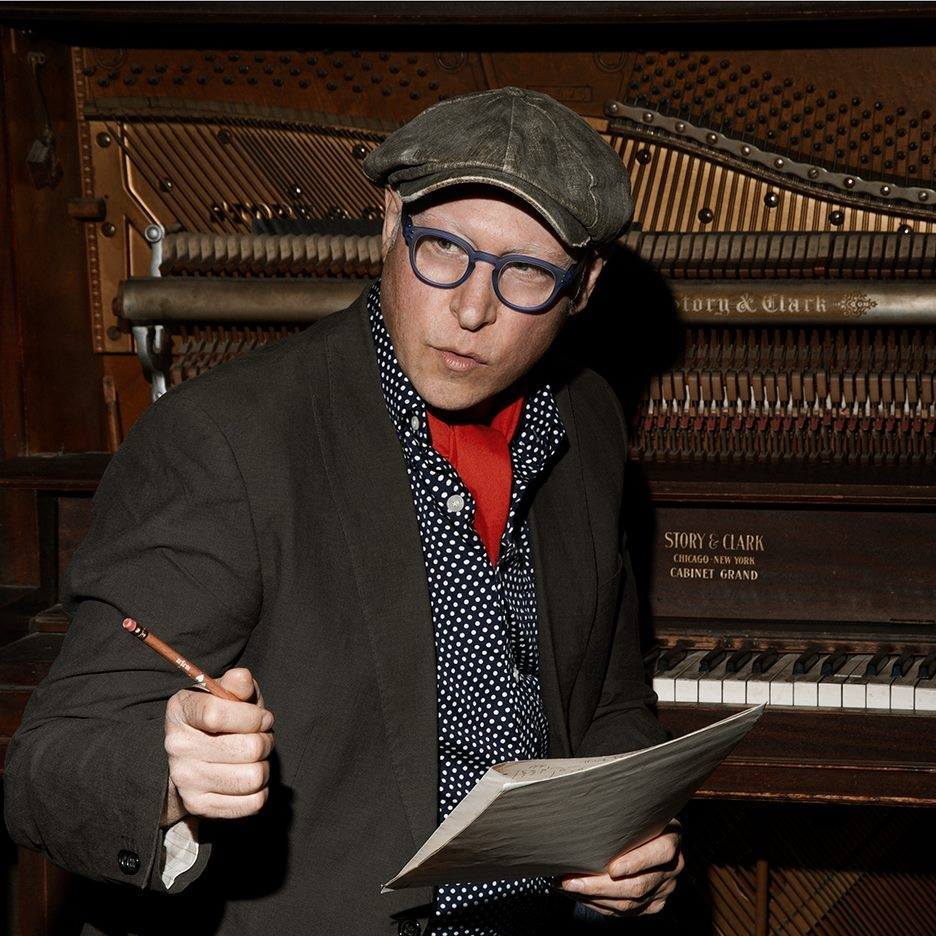
In March of 2020, as the COVID-19 pandemic signaled a period of mandated isolation throughout the world, musicians everywhere pondered what they could do at home with the imposed free time. For Joe Pisapia, the February middle ground between solstice and equinox perennially afforded him angst and opportunity; the rise of the pandemic merely heightened the former Guster songwriter’s daily awareness of both as the dark of winter slowly marched into an uncertain spring. Pisapia was already in the midst of writing and recording his new instrumental album, Imbolc, when the shutdown took hold. Inspired by seasonal changes and Pisapia’s ongoing interest for pairing music with his affinity for cooking--Pisapia’s been filming kitchen recipes to function as the music videos for several of the record’s pieces--the dozen-song set showcases his exceptional compositional instincts while utilizing classical guitar as the centerpiece instrument. Additionally, along with friends such as k.d. Lang, Ryan Miller, Zac Clark, and Jillette Johnson, among others, Pisapia has recorded a standalone single due for release in late January, 2021, “On The Other Side,” anticipating the joy of musicians and fans gathering once again in a post-COVID world.
Is Imbolc an album that you could have made only at this time and during these circumstances?
That’s a great question. There’s always a conspiracy of things that happen- at least, I notice- that make the conditions just right. First off, I notice February is such a slow time for me. Every year there’s nothing on the books and I get really afraid. Sometimes I get this blend of joy and fear; it’s like, I have nothing on the books! Oh, shit, I have nothing on the books. Because of that I get to delve into a creative thing and have nothing interrupt me. It’s a slow, dreary time of year that I secretly love. Also, I just bought a great microphone that I always wanted- a Neumann U67; I got a reissue and fell in love with it. I couldn’t wait to record with it, hearing things in a new way.
With your single, “On the Other Side,” there is a theme of celebrating a future time when we can return to gathering again. It’s a theme that has developed while artists were making their most ardent efforts to feel grateful about having time-off and being apart.
Man, you’re hitting the nail on the head. It’s all about seasons. My instrumental record, even the title, is pointing to a specific part of the cycle of the seasons. I had to look it up: Is there a name for the time between winter solstice and the vernal equinox? Is there something that shows where the middle is? It turns out, yes, and the Celtics had a name for it: Imbolc. It gives us a chance to celebrate that isolation. We really blow out Christmas around here. We have a huge Christmas jam, and Christmas dinner at our house. We do a roving caroling thing with people like Bela Fleck; all these ragamuffins- like 30 people- walking down the street with accordions and banjoes and guitars. After that, after being completely overwhelmed, I love sinking into the downtime.
Something I observed in the optimism of artists having isolated time imposed on them- of how much creative output they thought they could harness in that time- is that as the pandemic went on, the isolation from interaction with others became a hindrance, not just financially but to the spirit of music as a collective experience.
I’ll be honest with you: I was secretly excited during the first part of the pandemic. Uninterrupted creative time? Wow! Great! But everything needs boundaries and limits and balance. After a while [the isolation] really did make you appreciate the other. It’s like that Tom Waits line: Never saw the morning/ ‘Til I stayed up all night. Relativity is everything.
I’m intrigued with your interest in pairing music with food. I’ve often felt the palates are similar, in that, if you like the way something tastes, or sounds, then it’s good. No one can tell you it isn’t.
Duke Ellington said, if it sounds good, it is good. I always loved that one. I always considered myself to be genre-fluid in music. I’m curious about too many types of music; I never wanted to be just a rock musician, or Americana, or a jazz guy. I, selfishly, wanted to try everything at the smorgasbord, you know? I started this idea before the pandemic, and I do have a pretty bad-ass cooking playlist that I was putting together. The flow in the kitchen just feels musical to me. And even thinking about making records- the mix; what to add; what not to add; putting too many things in the soup; too many overdubs on the track- all that stuff is so analogous. Even during my day job as a producer, I can’t help but use food analogies.
If I’m being candid, a lot of instrumental music to me can be too precious or sound great in the New Age crystal shop, but not as great elsewhere. What I really enjoyed about Imbolc was the diversity between and within the songs. Did you consciously set out to write music that avoid that typecasting or did it just organically occur?
Do you know the book The War of Art? A couple of friends told me that I had to read it. The whole idea is that a writer writes. Every day. You go to your office and you write a piece of music every day. I had just finished the book, and I would go into the studio every morning, and I would try not to be editorial with myself. I would let things happen; just go with them. I get two or three that feel part of a unit and I keep going with that. The only thing that ties the music together is the time period in which it was done. There wasn’t any strict theme. The only thing that was a through-line for me was the instrument of the classical guitar.
I would argue that another theme is how melodic the music is; how there are lyrical implications throughout much of it. Consciously, did you think about the pieces lyrically as you composed them?
I never did. That’s what came out. Probably because I think, in my heart, I’m a pop music guy. If I use The Beatles as an archetype, as I get older I go towards McCartney. When I was younger I thought of myself more Lennon. I think I identified with the piss-and-vinegar of Lennon. And now it’s with McCartney, more in a melodic sense. And maybe, it’s something else. Like, as a singer I know that I have a limited skill-set with my voice. As a musician, those melodies can go anywhere I want. I’ve never thought of this but maybe, subconsciously or unconsciously, I was able to explore my fantasies more melodically rather than being limited in range with my voice as the instrument.
I also got a strong sense that what I was hearing was the musical translation of what you were seeing out the window or feeling at a given moment.
One-hundred percent. No to be all hippie-dippy about it; I was feeling the shortness of days. I live in Nashville now and one thing I noticed is that we get the four seasons but it’s different from how I grew up in the Northeast. In January and February down here there’s this pink and purple sky that happens at the gloaming, twilight, pre-dusk hours- that magic hour- that kicks in. I could feel the slow upward climb of daylight. It was full of hope.
Is Imbolc reactionary to or a continuation of your preceding work?
I put out a record in 2018 called Connection. That was the last full LP I came out with. I remember when I was working on it I was really pleased with the lyrical element of it. A lot of it was about the deeper communication that happens when you really connect. My wife and I were doing imago therapy, and we learned so much about language, non-violent communication, and all these different techniques. It was such an inspirational uplift; a deep level of how to connect with other human beings. When you put out something vulnerable that means a lot to you personally, and it doesn’t connect with people, it’s painful; a pain I’ve become used to over the course of my life, for better or worse. So there was something very liberating in creating a record that could be used specifically for background purposes. I would not be hurt if someone doesn’t pick up a nuance. It was liberating not to care how a person hears this stuff. With an instrumental record it’s like, have at it. Let this stuff be in the ether. It was nice to have something like that. It felt healing to the unmet needs of my ego.
I’m always curious about titles of instrumentals; the stories behind them.
Honestly, the titles were the hardest part, and may have held (the release of) the record up by maybe four months or more. (Laughs) I had no idea what to call anything. You have to do that painful thing and listen to your music over and over to see what it’s telling you, even after you’re done working on it and past liking it for pleasure; it’s back to work-mode but in a different way. I’d let the song play in the background and then think about how it made me feel or what I noticed. I thought about experiences in my life, like for “Casarza Ligure” I thought about being in Italy and being totally lost. And how it’s okay to be lost as long as you’re having fun. That song reminded me of that because it was such a shit-show to put together. I love the shambolic way it all sounded in the end; just like the experience in Italy had a beauty and a charm to it as I was trying to find my Airbnb at 11 o’clock at night.
Anything that surprised you that you’ll take from the experience of making this record?
Part of the surprise didn’t occur to me until later: that it felt very effortless to make. I have a ton of instrumental music on hand but it always feels like my private sketchbook. I’m thankful for how quickly and effortlessly it came together. It’s a potential, but it’s also a conspiracy of grace, too. It feels good to be pleased with what you’re doing and to know it’s both effortless and rare.
What about when songwriting for you is difficult? Does that now signal a problem to you, given how satisfied you are with music that came relatively easy to make?
That’s a valid concern. I’m, right now, trying to write a song about the environment without sounding didactic, and that seems like an impossible task. Everything is so weird right now. There’s so much intellectualization, and with that comes curiosity, and feeling unresolved as to the sincerity of the individual putting forth the thought. We’re not prepared for where we’re headed after all this fakery. Where do you find the balance between being sincere, trying to say something important and not coming off as some kind of know-it-all or arbiter? I admire those who can do that with grace and dignity. It’s rare terrain. It’s heroic.





