

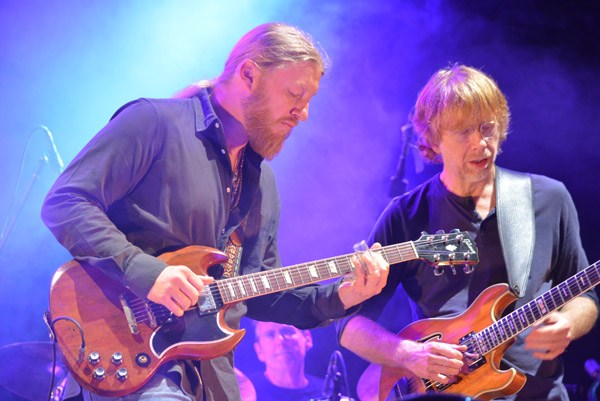
Starting Friday Sept. 27, Tedeschi Trucks Bandwill descend upon New York City for their ninth annual outing at the BeaconTheatre. As per usual, their six-show run was timed perfectly for the shiftingseasons, and while the rock and soul collective find themselves at the end ofwhat they have called a “year of triumph and tragedy” Derek Trucks is in goodspirits as he calls from his home in Jacksonville, Fla. Whether the famedguitarist is looking ahead to TTB’s Beacon shows or looking back on theirhistory-making LOCKN’ set, Trucks gives us a peek behind-the-scenes of one ofAmerica’s hardest working bands.
Thiswill be your ninth run with TTB at The Beacon. For you, how has the Beacon runevolved and developed over that time?
It’s hard to believe—I guess I hadn’t thoughtit was nine years [Laughs]. I mean, the band has evolved so much. There’s beena lot of change in the nine years—some were expected, some weren’t, some thatwill forever change the group.
I feel like the Beacon is the place where wealways re-check in as a band and assess where we are. We dig deep into thematerial, and it makes us look in as a group. I love it—it’s always a challengeto make six nights feel unique, but you never want to sacrifice a night just soit’s different. They all have to reach a certain intensity and a certain level.So it’s always a great challenge for the band, and I feel like we’ve alwaysjust gotten better and better at doing that. We look forward to it now morethan we ever have.
Do youwork harder on Beacon setlists, knowing that there are people who are going tobe seeing consecutive nights?
I think last year we did over a hundred andsomething different tunes over the course of the run. We try to vary it as muchas we can, but there’s some songs you just want to play more than one night.Like, “This is feeling really inspired,” and you just want to dig into it morethan once over the course of the run, or twice. You factor that in, but we keeptrack of all the sets we’ve played in any venue. Whenever we get somewhere,they’re always printed out in the dressing room. And, you look back at what wedid the last Beacon run, the Beacon run before that, and you don’t want torepeat the script at all—you want to keep it moving. The Beacon gives us thechance to dig into tunes that we don’t play that often—songs from our catalogs,songs from Susan’s solo catalog, or my old band, or bands that we’ve playedwith, anything that feels related and legit, we feel pretty open to dig into.
Are youtweaking setlists up until showtime, or are they set in stone at the top of therun?
It’s up until showtime. I have a sketch in myhead, and we’re thinking about things we want to do on certain nights. But it’sa very liquid process [Laughs]. You never know who’s gonna show up on any givennight, or who you’re gonna run into the night before, so there’s guests thatjust pop up and you rethink things that way. And sometimes, mid-show, you’ll beaudibling certain tunes, or even change the course of the whole set, so youhave to go back and rethink things for the next night. That’s kind of thebeauty of it, and the band is quick on their feet, so there’s no problem withthat.
TheBeacon has a huge history with not only Tedeschi Trucks Band, but with theAllman Brothers Band as well. Can you talk to me a bit about the first time yousaw the Allmans there?
I believe the first time I saw them play thereI had just been offered the gig, and Jack Pearson was doing his last run with theAllmans. So it must’ve been 1998. Maybe ’99? But I had heard stories about theAllmans at the Beacon, and they would always talk about how it was as close tothe Fillmore as anything they’d ever felt, that they were gonna set up shop andthat was their new spot. So, I came along when they were already well intotheir Beacon history. They had done an 18 show run, I believe, the year beforeI joined, and they realized that was too much [Laughs]. People went sortacrazy, and shit got weird. So by the time I went, I believe it maxed out attwelve shows, something like that. It was always such a huge part of theiryear, and a huge part of their history.
We would always plan things for the Beacon.Even when you were working up tunes for the summer tour, you were thinking,“Well, we’ll have to save this for the Beacon.” So when [TTB] got theopportunity to start playing there, it seemed like a natural extension, and Ifelt like that spirit kind of needed to keep going there, with a few people inthe family. But we decided not to do it in March, because that was their time[Laughs]. There was something really unique and special about that, and wewanted to make it different, make it our thing. A huge part of the reason we’vestayed at the Beacon is that legacy—it feels like home. We know the union guysthat work there, we know the guys running the elevator backstage—it’s very muchour people at this point.
You’vegot two openers this year, John Moreland, and the Capitol Sun Rays, featuringLuther Dickinson, Amy Helm, Birds of Chicago and Grahame Lesh. Talk to me alittle bit about why you wanted to bring those guys along, and why you chooseto have openers at the Beacon?
A lot of times, we want to hang out with them[Laughs]. I mean, it leads to good sit-ins. I think it’s nice to have two setson certain nights. We like playing one long set, as well. So, the weekdays arefun for that. Some of it is, we really want to hang out with Luther and Amy[Laughs.]
TedeschiTrucks Band’s newest studio output is the Highand Mighty EP, which showcases leftover material from the Signs sessions. How did that come about?
When we’re making records, we always goupstairs to the listening room at the end of sessions. When we get a few weeksinto making an album, we’ll start going up every night and listening toeverything we’ve done. And, we’ll give different people different cracks atsequencing the album and how we think it should go. There’s certain nightswhere you listen to it down and it just seems perfect. A lot of times it’sbecause you cut a tune or move a tune around. I think when we landed on wherethe album finally ended up, we realized that we couldn’t lose all those othertunes—they needed to go somewhere. We play them live; they’re part of ourthing, so it’s good to get them out there.
One ofthe interesting parts of the EP too is that it kicks off “All My Friends,”which was a favorite of Gregg Allman. Do you remember ever playing that tunewith him?
You know, we played it with the AllmanBrothers a few times—the gentleman who wrote that tune, his name is ScottBoyer, from another Capricorn band from Macon, Ga. back in the day calledCowboy, which wrote some beautiful songs. They recorded that originally, but mydad was really good friends with Scott Boyer, and everyone from that earlyAllman Brothers scene. Scott was probably closer with my father. Scott passedaway not too long before we recorded that—so we were thinking about Scott, andwe were thinking about Gregg, who recorded it on his first solo record. Sothat’s what was in the air when we were recording that tune. It was very much atribute to those two, and really everyone else, because the lyrics of that tuneare pretty powerful.
Well,I’ve put it off long enough, I’m going to ask about LOCKN’. Can you take meback to when the idea to recreate Laylaand Other Assorted Love Songs started to germinate?
We were playing at Red Rocks, and I got on thephone with Trey [Anastasio] to talk about what I would play in his set, andwhat he would play with us. At that point, I think Oteil had a set the day wewere playing, and originally it was going to be the Allman Betts band, so Iknew there would be a lot of Allman Brothers tunes played that day. And I waslike, “I want to avoid those, because it’s gonna already be happening.”
I mentioned “Keep On Growing,” or a few of thetunes that we play already, to Trey to see if it would be something that he’dwant to do. He wanted to do a lot of our tunes, but he was really keen on theDominoes stuff. And then I had a friend who was at the show that day, her nameis Julie Mendelson, and she overheard some of the tunes we were going to play,and she was like, “You should just do the whole fuckin’ record” [Laughs], andthat’s when the light bulb went off. And I was like, “Oh yeah, that’s whatPhish and Trey have done, they’ve done whole records.”
I’ve always wanted to play that material—I’veplayed about half of the tunes over the years with either my band, or with Eric[Clapton], or the Allmans, but there’s a bunch of them on there that I justnever learned, never played. It felt like the right time. So when I mentionedit to him, he was gung ho, and that was that.
I was named after that record—my parents namedme after the Derek and the Dominoes record. And then, when we were in New Yorkfor the rehearsals, I was trying to find the history, and the release date cameup, and it was Susan’s birthday [laughs]. The album came out on the day Susanwas born, day and year. So, I thought that was pretty unique. It felt like, “Wemade the right call!” [Laughs].
That’sawesome.
I was named after this thing; she was born onthe day. Pretty good stuff!
Youmentioned rehearsing in New York—what were those rehearsals like?
Maybe three or four days before we got to NewYork we started rehearsing the tunes with our band at soundcheck. Some of themwere starting to feel really good—we didn’t get to all of them. So when we gotto New York and Trey showed up, he did his homework and he was ready. Westarted the record, and the first three or four songs were like, “Well that’sgood.” [Laughs.] “That was really good.” And then we got towards the end, andthere were a few tunes that took a little more work than others.
And you know, I reached out to Doyle Bramhallabout doing it, because I love playing with him so much, and he’s been withEric [Clapton] for years. I knew some of the tunes, he would just be perfect onthem. But he wasn’t there for the New York rehearsals, so we were kind ofimagining what his parts would be. When we finally all got together at LOCKN’,maybe it was the day of, we all got together and rehearsed the whole record. Wewere feeling pretty good about it then, but I think the best versions of a fewof the tunes were onstage that night.
I’mglad you brought up Doyle. He seemed like a perfect addition to the lineup,considering both of you have had served time in Clapton’s band.
Doyle is one of my closest friends andfavorite people, and any chance we get to hang and play, we’re usually in. Butit was pretty last minute. We were game-planning for something else, and whenthat idea to play the whole record finally came up, we just turned [Laughs]. Iwas really happy Doyle was able to make it. He was on tour in Europe, then hewas in Iceland, so he flew in from Iceland to do LOCKN’ and the next day he wasin Sweden, or something.
Oh,wow!
He had his rental car and his hat on, and he rolls in like an “International Man of Mystery.” [Laughs] And that record especially—there’s so many guitars on it. It’s Duane and Eric, but there’s three Eric parts sometimes, and there’s multiple Duane parts, and there’s just so much going on. You can cover it without that many, but it sure is nice when you have enough players up there. And Doyle, Trey, me and Sue, everyone respected each other’s spot, so it was never a train wreck. It was a lot of listening and weaving—it was really great shit that went on; it was a lot of fun. Some of those tunes are so fun to play.
You hadmentioned an original plan before the Laylastuff had come around—can I press a little harder on that? What was theoriginal plan before you did Layla?
It was more of a mirror image of what I didwith his band, with him learning a lot of our material. He was familiar with alot of it, some tunes he wanted to play. So that, with maybe a handful of othertunes, and that was the original idea. We almost had a set list written—butthen when the Layla idea, it was alittle more ambitious. I like the idea of having our band just last minutelearn a record [Laughs]. It felt good.
Whenyou played with Trey’s band, the night before. Were there certain songs that struckyou? Do you find yourself more of a Phish fan or a Trey fan after playing withthem?
I’m certainly more of a fan after playing withthem. I feel like when you learn someone’s material, you learn a lot about theway they go about things—it’s kind of a window into the way someone thinks.There were a few tunes and a few chord changes that were just really beautiful,and a lot of fun to play on. And when we were doing the rehearsals for his set,also in New York, there were just some great moments.
And then, when he asked Sue to step in on afew songs, hearing her sing some of those tunes was really beautiful stuff. Thestuff that was kind of last minute was the acoustic tunes—for me, that was oneof the highlights of the whole thing. There’s something about just breaking itdown to nothing and just hearing a few guitars and a song and a voice. Thosewere really great. Knowing the subject matter about some of the tunes—he hadwritten about his really close friend that he had lost. Hit close to home for meand for us, so it definitely felt like we were walking the same path that time.It was a great experience, and there’s something really wonderful about havingto learn 15 or 20 new tunes in a short amount of time, and then get up and playthem in front of a bunch of people that know the material better than you do[Laughs]. That’s always the thing. I remember early on when I did those PhilLesh gigs—I didn’t grow up listening to the Dead. I’m not familiar with thatmaterial so well. So you’re up there, playing all these parts to people thatjust revere this music, and you have to do your homework. After we did the Layla record rehearsal, the schedule ofthe rehearsal was done, and he was like, “If you wanna hang, we can run throughall these tunes just the two of us, get a head start on tomorrow.” He’s all inwhen he does something—his work ethic is serious [Laughs]. He does not messaround. When he puts his mind to it, it’s on. I really appreciated that energy.The whole rehearsal, the show, it really was a great experience.
Havingplayed back to back with TTB and TAB, what do you see as similarities ordifferences between the two?
There are a lot of similarities. I didn’trealize he had the whole horn section and the singers. And I didn’t realize howlong they’d been together either! So when you hear that rhythm section lockingin—when the drummers and bass players are locked and loaded, that’s when youhave a band. One of the first things that struck me, getting in the rehearsalroom with him, was, “Oh, these guys have been playing together.” [Laughs] Thisis a bona fide band. I always appreciate that—there’s not a lot of that in thisday and age. I feel like anybody willing to keep a band that big together thatlong, I feel like it’s a real emotional investment. It’s a lot ofpersonalities. But yeah, it felt similar.
I think some of it is there’s regionaldifferences in the way people play, and hear, and think. I think that’s thebeauty of the music we get to play. It’s such a melting pot. When I hearsomeone play, you can often tell their background, quickly—you can tell, “Theygrew up playing in the church; they grew up playing in a blues club; they wentto music school for two years, or four years” [Laughs]. I love that. I think ifthere’s any differences in the bands, it’s those things. It’s just wherepeoples’ background is. The focus and the aim is pretty similar.
TedeschiTrucks Band has called 2019 “a year of triumph and tragedy” can you describethat intersection of emotion?
The last handful of years have felt like thatin a lot of ways. But this year, so much more acutely. It’s been an amazingyear for the band, there’s been a lot of great things, but it, in no way,outweighs the whole. Losing Kofi—the band will certainly never be the same. Therewas just a bond and a connection where you know that you’re going to betogether until either one of you is not here, and you just don’t expect that tobe as soon as it was.
I think the LOCKN’ shows felt so great. It wasa triumph. But even leaving, I was thinking, “Fuck, Kofi would’ve reallyenjoyed that!” [Laughs] Or, “I wonder what he would’ve sounded like on this.”Missing him. Just missing him, personally, his presence. For me, that’s theyear. That’s just what it is. But in saying that, we’re so blessed and lucky asindividuals and as a band, as a family—me and Sue—that it’s not self pity, or anyof those things. It’s just missing your friends, but incredibly appreciative ofthe rest of it. We feel so lucky that we ran into Gabe Dixon and Brandon Boonewhen we did, because they were saviors. I know the band wouldn’t be in thestate we are in if we didn’t let them in. They really helped us through anincredibly tough time, and made it feel good to play music, and made it feelokay to play, and made you look forward to it. They’ve been godsends, both ofthem.
Anythingelse in the TTB world we should mention?
We’ve got a busy few years in front of us, sowe’re looking forward to getting back to it. I’m looking forward to gettingback in the studio with these guys and feel out where things go.
Do youhave some studio time set aside?
We have some time off set aside, so we’ll seehow that shakes out. I know there’ll be writing and stuff going on in thestudio—there’s nothing set in stone yet, but we’re dialing it back a little bitnext year. We’ve just been running so hard. We just need some time to take adeep breath and think about things, and then get back in.





