

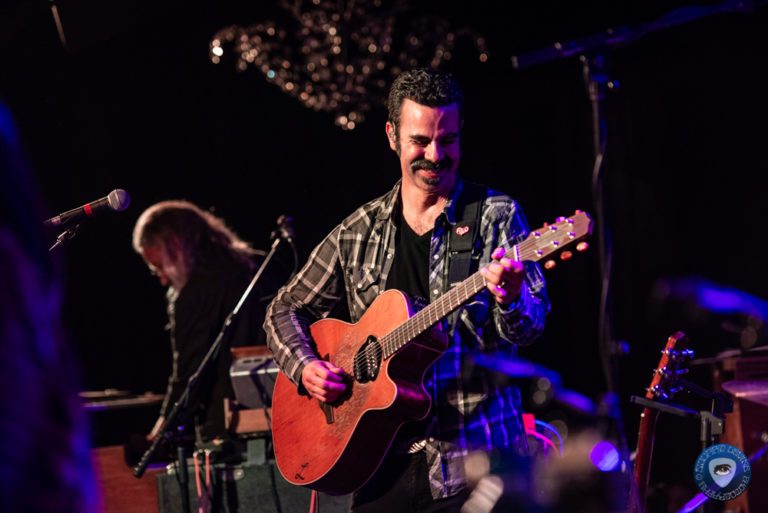
“I’m kind of like a sponge,” Dan “Lebo”Lebowitz says, watching the Miami skyline fade away on Jam Cruise 2020. “I justlove absorbing all the different influences. All the different styles. I feelreally lucky that I’ve been able to meet all these folks and I can call them upand put bands together.”
Indeed, if you scan the guitarist’s recenttouring schedule you will find onstage antics with legends like Phil Lesh, BobWeir and George Porter Jr., as well as all-star networks like the DoobieDecibel System and Leftover Salmon.
And yet, Lebo still maintains a steady spot as one-fourth of ALO, who are in the midst of releasing an EP series and return to the stage on Saturday night at the Warfield, with additional dates to follow over the weeks to follow, including some rare East Coast shows.
Finding a brief moment of rest, Lebo sat downfor a quick Q&A to take stock of his current place in the live musicecosystem.
Youguys released the Creatures Vol. 2 EPin January. Tell me a little bit about this project and why you guys chose anEP route over the standard album cycle?
With ALO especially, we’ve been playingtogether since we were 12 years old. So we’ve been doing this thing a longtime. When we were talking to our label, Brushfire, about ideas and ways to dothings differently, they had some other artists who were doing EPs. They askedus “Oh is that something you would be interested in?” And we were like, “Yeahthat actually sounds fun.” We’ve been just popping into the studio a coupledays at a time and we will go knock it out. It’s been a fun compact way to doit.
We like a lot of different aspects of music.We’re not like a cookie-cutter clear genre. So this has been fun because wehave just been picking a group of four songs that go together. We have plentyof stuff, and we like it all, so it’s like “Oh what four would sit welltogether as a little thing?”
A lotof artists find that taking time away from the stage to go into the studio kindof kills what makes live music great.
It so often does! That also happens whenyou’re like “Oh we’ll finish the tour we’ll take some downtime” That’s oftenthe time when you’re most ready. The most in the flow.
Do youfind that you’re trying to capture the ALO live experience in the studio?
Yeah, definitely, we always are. ALO has twosides to it, though, because we’ve always been a band that worked a lot onsongwriting. That’s always been a big part of the band. Which is interestingbecause people don’t see that because that’s like our private side. So peoplesee the show but there is this whole other thing that is pretty equal for us interms of how we operate.
As yousaid earlier, you and Steve [Adams] and Zach [Gill] have known each other fordecades. Can you put your finger on what makes you so musically compatible?
Those were the first friends I got into musicwith, you know? We were 12 years old so you can’t really replace thatexperience. Maybe if I distilled it down to the smallest thing it's this: We’veexperienced so many key moments of life together. Outside of music and withmusic, a lot of our milestone moments have been together. Like, those guys cameto my Bar Mitzvah. [Laughs.]
Changinggears, you have been playing with Phil Lesh quite a bit as he recovers fromback surgery…
To me it's always an awesome thing when I canplay with him. The Bay Area music scene, I would say right now TerrapinCrossroads is really ground zero for it. Like an incubator. That and SweetwaterMusic Hall. Those two places incubate a lot of music.
Both ofwhich are closely tied to members of the Dead.
Exactly. The thing is Phil has been such a big“on the ground” part of Terrapin because he plays there all the time. I’veplayed a bunch with him over the years. But since his injury, he’s been out ofthe fold for a number of months. When they called [and said he was ready toplay] I was already really psyched.
Originally they were like, “Since it’s hisfirst comeback show it’s just gonna be a single 90-minute set.” Of course, itended up turning into two shows over two days. Two set nights with good meatysets. Phil loves to play so I think he needs to be careful and take it easy ashe is easing in. But on the other side of it, he was just fine.
I feellike he’s turning into the bionic man or something.
It’s kind of crazy right? He is like amachine. Some of these musicians who are in their later years, they do it just‘cause it’s how they make a living. With Phil, that’s just not the case. Heloves music. He is always psyched to explore. He’s always ready to go a littledeeper.
Youalso jam with Bob Weir on a fairly regular basis. Talk to me a little about thedifference between playing with Phil and playing with Bob. Are there differentleadership styles there?
They are definitely different. I don’t knowhow I can describe it in short words because it’s like describing how youinteract with someone.
I will say this, the same goes for Bob interms of music. He’s just all about playing music too. The spirit is alive, andit’s definitely with both those guys. There is no phoning it in. There is no“Okay, I’m gonna show up and clock in.” They both are lifelong committed tomusic and exploring music not just being performers.
Bob andPhil are firmly west coast guys, you’re a west coast guy and ALO is kind of awest coast band. However, you guys are touring back east for the first time ina little while.
We’re gonna hit a bunch of spots we’ve playedbefore: Brooklyn Bowl, Ardmore. Then we will be up in Boston for a couplenights too. It’s great because ALO doesn’t get out east nearly enough. We arevery West Coast, you know? I grew up in the Bay area, went to school in SantaBarbara then moved back to the Bay area. We play so much on the West Coast. Icome out east with other bands throughout the year, but ALO, we don’t get outnearly enough.
Personally, I feel like I grew up on the WestCoast and I feel very west coast in my ways, but both my folks are from UpstateNew York so I grew up with east coast culture. And as I’ve gotten older and goto the East Coast more, I feel a certain comfort there. There is somethingfamiliar about it.
Inaddition to ALO and other collaborations, during things like Jam Cruise youappear as a solo artist-at-large. What makes your solo appearances differentfrom all these other things?
So they are all different sides of what I do,right? I have a bunch of material obviously that I do in ALO, but I also have alot of material that I don’t do in ALO.
ALO is such a collective band. We all put alot of material in there but it’s one band and there’s only so much time for somuch material. When I’m bringing in something for ALO I got those guys in mind,and I bring the stuff that I think would fit them, but there’s other stuff too.Of course, the Dead world is Dead world and that’s awesome and inspiring.
But one of the things that has been fun for meis Lebo and Friends. It’s been a fun opportunity to play with other musiciansand interact with a rotating cast thing. I also have, in the back of my mind,that one of these days I am going to get a more consistent lineup thing going.Because there is a fun depth you can get when you’re playing with the same catsall the time too you know?
Oneother thing I wanted to mention is that you’re an acoustic guitarist in a scenevery dedicated to the electric guitar.
In a way, I actually think of myself as anelectrical guitarist. Like, there are all these types of electric guitars:Telecasters, Stratocasters, Les Pauls. I happen to use an acoustic guitar as myvehicle for it. But it’s very much an electric guitar thing. It’s kind of funit’s got its own sound. You know, it doesn’t sound like a Les Paul or aStratocaster or any of those guitars you know and the other thing that for meat this point it’s sort of like the shortest path from the ideas to realizingthem into the air.
I know a lot of guitar players that switchguitars a lot and I totally get that. But I’m kind of on the other side. I likehaving one instrument and trying to pull off the sounds from that oneinstrument. When I was young I always played electric guitars, but I think Iwas doing a bunch of acoustic gigs and then just out of necessity I was doing alot of shows where we were plugging in and it was getting electrified. Then Ijust never changed guitars and adapted.
Right when I finished college before I startedtouring I apprenticed with a guitar builder, a luthier. I’ll tell ya, I usethat shit every day I’m on the road like, that knowledge from refretting a fewhundred guitars over the course of a couple years.
So ifyou crack a neck you know what to do?
Oh, I do it all myself, yeah. And I think thatis part of the nature of how my guitar became like it is. It’s way differentfrom how it started out. It’s an acoustic guitar, but I put all those pickupsin. I don’t use any of the electronics that came in it. I’m kind of a tinkererin that way. I got a little corner in my garage that’s like a shop, you know?With all the Luthier tools and I’m not afraid to grab a drill out and drillinto my guitar to try something out on it.
Youhave just one guitar, right?
Well, I have one acoustic guitar that I play98% of the time. And I have this other acoustic guitar that is very similar,that I use about one and a half percent of the time. And then a half a percentof the time I’ll pick up a Tele or a Strat, usually in the studio.
Yourmain one has the script L on it?
Yeah.
Is thatlike a Laverne and Shirley thing?
[Laughs.]I’m Lebo, so growing up if someone would write to me they would just write L.So I just kind of adapted.
It’slike Willie Nelson’s Trigger.
I got an acoustic guitar in high school andused that many many years. Then, in 2004, ALO was on a tour and we hit some icegoing from Colorado to Utah, and the van flipped over. My guitar was in a softcase and suddenly a Rhodes piano and a whole bunch of amp cases were on top ofmy guitar and smashed it. So I went out and got another guitar. And that’s thesame one I’ve been using. It looks like it’s from the 1800s because it’s gotthat amount of hours, or probably more hours than a lot of guitars from the1800s have on them, right? Because I use it every day. I perform with it,practice with it.
Does ithave a name? Are you one of those guys?
No, I don’t have a name, it’s just my guitar.
Eversince that experience do you keep it close when you travel?
I always take it with me, and I got a reallygood hardshell case for it. The case is heavier than the guitar.
And every day at the end of the gig I walk outof the venue with my guitar. I go into my hotel room with my guitar and…youknow, there is actually another aspect to that. A tip I learned many, manyyears ago - and I think it’s a really great tip for a musician - is thatguitars in cases don’t get played. When the guitar is out you just grab it. “OhI got a half-hour, let’s play guitar for a half-hour.” I am certain I’ve loggedthousands of extra hours just from that simple thing.
Do youfind you get writing done that way?
Oh tons, writing and playing time. But I thinkit’s like a metaphor for life. Anything you want to do, it's good to just surroundyourself and make it really easy. If someone wants to do yoga, take the yogamat out and put it on the floor. And when you walk by and you see it, maybe youwon’t get like some hour-long marathon session but you’ll probably jump downthere and get some poses in and get some stretches done. Whatever you surroundyourself with is what you are gonna do. If the guitar is in the case andthere’s a TV out there sitting in front of you you’re probably going to watchthe TV [Laughs]. I put the guitar in front of the TV.





