

***
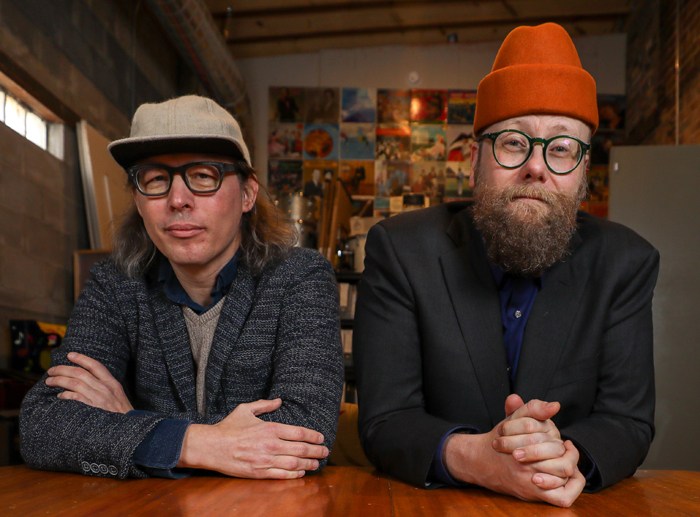
Several years ago, Ghost of Vroom – Mike Doughty and Andrew “Scrap” Livingston – spoke with me about the duo’s debut EP and full-length album when the pandemic placed the music industry on pause. Here we are again, discussing a new Ghost of Vroom release, Ghost of Vroom 3, just as a COVID variant is making its way across society.
Doughty wrote the new album during lockdown. It acted as a means for him to keep busy and not think about the inability to tour and play the music created on their initial two releases as well as an extension of his official Patreon page, where he’s posted at least one completely new track each week since 2015; nearly 300 songs.
On Ghost of Vroom 3 they reunite with producer/collaborator Mario Caldato Jr. (Beastie Boys, Beck, Jack Johnson), for a dozen new tracks that rely on can't miss grooves, sideways hooks, dubby textures, cleverly odd samples, and Doughty’s signature skill with a twist of phrase and memorable art-pop stream-of-consciousness lyrics as exhibited by the singles "Pay The Man," "Still Getting It Done" and "Yesterday in California."
Last year saw Ghost of Vroom perform improvised music residencies in Brooklyn and Los Angeles, creating a completely unique show with each and every set. Besides acting as creative oxygen for the two, the dates also led to Ghost of Vroom enlisting its third member, drummer Madden Klass.
A zoom interview finds Scrap in New York and Doughty in Memphis discussing the new album, improvisation, samples, their creative relationship and the power of vibe.
JPG: How has your collaborative relationship developed over time?
MD: Well, Scrap is the other half of my heartbeat. He's just a great player, a great personality, a great vibe when you're trying to get stuff done in the studio. He's just a full-on partner.
Ghost of Vroom reflects my relationship with Scrap, just enjoying his vibe as an artist and wanting to turn our partnership of -- going on 20 years -- into an actual band.
JPG: It's nice to see another Ghost of Vroom record because, sometimes, projects start. They happen. Then, for whatever reason, they get pushed aside. But, the two of you really seem to be deep into it and want to do it, which brings up the collaborative relationship between you and Mike. He's always writing, always creating. You’re creating too. I remember when we talked last time that you're doing stuff at home as well, but are you getting material from him and that influences what you do or do you send him material?
ASL: I really dig our relationship musically because he comes with pretty well-formulated ideas and then he lets me add stuff all over it, which is really, really what I love to do. I love to add sauce and glue to other people's music, provided it’s someone that I’m close with, and have a close musical relationship with. So, for me, it's great because he kind of does the heavy lifting and writes all these tunes and then I get to vomit ideas. [Laughs.] It’s just really a joy.
JPG: It’s interesting timing that the last time we spoke was 2020 and COVID was happening. Here we are now and COVID has re-emerged, not that it totally went away.
ASL: We’re the harbingers of illness. [Laughs.]
JPG: I like that. That should be an album title or a song title or used in a song. I don't know if it will get that bad again where everything's going to have to slow down or shut down…
MD: I don't even want to think about it. It just ruined my fucking life.
JPG: At least you always have your daily songwriting.
MD: As a matter of fact, this album was really written during lockdown. I had a tremendous spark those first few months of the lockdown, and I was really all cylinders firing for the first few months; getting up every day and working. So, it was really kind of a boon initially until it became a total drag, total life sucker.
JPG: Dealing with that whole situation back then and the issues that surrounded it, you two still seemed to thrive.
ASL: Yes and no. Mike and I both have a real need to make things. Mike certainly does. He is very, very productive. Especially at the beginning of COVID, he went on a writing frenzy, which is great for me. I know he would probably be productive no matter what was happening in the world.
At the same time, I feel like the COVID thing has had more effects than any of us even realize now. It's altered the world in so many ways that we're still wrestling with it, certainly in music.
JPG: I recently interviewed Warren Haynes of Gov’t Mule and, technically, it’s been three years since COVID started and became a part of our everyday conversation but that's when they were recording their album. So, it’s still part of the discussion and we’re still dealing with it.
ASL: Yeah. People don't go to Europe as much or they do Europe differently these days, too.
JPG: Eventually things chilled out enough that you were able to tour and even do your improv performance.
MD: Oh yeah. The improv thing was really what my heart needed. It was exceptionally necessary.
JPG: The improv performances that you did. I watched the one with Vernon Reid of Living Colour, Dan Wilson and Money Mark.
Are you still planning to do more of those in the future or on this upcoming tour?
ASL: Yeah. We did that improv residency in L.A. and then we did it in New York, too. I think on this next tour our opening set, the opening band, will be us improvising. Improvisation is such an integral part of our musical relationship.
JPG: What is it about improv that appeals to you?
ASL: One of the things that both Mike and I love, because we've talked about this a lot, is if you have a tour where you're improvising or a residency or whatever, it just gets better and better. By the time you're two-and-a-half weeks, week three of a tour, if there's an improv set in there, especially if it's first, a couple weeks into the tour, those improvs, everyone's going to feel safe with each other and it can get more experimental because people need to show off less. There's less ego involved. It's like fine wine aging to perfection. Then, we've experienced it a bunch of times where you have an opening set of improvisation. By the time you do the sets where we're playing the tunes, everybody's greased up so well that the music just plays itself.
JPG: I was wondering if the improvs led to material used for Ghost of Vroom songs.
MD: Certainly. There are aesthetic touches that come from the improvs and certainly the band wouldn't be the band without the kind of impetus of the improv. Madden Klass who drums on the album was also the drummer on the Ghost of Vroom improv dates. It was her or Billy Martin did a couple of them, but she did the bulk of them, and it really turned us into a band. A collaboration that intimate, which improvisation is by nature intimate, it’s going to have a beautiful effect on the way a band relates to each other.
ASL: It's all fair game, and Mike is really good at archiving that stuff. He's very good at mining it for parts.
JPG: At the same time, like your previous releases there's the Mario Caldato Jr. effect because Mike brings in his songs then Scrap gets to “vomit ideas” on them, and then, it’s handed over to producer and collaborator Caldato Jr., and he, would you say, mixes it altogether?
ASL: He puts Mario Sauce all over it. He does this magic thing that I don't think every producer can do. There's something about him just being on the project that adds a vibe. Being in his studio with all the instruments he has and all that stuff and the vibe in there that comes on to the record.
JPG: You mentioned the word “vibe.” I watched the documentary on the making of the new album and “vibe” was mentioned several times. Can you elaborate on that?
ASL: You know what? Forgive me for being too metaphorical, but if you go to Italy and eat delicious food there it can't really be reproduced here because those tomatoes are grown in that dirt and that cheese comes from those meadows, and those cows, that grass. And I feel like Mario’s studio -- where it is and how it is -- it's like specific ingredients.
MD: There's more than just the songs and the playing and the singing. There's also this kind of mysterious soupy whatever that creates whatever is special and magical about the recordings and that is the “vibe.” You could use a word like texture or timbre or feel or pocket. The vibe extends to lunch in the studio. It extends to the conversations in the car and the drive to the studio, not just the performances. It's the overall feeling that encompasses the entire project.
ASL: Also, Mike and I are fans [of Mario], which helps me. Every time I’m in that studio, I’m always very grateful to be in there. It's fun.
JPG: It looks like it's a house or his house. It gets you out of that sterile studio environment.
ASL: Some studios feel like purgatory where there's no windows. It's lovely to be in a home. There's light. In between takes we go sit outside and it's cool.
MD: It's Mario's place. So, it really is his Instrument. We brought [Scrap’s] cello, but in terms of the guitars, in terms of the keyboards…I brought my sampler but 90 percent of the instruments on the record are what was in Mario's house. So, we really tried to maximize the use of that Instrument in every way possible.
The other thing is a huge part of the performances on the record is the use of the delays and the echoing voices, the repeating, dubbed-out textures. Mario really was a musician on this record. He wasn't just a guy hitting the record button.
JPG: As far as the songs on the new album. I like the latter half where it gets weirder, artsier and more out there than the first half. I don't know if that was intentional, or the track listing came about that way.
MD: There were some songs we definitely wanted up front but other than that…We do this thing with keys where we never repeat the key of a song. So, putting it together was about figuring out what the structure was in terms of the keys, and it's not something that your average listener is going to be conscious of, but there is definitely a sense of movement if you change the key on every song.
Also, each song has what we call the dreams, which is the long instrumental usually with a little vocal snippet sample in there after each song. That is very much like a misdirection. We'll go from whatever key the song is into an unrelated key or a barely connected key, and then that will flow into the next tune. I guess we were trying to make the second half of the record trippier if that’s what you’re asking, just more of a structural fly by the seat of our pants type of thing.
JPG: Is that something on “3” compared to “1” where you push the singles to the front and things go out there a little more later?
ASL: I think that's an accurate assessment and probably because we did Ghost of Vroom 1 and then we did that EP, Ghost of Vroom 2, which actually came out first. By the time we did Ghost of Vroom 3, we'd known Mario for a few years and there was a comfort level.
I'm also biased in that I think that whatever is current is the best thing that's happened. [Laughs.] So, I feel like the way of working after now that we've done “Ghost of Vroom 3,” it feels like we have our sea legs on how to make something like that in a couple of weeks.
JPG: Mike has a fondness for using a sampler and samples. Obviously, the samples are merged into the tunes themselves but then there's the little sections at the end of the tunes; one example being at the end of “Cold Smoke” with 20 seconds of sonic cacophony.
ASL: One of my favorite features about Ghost of Vroom 3 is we do these songs in between the songs where there's 15 to 30 seconds of music that has nothing to do with the previous song or the next song that I think is a real joy of this project.
MD: It brings the instrumental bit into focus. It's like the dot your optician makes you look at when he tests your eyes. It's a focal point, even if it's not really the most important part of the section.
ASL: We make all those separate from the songs and then it gets decided which ones get tacked on to the end of which songs. Sometimes, a song naturally leads into some weird tale or something.
JPG: Are you sampling rhythms as well or are you sampling vocals and sounds?
MD: It's all it's all sounds basically, vocal snippets. “Still Getting It Done” is built around a sample of a “Sintayehu” by Hailu Mergia & Dahlak Band. Other than that, they're basically played effects. I perform it all live. It's all triggered live.
JPG: Memory-wise, does your sampler fill up to the point that you have to either add memory to it or…?
MD: I use Ableton Live, their sampler interface, and then this shitty little keyboard that I use to trigger it. So, there's plenty of room. It’s not like the old days where you had to fill a zip drive and then constantly be juggling these different zip discs for every song.
JPG: Mike, you contributed to “The Ultimate Gen X Summer Playlist” (https://www.aarparrow.com/inside-dope/the-ultimate-gen-x-summer-playlist). I was really surprised -- even though I do love the song – that you picked The Stone Roses’ “I Wanna Be Adored.” I think of you and the influence of hip-hop, but you went in another direction.
MD: Oh yeah. I love that song. That's definitely…to this day, a repeat listen. My musical tastes are really really wide, and, of course, you sort of end up stereotyped by the music you make. But, I listen to an incredible variety of music.
JPG: So Scrap, what song would you have picked for the playlist?
ASL: Gosh, that's a great question. This might be just because you're asking me on this day, and what I was listening to last night, which is pretty random, I might pick “War Ensemble” by Slayer.
MD: Oh good. Excellent.
JPG: Oh, wow! Okay. That works.
ASL: If you ask me tomorrow, I'll tell you something completely…I might say Duran Duran or something. [Laughs.]
JPG: Were you playing along or just listening?
ASL: Honestly, I was playing along. I try to do a lot of weird stuff to keep my chops in shape. I listen to Bach. I try to play some Bach every day. I try to play some kind of jamband-y stuff every day, if I can. And sometimes, I try to play along with Pantera or Lamb of God. I keep myself guessing too. [Laughs.]
JPG: Besides keeping your chops up, and besides doing Ghost of Vroom stuff are you constantly working or doing gigs?
ASL: I do. I play upright bass in a trio with a piano player and a guitar player, and they're both like 76 years old. We do a monthly gig in a jazz club in Boston. It's really fun and really sweet. They're good people. Then, I do some really weird experimental chamber music with some friends of mine. We’re all composers and performers.





