

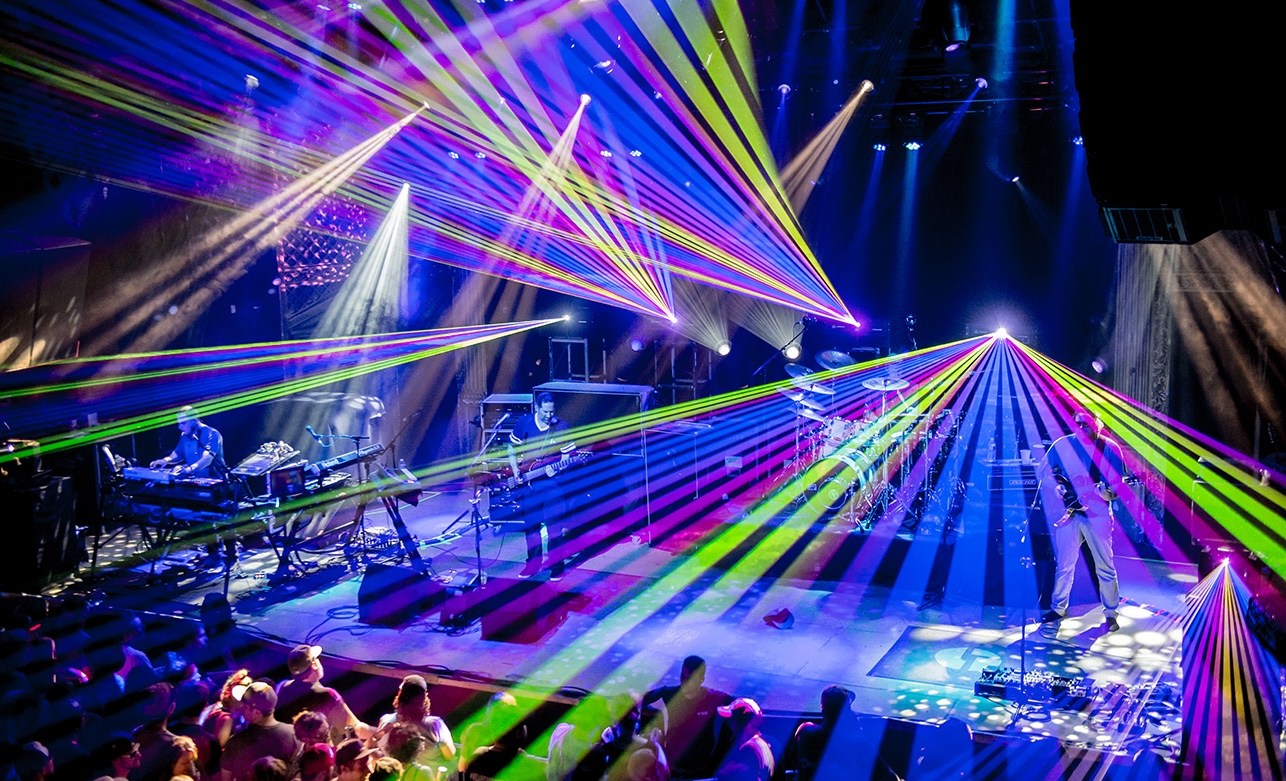
Two years ago, the Disco Biscuits followed the traditional route of writing and recording new songs, debuting them at concert appearances and releasing accompanying videos.
Then, an idea was hatched, and the original plan was scratched.
Instead, the long-running quartet embraced the concept of a space opera with a storyline that featured the four band members – Marc Brownstein, Jon Gutwillig, Aron Magner and Allen Aucoin – saving the world from hard-partying aliens whose ship got lost in the universe.
Originated and developed in part by Barber’s collaborator, Joey Friedman, the band enthusiastically convened to create Revolution in Motion, the Biscuits’ first new studio effort in 13 years.
Brownstein also revealed during a lengthy conversation a week before the band’s album release gig at Webster Hall on March 29, the work on Revolution resulted in a disciplined and productive approach to songwriting. Nearly a dozen new tunes—and counting—have been developed. Some have already been played at Biscuits shows. Many, if not all, will make their public concert debuts in the future.
Besides discussing the group’s space opera, Brownstein dove deep into thoughts on The Beatles, Phish, Grateful Dead, learning the “trick” and much more in our Zoom conversation, which finds him at home, wearing a Dead t-shirt and Phish slippers, on a brief break from playing anywhere on the planet.
JPG: I follow you on twitter (X) and I love this post: “Now all I’m saying is if you let your kid go to SPAC to see the Grateful Dead, there's a very good chance he's going to start experimenting with psychedelics and create a band called the Disco Biscuits.”
MB: Yeah, my most popular tweet of all time. I knew right when I wrote it that it was gonna be the most popular tweet that I ever had. I had written another tweet on the subject earlier in the day and it didn't quite have the…zhoozh of this one. This tweet, I knew that I had worded it perfectly and it was, in fact, well-liked.
JPG: You are home for a bit, about a week. How does it feel to be sleeping in your own bed?
MB: It's great. It feels great. I'm having trouble getting the bottom sheet to stay over the corner of my bed. So, it pops up in the middle of the night. That's one thing that I'm wrestling with right now, but other than that, it's really great being back in my bed.
This weekend will be the first weekend since the beginning of the Disco Biscuits tour that I don't have any shows because I had done the Jam Cruise and the week before that I did a series of DJ shows. So, this is my one weekend off between January and middle of April. I'm looking forward to it. Although, when my kids and wife went to work and school on Monday morning, Monday was my first day that I didn't really have anything to do. That really was my weekend. Monday and Tuesday, when there's nobody in the house and I've got nothing going on, those are the days that I consider the weekend because on the weekend we'll be playing or hanging or doing work or driving, cleaning, cooking…It's like you turn into an everything job. So, I really did enjoy Monday and Tuesday of this week. They were extremely chill days.
Last night, I got to go out and see Damian and Stephen Marley at the Fillmore and it was one of the most enjoyable concerts that I’ve been to in a very, long time. I enjoy pretty much every concert I go to but this one I had chills and tears. It brought me to tears. It was such an incredible show.
JPG: That’s probably one of the frustrating things for someone like yourself that you start off as a music fan and then you start a band. As a music fan, you have to take a back seat to attend live shows because you're so busy. You can't see other artists playing because you're working.
MB: I'm the guy who's wearing [Phish] donut slippers and a Grateful Dead t-shirt right now during this interview. So, I don't think my fandom ever really took a back seat. That's a nice thing for me, the way that I treated music as opposed to a lot of other musicians. I would say it's changed at this point but when my generation of musicians was coming up, there was a taboo about being a Phish fan or publicly being a Phish fan. People wanted to maybe not talk about it or show it or go or listen, and that seems silly to me.
It was my favorite band and I just wanted to be able to go and enjoy it. It was a different experience after we started the Disco Biscuits because I'm going to see the band as a public figure in the jamband world. So, the experience changes a lot because you have spent a lot of time meeting people and talking to people but that's what I always hope that the experience would be before I was in the Disco Biscuits, but I was a little bit shy.
So, I never really went to shows and met a lot of people and talked to a lot of people. The Disco Biscuits was almost like an unlock where the kind of experience that I was hoping to have when I went to see Phish, which was to be very active in the community and know a lot of people and be one of the more friendly faces on lot.
I've been off of tour for two days and we went to Stephen and Damian last night, and we're going to see Eggy on Friday. Some people don't want to go to concerts when they're not at concerts and it’s their job but it's like somebody said to me yesterday. We were talking about me being in a band for 28 years now and then filling every other weekend that I have with other things that are music-related, whether it’s DJing or playing with my son and the guys from Eggy in the Brownstein Family Band or playing with Star Kitchen or the multitude of other acts that I'll end up playing with on Jam Cruise. I went out and did a collaboration with Chali 2na, which was amazing, and we had Adam Deitch and Nikki Glaspie, Marlon Lewis from Star Kitchen and Stanton Moore; four drummers right in a row during this thing. All of those experiences, I don't do it because I have to do it. I do it because I love to do it. I have the best job in the whole entire world.
This what you dream about doing when you're a kid and then I get to do it. So, I try to always look at going and playing shows part of it from the most optimistic standpoint. I love playing shows. Travel’s not always easy. Being away from the family is not always easy. Our kids are older so it's gotten easier than it was when they were younger, but I just love it so much and that comes from being a fan of the music. It all came out of fandom and so I feel like when you're a fan and you look at the musicians and you have a dream to do that, doing it didn't change my fandom at all.
JPG: When you were at that SPAC Grateful Dead concert, were you already playing bass or playing an instrument, or did that give you the inspiration to take something up?
MB: The inspiration came earlier. I was seven years old when John Lennon was assassinated in New York City. I grew up in New York City. So, the people pouring into the streets and the people crying and, on the news, seeing what was going on in Strawberry Fields in Central Park across from the Dakota [where Lennon lived and where he was killed in front of the building]. Seeing how losing a musician like that affected the whole entire world woke me up to music. That's when I was like, “Wow! This guy must have been really something special if everybody's freaking out this much about it.”
So, I started listening to The Beatles. I was like, “Let me check this out.” I got a book that I still have on my piano right here called Beatles Gold, and it was easy piano arrangements for Beatles songs. My parents started getting me classical lessons. I resisted that greatly. Obviously, as a professional musician, anybody who resisted classical as a kid probably regrets it later in life, but we always had a chance to go back, and as adults, we went back and studied it.
The thing that I remember was there was a rock musician around the corner from me named Ricky Tepperberg (aka Ricky T). He's still a keyboard player. He was in the High Times Cannabis Cup Band. He was also in a ska band called the Skadanks when we were in high school. I just saw him and was like, “Man, I just want to play rock music.” That's what I wanted to do.
So, my mom bought me this Beatles book and I started doing that. Then, in second grade music class, I had my first public performance. I played “Eleanor Rigby” on the piano for my second-grade class. My second-grade music teacher ended up being a part of my life all throughout my life. That was the start of it for me—John Lennon, The Beatles and I learned a bunch of those songs. It's like I've never stopped.
Much to my family’s chagrin, I will sit down at the piano and play through all of my Beatles-related songs every day—“Fool on the Hill,” “Imagine,” “Watching the Wheels.” I have a five or six song medley that I’ll rip through and sing along with to practice for tour my vocals. And I practice my piano on these same songs that I was learning nine years old.
That sparked it, and what's funny is my older brothers were both Grateful Dead fans all through my life and that was their thing. They brought me to the Grateful Dead at SPAC. We were not far from SPAC and we were going every concert. The Grateful Dead concert was one of a string of concerts that we hit over the course of three summers—Men at Work to Whitney Houston to Yes and J. Geils Band.
I saw so many amazing shows at SPAC growing up. But the Grateful Dead one, that tipped me off to a culture. I knew that my brothers were fans. They also liked the Allman Brothers, but that show, I was like, “Oh my God! There's a whole culture around this.”
That was in 1987. Then, in 1991, ‘92, I discovered Phish, and for me being like 17 to 20 during that time period, I connected more with Phish. It was smaller. It was a younger culture, more like my culture than the Grateful Dead did at the time.
That's when I became swept away with the bass. I had been playing bass since seventh grade. I moved over from piano to bass in seventh or eighth grade. I had abandoned it in high school, but I didn't necessarily see a path to professional musicianship until I discovered Phish. That's when I was able to clearly visualize what's going to happen in my life. Everything from that moment forth, that was 1993. We went to the first show at Roseland, and then everything from February of 1993 through all of 1994, when the Biscuits started, but not as the Biscuits. The first Biscuits show as the Biscuits was July 4th thereabouts 1995. The whole year-and-a-half before that, we had a series of lineups. Bill Ravenscroft was in the band on guitar, but it wasn't serious enough. Then, Ben Hayflick was on piano, and he didn't want to show up to practice, so we got Magner.
So, little by little the band’s line up formed from ‘94 to ‘95, but it was really for me the visualization of the whole arc that was about to take place from ‘95 to 2005 was solidified when I was in Roseland watching Phish.
All of these things were goals. I didn't know that we'd ever get to Roseland where I saw Phish, but we started the band in 1995 and it was only six years later in 2001 that we were on that very same stage. From the moment where I could see us doing something like this. We knew it couldn't be that exactly because the whole point of Phish was their originality. So, in our heads, it was like, “Alright, let's start the band. Let's find our version of this. Then, go through all of the steps that you have to take from having five fans at your first show to having 3,000 fans at Roseland,” which is the place where it all came together, and we saw that this is a possibility.
JPG: It's interesting that the bands that you’re talking about, the creative line going from The Beatles to the Grateful Dead to Phish finds them taking a number of different influences and create something original. In your case the psychedelic electronic dance jam elements.
MB: For me The Beatles did it but not in an improvisational way. They went out and they studied all this music, and they came back and incorporated everything and turned their music into psychedelic world influencing music.
Who also did that was John Coltrane and so John Coltrane came in the very early ‘60s into this same sound, this Indian modal sound. And when he was doing all the shows at the Village Vanguard that whole series of shows at the Village Vanguard with Jimmy Garrison and McCoy Tyner. That was kind of the spark that birthed the jamband scene.
It's funny because when Miles Davis’ band opened for the Grateful Dead in California, there's a thread there between the kind of modal improvisation that Miles Davis invented with “Milestones” in 1958. And John Coltrane's in that band with him, the classic Miles Davis Quintet with Red Garland and Paul Chambers. That quintet birthed this whole style of music that we play, which is modal jazz essentially. We do modal jazz over techno beats with techno sounds but it's really modal jazz. We'll be sitting in D Dorian or whatever mode we choose to play in, and we're all kind of just jazz improvising in and out of each other.
We took modal jazz and we mixed it with electronic music, to your point. Phish took that and mixed classical music and jazz, actual jazz, back into it.
That's what took me in about Phish was they were based off of classical and jazz, which was my thing, where growing up in Brooklyn and Manhattan I wasn't really exposed to, and actually was averse to country-sounding music. Anything that was pentatonic, based off of country music, like the Grateful Dead were, I had an adverse reaction to it, unfortunately.
I still was going to see the Grateful Dead. I saw 10 or so concerts before Jerry passed away, but it wasn't landing for me the way that it eventually did land in 2014 when they paired us up at the Gathering of the Vibes to play with Bill Kreutzmann and Mickey Hart. Now, that was deep dive time for me. I wish that I had deep dived 10 years before that because I wasn't prepared for that moment because I didn't really know that music well enough to be prepared for it.
I never really played over major pentatonic. I was adverse to it and so I didn't have all of the patterns and fingerings that you needed to be fluid and fluent over those styles. I kind of bungled those first couple of shows with Billy and Mickey. I'm sure they sound great but for me I wasn't comfortable. It opened something up for me where I was like, “Whoa, this music, these songs are unbelievable. This music is incredible.”
That period of time—2014 to 2017—when I played with Bob [Weir] at Brooklyn Bowl for a HeadCount benefit and did shows with Billy and Mickey at the 9:30 Club and we did Red Rocks, I had to get more and more comfortable over that music. Eventually, I started a band with John Kadlecik called the West Philly Fadeaway, and I did four or five shows with Kadlecik and he sat me down after one of them and was like, “Can I show you the trick?” I was like, “Please, show me the trick. I'm struggling here. I'm landing on the wrong note every single time. What am I doing wrong?” And he showed me the trick. There's passing tones in the pentatonic scale that if you use the passing tones you always land in the right spot. It's a five-note scale. If you add two more notes in and make it a seven-note scale, you're always landing on a one or a five like you're landing on a chord tone. So, he was like, “Here’s how you can get to the right note. You just add these two notes in when you're in major pentatonic. Add these two notes in when you're in minor pentatonic.”
That little lesson changed my whole playing style. Everything changed after that point. A lot of people have told me in the last two or three years that they’re impressed with the amount of progression there's been in my bass playing since the pandemic because during the pandemic we had all the time in the world to practice. You can’t practice when you're touring all the time.
But, it was like the Grateful Dead came back into my life, and then through learning it and playing it and talking about it and happening into people who are noticing me struggling through something and they want to show you the way, I was able to take that little lesson and apply it to everything I do in improvisation with the Biscuits. “Okay. These two scales work over everything.” Part of the reason that the Grateful Dead always sounds so great, they've got these two scales that if you're in one or the two of them, it's like, here's the notes and everything works. It's a beautiful free for all.
Anyway, that's the thread from The Beatles and John Lennon dying to the Grateful Dead to deep diving into Phish and then rediscovering the Grateful Dead later and having relationships with them.
JPG: Speaking of playing, your tweets mentioned how excited you've been with the recent tour dates and the band's playing. The idea of a creative resurgence and enthusiasm among the band members, is that due to time away from the Disco Biscuits or years of playing or something else?
MB: Years ago, I was talking with Barber about our lack of touring, and he said, I’m paraphrasing here, I don't really see a point in going out and touring around the whole country with the 130 songs that we've been playing for 26 years. Something like that. The insinuation was, and he said this actually outright, “If we had 30 new songs or 40 new songs and can play full new shows with all new music, I would consider that a good reason to go out and tour the country.”
The reality of going from a band that hasn't really done that kind of writing in 10 to 15 years to one that is doing that kind of writing is tough. So, the spark that set it all off was we were at a drive-in show in New Hampshire and one of our friends, Joey Friedman, who's come on to be a co-writer with us, came backstage. And he was like, “I got this idea for a rock opera. It's more of a space opera where the Disco Biscuits save the world. Basically, there's an alien invasion.” And he's working through this in the trailer after the show.
There'll be an alien invasion. The Biscuits will be in the basement at the PlayStation Theater doing their New Year’s show, and the aliens come into Times Square for New Year’s, and they freeze all of Times Square but because we're underground, we don't get frozen. Then, we come up and become abducted by these aliens and we go up into their ship, where we have our instruments with us because we just came straight from the show, and Aron Magner’s got a keytar.
We end up on this ship and get the chance to perform for them. The aliens he described to us as derelict aliens. They're getting high and they love us. So, a series of events goes by and the Biscuits end up saving the world from this alien invasion.
We all liked the idea. We were like, “This is all very meta. We’ll write a rock opera about ourselves saving the world. What's better than that, right?”
So, Joey, in the middle of the pandemic, started flying into Philadelphia and sitting in a room with Jon, starting the process of writing the lyrics and writing the music. They would sit and work on stuff. Jon would show parts of music that he had. Joey would start with some lyrics. “Another Plan of Attack” was the first song that they were working on, and they started making headway. I was working on Lively at the time, teaching a lot and working on this tech platform. Then, Aron got involved with them, and started to bring these songs to life, and they hired Derek VanScoten—Cloudchord—who's the producer of the album, and they just got into a groove where it was all Jon was doing was getting together with Aron or Joey or both of them and writing.
Over the process of that, I started to get involved with it towards the end of the rock opera. Now, since that project ended, about eight months ago or a year ago, we've moved on to a new set of songs. We have nine new songs. The process has been basically the same but with me in it. So, Joey and me and Aaron and Jon all get together, sit in a room for three or four days. We wrote “Buy the Time” and “Photograph.” lt was just a great day. Two songs that have been carrying sets for the last bunch of months came out.
One day we wrote “Dino Baby.” Then, I left, and later that night they wrote “No Recollection” at midnight. From midnight to 3 a.m., the whole song came out. Some of these songs we’re writing over jams. “Fire Will Exchange” was another one that we wrote in these last couple sessions.
We'll take really great jams with great chord progressions, bring them in, and start writing melodies and lyrics over them. Then, we record the stuff, and it turns into some of the best material that we've had in years.
I don’t know when this is going to go up but Revolution in Motion comes out on March 29th, and we’re doing a show in Webster Hall in New York City to celebrate the release of this album. So, this is the end of a process. But, what ended up happening, to answer your question, is the amount of material that was getting written and the process got dialed in to where we now have a process for pumping great new music out.
Part of it was Joey organizes this stuff. He's like a project manager for us. He'll be putting on these three songs, and we're treating it like a business but a creative business.
When we started out, we knew we had to write songs, but it was on a schedule. It wasn't on a calendar. We just picked up the guitar when we were home and wrote when we could, and it would be finished. Now it's like, “Alright. The 16th to the 24th of this month is writing sessions.” Everybody's going to be in Philadelphia. We get together and every single time we're getting game-changing material for the band right now for me and for everybody else. This is clearly the best batch of songs that we've had since the early 2000s. We had a great batch in 2007, 2008 and 2009; a lot of great music that still is in the rotation. We had a great batch of music in 2019. Jon wrote like 20 songs but they're not all done.
This batch was seen through from inception all the way through recording and release. The songs are developed onstage. We can play through the whole rock opera and none of the songs need work at this point. We put that work in on the road, and that was the reason to go touring because we had 25 new great songs and the best place to develop them is onstage. So, we went out and worked on them. We've gotten it now to the point where the songs are so good and so well-developed with great jams, and everybody knows what they're supposed to be doing and the vocals are good, and the fans love them.
So now we’re at a place where we’re playing 50 per cent or more new music at the show and sprinkling in old songs here and there, and the fans are saying it's our best period of playing, maybe ever. Some people think that's blasphemous but to me it's obvious that this is the best we've ever been because the musicians are the best they've ever been individually, the vocals are the best they’ve ever been, and the songwriting has developed into something really mature and special.
It's about creativity. It’s about consistency. It's about dedication. All four members of the band for the first time in a long time are all on the same page with the same goals with the same mission. It's like when I told you earlier about 1993 and seeing a path. We got to a certain point, but we didn't see the next stage. We didn’t know how we're gonna get to that next stage but right now we're where we were when we were growing in the beginning, and we have now a clear vision of where we want to go and how we want to get there again.
JPG: I interviewed Jon in 2022 just before City Bisco. When we discussed the lack of touring at a certain point his enthusiasm for being in a band and doing music was not there as much as it was previously. As he put it, other technologies were interesting to him. At that time the band was starting to release new material—“Lake Shore Drive,” “Evolve” and “M1.” At the time it was announced that there was going to be a new Disco Biscuits album at the end of 2022. That didn't happen. So, what happened?
MB: There's a couple of layers to this question. For one, it took us longer than we thought it was going to tell the whole story. It ended up being 14 songs. We thought we were going to write like an eight, nine song record, and put it out but when we got through it and developed the story out, it was 14 songs; some of the songs taking longer than others to complete. They were bigger and more complicated songs.
The second thing was, we started releasing the first six songs. Everything that's already out—
“Another Plan of Attack, “Shocked!”—the first six from the space opera were coming out, and we didn't see the plan for how the full release was going to come out. The plan that we have now, where we’re at three videos out of four, releasing the story in four parts. They were just releasing singles, and we didn't see a plan.
So, we paused. We changed management in the middle of this process last April 1st of 2023 when we were a couple months past where we were expected to release the album. We were on pause for four months. We hadn't done any releases, and we were looking for new management and we hired our current managers at that point, and they're the best managers in the game. The first thing that they said was, “We're going to release this album when it makes sense to release it based off of coming up with a plan to roll it out in a more sensible way than what's been going on.”
That's where we came up with the idea of four parts with four dedicated videos that would tell the story [of Revolution in Motion] that all release leading up to an album release show that would be super-hyped and sold out. We had to find the perfect venue and date for that.
Ultimately, it took about a year—April 1st to March 29th—from their first day as our managers to develop the plan, get the songs finished and mixed because they weren't even all done at that point, figure out how we were going to get everything mixed and then come up with this plan and release it.
In the end it proved to be a more complicated process than we were giving it credit for because back in the day, we would just go in the studio record nine songs, have them get mixed over a three-week period, make some art and put the album out. But, there’s a story here and they wanted that to not get lost in the shuffle of releasing singles.
The single releases went well. Don't get me wrong. We were on major playlists with hundreds of thousands of monthly viewers. Our last managers, Spotify is what they do well, but the storytelling wasn't necessarily at the forefront of the process.
The good thing is this album's coming out next week and we're already nine to 12 songs, somewhere in that range, into our next album. The songs are all written. The demos are all made. The songs are being worked on in live shows at this point. Those songs are all going to get released next.
“Dino Baby,” it's the best new song we've had in 25 years. It's unbelievable. It's so infectious and melodic and hard and in your face. It's just so fucking great. I love it so much. I can't wait to get back out on tour because of the new songs.
That's what I'm looking forward to playing. “Fire Will Exchange,” we've only played it six times. We played “I-Man” and “Morph [Dusseldorf]” 250 times each. These new songs have a whole life ahead of them. Dozens to hundreds of versions of these songs can be played over the next decade-and-a-half or two decades or however long this band ends up going. The most recent correspondence that came in from Jon was, “It's been three months since we've added a new song into the repertoire, and we have all these other new songs. When are we going to get together, practice these and get them in?”
The wheel continues to turn. The process continues to roll. Hopefully, there'll be a time, I know there’s gonna be a time next Friday where we play a full show and not play a song from the old Biscuits. It was written. That's happened. At a regular show we're not far from being able to play a full set of music that was all 2019 and beyond and have them be great, and not have people complain that it's all new music.
I'm so used to the jamband world bands coming out with new music and the fans being like, “We just want the classics.” I mean, how many different cycles does that happen with Phish? The music catches on…some of it ends up being great—Sigma Oasis, the whole album, is so great, their last album. We've gone through ourselves a couple of iterations of, “Here's a batch of new songs,” and the fans just shit on it and never give it a chance to develop.
We're now past that. We're at the point where we don't listen to that. We have our system. We’ve got a new song. We play it every other day for a couple of weeks. It'll eventually fall into normal rotation. By the time it does, we've gotten through the part where we know nobody wants to hear a new song every other day. It’s the only way to make it stick. It's the only way to make a song good enough to have it grow into a set closer or an encore or second song of the second set position. “The Deal” has been in the second song of the second set position for the last four or five months. We started moving it around recently. That’s the slot. That’s the meat of the show. The beginning of the second set, first two songs, have got to be the best part of the show to me. That's how I look at building a show. Peak like it's like a bell curve that peaks in that middle part of the show—the end of the first set into the first half of the second set. And we have our new songs now and our fans are not complaining about them.
JPG: Maybe it's my personality, I’m always excited by something new whereas I think of the classic rock band mentality where musicians are stuck in that box and only get to perform the hits.They're still touring behind them but I'm sure creatively they wish they could come up with something else.
MB: Here’s the difference. We don't have any hits and neither does Phish. Neither did the Dead until “Touch of Grey,” 20-something years into their career.
When you don't have hits, you have the creative drive to try to get hits. [Laughs.] You never stop wanting to create new music because “Hey, maybe one of these will become the hit!” and with the Grateful Dead, it did. With us, I think it's going to happen. I really do think one of these songs, with the improved vocals of the band over the next few years, has a chance of breaking into having some mainstream success. “Fire Will Exchange” is extremely poppy sounding but it's also deep and intelligent and emotional. It connects with our fans, and I think it's going to connect with people who hear it for the first time that aren't our fans. It's probably not that but it could be something, and that keeps you motivated.
JPG: There are a few tracks on Revolution in Motion—“Shocked!, “Freeze” and others—that work in that way as far as mainstream potential.
MB: We call them jamband hits. We have a ton of jamband hits. We got 50 songs that they’re hits in our scene: everybody's favorite songs. Just because they never broke into commercial success doesn't mean that they haven’t been commercially successful for us. They certainly have driven the whole economy of the whole entire band.
JPG: Those songs could go beyond the jambands scene.
MB: And I think that they can, too. Sometimes, they take time. Sometimes, the song comes out and three years later, like “Touch of Grey” was around for six years before it became a hit. It was later on, but they were playing it. When you're a band that had hits 20 years ago and you haven't had a hit since, you fall into the mentality of, “This is what we do. This is what people want to hear.” But you know what? Paul McCartney never stopped making new songs. He was like, “I'm going to continue to write.” There's some legacy bands that have stuck to being creative. David Bowie released an album right before he passed away. “Blackstar.” He was committed to putting out new material right until the end. Billy Joel just put out his first song in years. It's a good song! I can see it being a hit.
JPG: Back to Revolution in Motion, in reference to the videos, how does it feel to have yourself animated?
MB: It's encouraging me to take 15 to 20 pounds off because they made a slightly more svelte version of me than what exists in real life. I see it and I go, “I'm gonna hit the gym today.” [Laughs.]
It's really funny. It's great. I have no idea how it's been received. I am in a really good place in my life where I don't go seek out opinions of other people on the stuff that we're doing. After a great show I can't avoid people telling me on my personal accounts how great the show was. I hear a lot of that, but I don't go to Phantasy Tour or any other places where fans are being fans discussing fan stuff. I don't know how people think about animated Disco Biscuits but I'll tell you what, I love it! It's awesome and they're doing such a great job without a ton of conversation in the videos telling the story, getting through the story. It's a testament, really, to Joey's ability to convey to an artistic team what his vision for this story is and it really is about Jon and Joey's vision for how the story gets told.
JPG: I watched the videos that presented the story and the new songs. When will the fourth video installment be released?
MB: I think it comes out on the day of the [album release] show. There's three more songs— “Once Chance to Save the World,” “Why We Dance” and “To Be Continued...” Three of my favorite songs from the whole record. The whole album drops with those three songs, and then Part Four video will come out on that day as well. These all come out on Fridays. The 29th! It's our Chinese Democracy.
JPG: Well, it has been 13 years in the making since your last studio effort.
MB: We started talking about an album in 2019 because in late 2019 we started doing bundles for the album. There's people out there who bought this album four years ago, and they're about to get it this week. So, that's great. It really was a three-year and four-month process from when we started talking about putting this album out. We thought we were making the album when we were doing “Lake Shore Drive” and “Evolve” and “M1.” We thought, “Here's the first three songs from the album!”
Then, the rock opera came up to fruition and that became the album. So, those three songs, they may be on the next album. We have two albums to release right now. The question is how and when on that next one. I'll tell you one thing. It's not going to take four years.
JPG: Speaking of years. I did the math and since The Disco Biscuits officially started in 1995, next year will be your 30th anniversary. Is there any talk of what you may do to celebrate that?
MB: We don't do anniversaries. We decided before our 20th anniversary that we're not a celebrate how long we've been a band kind of band. We'll let the fans celebrate it. I'm happy for the fans to do a 30th…Hopefully, it'll be Biscoland, which is July 4th this year. Hopefully, it’ll be Biscoland in 2025, the same week and that will be our 30th celebration. Maybe our new managers will make us do it. Who knows what's gonna happen? But, as a band, the four of us, when we were unmanaged, we're like, “Let's not do that.” At this point, it is what it is. We've been a band for a really long time. I feel like the band looks pretty fucking good for four guys that have been in a band for 30 years.
We feel pretty fucking young for four guys that have been in a band for 30 years, too. Look at the bands above us. That's inspiring. Phil [Lesh] is 84, and he's still flying out and doing multiple shows at the Cap. We have arguably more time ahead of us than we have behind us.





