

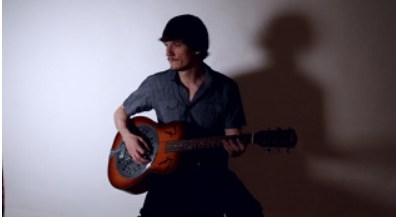
Perhaps best known as the drummer for the North Mississippi Allstars, a band he founded with his brother Luther over two decades ago, Cody Dickinson is also a multi-instrumentalist, singer, songwriter, and producer set to release his new solo album, Checkerboard Lounge. He’ll follow that with a series of Cody Dickinson and Friends shows, March 13-20, in the southern U.S., uniting with Todd Nance (Widespread Panic), Jon Mills (Bloodkin), and Kody Harrell. Dickinson explains that the new album, his second solo record, "is named after my home studio that I built early last year. I played all the instruments, except for a few featured musicians, and did all the production and mixing." The enthusiasm and anticipation in Dickinson’s voice virtually reaches through the phone and grabs hold in the same fashion as his electrifying blues as he discusses his new album, the thrill of performing live, and the continuing influence of his late father and famed musician/producer Jim Dickinson, Phil Lesh, and the late Col. Bruce Hampton. I’m going to guess the name of your studio is a reference to the Chicago blues club where the Rolling Stones played with Muddy Waters. It’s not. We painted my studio black and red. We joke about it being a checkerboard lounge. So you didn’t know about the blues club and the Stones connection? No, but that’s so cool. That’s perfect. What a beautiful, serendipitous connection. Guitarist Eric Schenkman from Spin Doctors is one of those featured guests on Checkerboard Lounge and is on the first track you released from the album, “Bumping My Head.” Eric just rips up the solo on that. I think he did it in one take, two takes tops. “Bumping My Head” was inspired by Karl Denson. I was watching Karl play with the Tiny Universe and I was saying, ‘He’s in the Rolling Stones!’ It doesn’t get any higher than that. He hit the ceiling. He’s bumping his head. So, that song is basically about good times and success. There’s a lot of depth to these songs. The rest of the record is really about love. I’ve sort of avoided, my whole career, writing songs about relationships. For whatever reason, I decided to take it head-on. It’s a very personal record. A lot of the lyrics deal with the trials and tribulations of falling in love, and then the beautiful payoff; the happiness that makes it all worth it. Music is such a powerful communicator. Hopefully some of these songs will resonate with people and they can enjoy listening to them as much as I enjoyed making them. You’re going to support the record with a string of shows? We’re going to hit the road, and I’m super excited about it. I get to premiere all these new songs, these 10 originals from the record. Also, Todd has these awesome songs. It’ll be a mashup of North Mississippi hill country boogie with that Athens, Georgia, song-oriented music. With Todd there, I’m guessing you will be playing a lot of guitar. Mostly guitar and singing. Some piano. I’m also setting up a double drum kit so Todd and I will do some double drumming. And, of course, the electric washboard. Your Cody Dickinson and Friends show are in between runs with the North Mississippi Allstars. Where are the Allstars at right now in terms of an artistic trajectory? The Allstars have been going strong for over 20 years now. The beautiful thing about blues music is its longevity; the older you get, the more seasoned it becomes; the more the music makes sense. The Allstars are just now learning how to play with dynamics. We can take a big rock show and break it down to a heartbeat; where you can hear a pin drop, like (what) Buddy Guy (does), at the drop of a hat. That’s something you learn with age. I feel like even though we’ve been making records for a long time we’re really hitting our stride now. Why now? The older we get, the more interesting the music becomes. We’re telling a story. It was exciting when we were new. But, that freshness wears off even though those times were amazing. I know there will never be another Bonnaroo one, or the first time we went to Europe and played Glastonbury, or whatever. Those times have come and gone. We’re in a new world now. It’s a world around us that has changed so much. There is a culture behind what we do. I feel like there needs to be preservation, along with the celebration, of this music. Did playing with your brother ever hinder getting to this point or did it give you a head start? Absolutely, it’s a head start. As my brother from another mother, Oteil (Burbridge) said, ‘That brother thing is once in a lifetime.’ There’s nothing like it. The musical dynamic, the communication is immediate. When you’re playing music, it’s incredible and definitely an advantage. It’s a clear channel. When instinct kicks in amazing things happen. Luther and I have very different tastes, but very similar instincts. We have been playing music apart, and there’s definitely something to be said for working separately. When we get back together with the Allstars we bring new things to the table. The Allstars are like a bicycle: we just pick up where we left off. Any sibling rivalry? Yes, of course. Anybody that has a sibling knows that dynamic. You know each other so well. It’s easy to push each other’s buttons; to have a short fuse because you don’t have to maintain that common courtesy that you would with a stranger. You have your own shorthand. We’re adults now. We’re matured. And, we’re business partners as much as anything else. So now that shorthand is a strength. That being said, 99% of the disagreements we have had over the years have been about music because we are both so passionate about it. The bass spot in the Allstars has been the one that has been in flux. Is it hard for a bassist to get in there when your connection with your brother is so strong? And how has Carl Dufresne done with that task? Sure it is, and that’s a very observant question. You can probably see that onstage. You can watch us perform and pick up on that dynamic: that Carl has to get in there; get between us. That’s no easy task, that’s for sure. We’re into our second year with Carl after a bit of a rotating thing with players coming in and out. Carl’s played every gig with us for over a year now. He’s locked in now and it’s been great. What’s made him great? Carl’s a psychedelic warrior. The Bayou Buddha. The Allstars really like to stretch out. We improvise a lot. Carl really knows how to listen and improvise. I remember first seeing Carl with you as part of North Mississippi Osborne. He was with Anders Osborne at the time, and you did a marathon show at the Troubadour, with Paul Barrere (Little Feat) and Duane Betts sitting in. That was some serious jamming. Anders is a force of nature. Great dude. Awesome friend. Incredible songwriter. NMO was badass. We need to get that going again, too. I miss it. Duane’s been a frequent collaborator onstage with the Allstars, including at your most recent show in Los Angeles last month at the Roxy, and guesting on the upcoming Allstars album. Duane is one of my brothers, man. I’m so proud of Duane. He is just playing better than ever. And you and Luther played with him and Devon Allman at the annual Allman Family Revival at the Fillmore last December. For me, it’s so musically gratifying playing that music with Duane, Devon, and Berry (Oakley). It’s just crazy. That music is sacred. What an honor to be asked to do that. Are there people that you keep in your head each day, like guideposts, as you develop as an artist? My dad’s words, his teachings, ring true in my ears. Every time I get together with my brother to play music I think of him. It really feels good to keep his vision alive. He’s still producing us to this day. I’ve talked to Devon, and he’ll say, ‘Man, I miss my dad.’ The truth is it’s really painful, and with loved ones, that kind of never goes away. In fact, sometimes it gets worse. Music brings us together. It’s such a cathartic experience. It’s also a way, I believe, to bridge the gap between the existential world and the transcendental. Anybody else? I think about Phil Lesh a lot. Playing drums with Phil has been incredible, and getting to play in Phil and Friends is such a learning experience. As a drummer, he teaches me so much. So every time I get to play with Phil I’m just all eyes and ears, paying attention and learning. The soundchecks are epic. That’s when we run through the set. He keeps a rotating wheel of musicians, and I think a big part of (doing) that is because he wants to pass the music on. Do you remember being receptive to your dad’s influence or did you rebel against it when you were growing up? That’s a great question. It was both. I was very receptive, definitely soaking things up through osmosis. As the youngest, sometimes I felt a little in the dark. I didn’t know what was going on a lot of times. Sometimes I was exposed to things before I knew what they were- incredible artists or music that later on I would become fans of- like Ry Cooder or Jim Keltner. As a kid it’s hard to process that. I was also rebellious. I had that teenage thing of wanting to forge my own path. I certainly found ways to offend my dad, too, both personally and musically. It was a really exciting, volatile combination of both. I’m guessing that’s one of the great benefits that you as a player and the Allstars as a band took away from being exposed to so much at a young age: that you fit in with all different types of players, or at any number of festivals, whether it’s blues, folk, Americana, roots, jamband. Is there an audience you have found to be most receptive to what you do? I feel like I’m pandering to your audience here, but I love jamband festivals. The jam world- you have bluegrass, blues, rock-and-roll- it’s all different genres fitting under one umbrella. And the one common denominator has been that (those artists in the jamband scene) are all players. And, the audience is sophisticated. I’ve been getting ready for this tour with Todd Nance and I have been learning some Widespread Panic songs. That’s complicated music, bro. There’s a lot going on. The audience reacts to improvisation. They want to see you bring the heat. I like that. Can you prepare for improvisation or is the whole point that you can’t prepare? It’s the 10,000 hours rule of mastery; the Malcolm Gladwell thing. You can’t fake the funk. You have to put in the hours. The way you prepare for the big stage at a festival is by playing night after night in the clubs all year. All the rehearsing in the world can’t prepare you for the moment. Playing interesting improvisational music is all about creating moments. I would imagine, especially at festivals, there are people seeing you for the first time. Do you like the idea of every show being a chance to surprise someone? Absolutely. I love that. Every chance to play music is a blessing and a gift. All the time I talk with people who are seeing us for the first time, and that’s very exciting and very encouraging. Play every note like it’s your last. Sadly, that reminds me of Col. Bruce Hampton, who passed away doing just that. Col. Bruce was another person I would name as someone that sticks with me. Picking up the magic and the mojo of Col. Bruce- it sticks to you. We all learned so much from the Colonel. He’s still producing us. You’ve always had, in my opinion, an open mind when it comes to playing music, both your own and with others. Do you have a ‘big picture’ plan about all of this or do you leave it open to possibility? I love playing music. My bread-and-butter is playing gigs. As long as I can continue making a living doing what I love, then every day is a blessing and I’m thankful. With gratitude comes responsibility. I do my best to walk the path; to live a meaningful life that will hopefully inform and influence my music and my writing. The short answer is that being an artist is so gratifying but also so terrifying. Finding new ways to express myself is a constant challenge. For me it’s always about growing, in my craft and as a person.






Subscribe to skip adsAdvertisement