

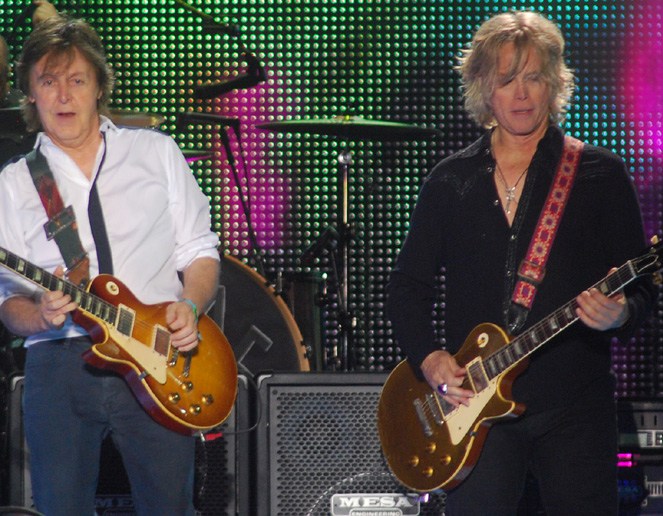
In 1973, Brian Ray was an 18-year old guitarist and singer from Southern California- a newly-minted high school graduate- when he was introduced to the R&B legend, Etta James. Ray would serve as James’ guitarist and musical director for a decade-and-a-half during a career resurgence for the iconic singer that included touring as a support artist for The Rolling Stones. A successful songwriting career and roving tour appearances in France bridged the time between his duties with James and an opportunity in 2002 for Ray to perform with Paul McCartney at the Super Bowl. That one-off gig became the first of hundreds over the next 17 years as the guitarist, bassist, and singer in the former Beatle’s touring band. When not performing McCartney’s immense catalog of songs, classic and current, Ray maintains a steady solo output, issuing albums and singles most often heard on Little Steven Van Zandt’s SiriusXM outlet, Underground Garage. Ray spoke to us from his home in Los Angeles shortly after completing his latest tour with Sir Paul.
In July you wrappedup Paul McCartney’s Freshen Up tour with a show at Dodger Stadium in LosAngeles. Do you know what’s coming nextwith Paul?
If I did know I wouldn’t be able to tell you. But I can tell you right now it’s safe to saywe’re in a holding pattern. Paul has abook he just finished, Hey Grandude,and he’s doing a book tour. It’sprobably a great palate cleanser for him because we’ve been hitting it so hardfor so long.
Yes, this February it’llbe 18 years that this same group of musicians has been touring with PaulMcCartney. That’s longer than TheBeatles or any of the Wings bands were together. What do you suspect is the reason this sameband has stayed together?
I guess he just ran out of phone numbers. (Laughs) I guess it says that Paul has made choices that work for him and thatsays a lot about his bandleader management skills. It’s also about trust, and we’ve gained andearned the trust he places in us. Soafter 18 years we’re the guys he calls. Paul McCartney could call anybody and he calls us. We’re very, very honored. It’s great to have his trust.
Before McCartney, youspent a long time with another music icon, Etta James. How do you compare that experience?
I was with Etta for 15 years, and then off-and-on foranother few decades of touching base; writing; producing; doing filmmusic. She even appeared on my firstsolo album, Mondo Magneto, on a songcalled “Soft Machine,” back in 2005. Forme, those are the two most significant artists I’ve worked with. With Etta I was a newbie, a little skinnyblond kid from Glendale, and she took me under her wing. She trusted me in the same way Paul trustsme. We formed a bond that was singular. In a way, she was like a second mother tome. I went through some formative yearswith her. I was 18 when I met her sothat was my college. I went to thecollege of Etta James. We went fromplaying in a cinder-block chitlin’ circuit bar in Colorado Springs to openingfor the Rolling Stones in a matter of four years.
Was it a good time inEtta’s career to be working with her?
She was gaining steam with promoters again after having losttheir trust as a result of being a heroin addict. It’s well-known. I’m not breaking any codes here. My relationship with Etta was long andlovely, tumultuous and exciting, maddening and very, very colorful.
Every night with Paulyou are playing so many songs that are basically in the bloodstream of millionsof people. I would imagine it was alittle bit like that playing “At Last” with Etta every show, where an audienceexpects to hear it done in that classic way.
Funny enough, we didn’t start playing that song until I’dbeen in the band about two years. We didmore blues and rockin’ numbers and some covers. When she gained traction, she went over her set and decided it was timeto start honoring her own legacy in the form of songs she’d madeindelible. When we started playing it,it was part of a medley, with a little piano intro to it, but it didn’t payattention to the lovely, interesting string lines that open the record. Other than that, it was always going to be inthat tempo, done that way. Performing itlive, she took more liberties, being in the moment. But, wow, that song! There’s a reason why it’s played at moreweddings than any other song. It’s sucha great, great romantic track.
Are there songs youhaven’t done but would like to with McCartney?
Plenty. I’d love todo “Back Seat of My Car.” I’d love to do“Junk.” I think that’s a lovelymelody. I’d like to do “I Want to HoldYour Hand,” which, for an American kid, is pretty much the one that busted TheBeatles open. I would love to open a showsometime with that. That’d be fun.
Being on the otherside, the inside, of the McCartney-Beatle experience, do you understand itdifferently than you did when you were growing up as a fan?
I didn’t understand it any differently than I alwayshave. If you have one word to describeit, it’s phenomena. And the reasons are many. First, they were damn good. The songs were unbelievable. They were perfect. The voices were convincing. The performances on the instruments were alsofull of conviction. They were on it;ready to go. The Beatles were not thereto mess around.
Before this, what wasyour experience as a bassist?
Most guitar players play a lot of bass. Playing bass was something I did a lot athome, on my recordings, on demos. ButI’d never played bass in a band.
And now you play bassin front of tens of thousands in McCartney’s band when he’s playing guitar orkeyboards. How does that happen?
The opportunity to play with Paul was really the result ofmy friendship with (McCartney’s drummer) Abe Laboriel, Jr., with whom I’dtoured all around France in the ‘90s. Shortly after Paul hired Abe to play on his Driving Rain album I happened to be at a party with Abe. I said, ‘Who’s going to play bass when Paulplays guitar or piano?’ He said theywere looking for a guitar player who plays a bit of bass. I put my right hand up and said, ‘I’d love ashot at that.’ He said he’d see what hecould do. He told David Kahn, Paul’sproducer, pretty quickly thereafter that I would be up for it.
That’s how you gothired?
Two weeks later I got a call from David Kahn. He asked me about coming in for a meet-up inreference to playing one song at the pre-game show for the Super Bowl in 2002and would I be up for that? I said,Hell, yeah. The next day I met David athis office and we talked a bit. I playeda little guitar, talked a bit, played a little bass, talked a bit. At the end he said he had a good feelingabout it, and though he couldn’t promise anything, he’d put my nameforward. The next morning I got a callfrom Paul’s office asking if I could be on a plane tomorrow. So, it was a call on a Monday night, ameeting on Tuesday, a call on a Wednesday, rehearsal on Thursday; just likethat.
So the audition wasthe meeting in Kahn’s office?
The audition was that 2002 Super Bowl in New Orleans. After (the appearance) we were in our boxseats at the Super Bowl and Paul introduced me to Wynonna Judd by saying [theperformance] was my audition, and we laughed; a nice, little intimate affairwith 70,000 people and five billion watching at home.
Did you feel you hadpassed the audition?
I thought that was it and we’d go our separate ways. We went to the hotel bar for a drink afterthe game. After talking at the bar, Paulgave us all a goodnight hug, and then he said, ‘Brian, stick with Abe and Rusty(Anderson, guitarist). They’ll show youthe ropes. See you in five weeks.’ It wasn’t until then that I thought I was inbetter shape, but I still didn’t really buy it.
So what did youdo? You had to assume you were going tobe in the band on tour.
I went home and woodshedded; grew out my whiskers and workedaway at it. I had a stack of CDs- nosetlist- and I had a guitar, a bass, an acoustic, and a mic stand. For five weeks I stood there learning as manyBeatles’ songs, Wings songs, and Paul songs as I could get my hands on. It wasn’t until the end of the firstrehearsal when Paul said to us it sounded great that I thought, Oh, my God, Ithink I’m going on tour with Paul McCartney.
If you had topinpoint qualities you possess that make you the right fit for this, what wouldthey be?
That wouldn’t be for me to say. I really don’t know. I guess, good listener; good employee. I listen to what’s asked of me and I do what’sasked of me. I get along with mybuddies. I’m a self-taught musician so Ibetter listen well. (Laughs)
How do you balancethe confidence it takes to believe you belong up there, playing these songs, infront of so many people, with the humility it takes to be a good listener andemployee?
It’s a good question. A funny anecdote: The first day of the first rehearsal, before Paul hadeven arrived, on a soundstage in Culver City, getting to know the band and thecrew, with all of mics at the front of what’s defined as ‘the stage.’ The mics are all on the same line, on thesame plane, exactly, as Paul’s, at the front. I take my mic stand and start walking backwards with it. The tech manager asks me what I amdoing. I said I’m going to just move mymic back a bit; be more comfortable back here. He says, Oh, no, no and walks the mic back up to the front. I wasn’t really ready for all that. But, I will also say, in a way, I wasready. I had toured in stadiums andarenas opening for the Rolling Stones and done everything in-between. Yes, you have to catch yourself if your headgets a little big. There’s a lot to thinkabout; a lot to do. You have to keepyour nose in the show.
I’m sure thisexperience has raised your public profile. How has that been for you?
It’s been okay. It’sthe right size, the right scale of attention. It would be a lot harder to have a normal-feeling life as Paul orRingo. That’s a whole differentlevel. This is bite-sized, and fine forme. It is nice. I’ve been working since I was 18. It feels good.
I can imagine it’salso had a positive effect on your solo work.
Having a job like this gives me a baseline of comfort when Igo and do my own stuff. Obviously,having the income from my work with Paul helps me to make the kind of records Iwant to make on my own, in the way I hear them; not compromised by budget. They’re getting played on SiriusXM radio andthat’s very satisfying.
Take away themagnitude of the music and the crowd. What’s it like simply to play with Paul and these guys in this bandevery night?
They’re magnificent musicians. It’s very, very special. We all listen to each other and it’s all inthe moment. It’s real. We don’t play with computerized, digitizedtracks, with tempos clicking away in our heads, or a string line coming inthat’s been pre-recorded. What you hearis us singing and playing in real-time with all the beauty and themistakes. It’s real musicians going towork and you’re there experiencing it.





