

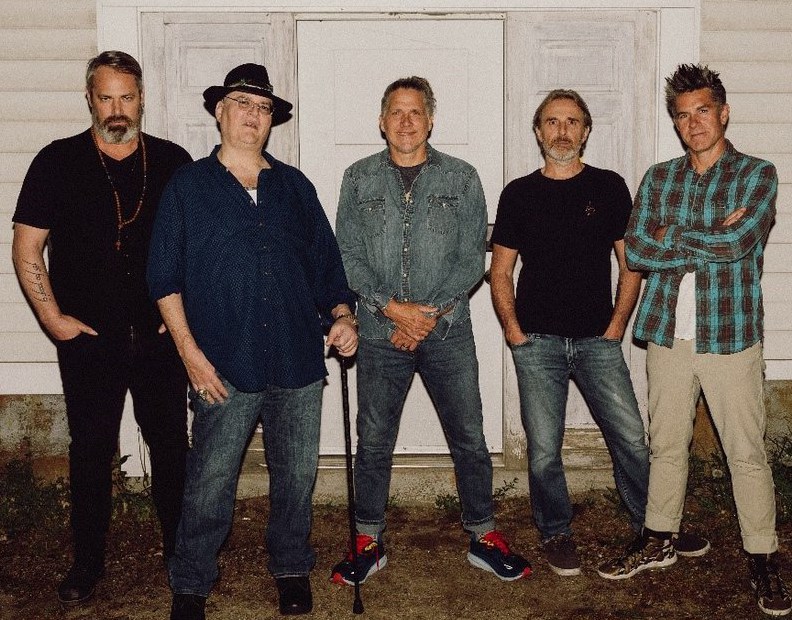
The phone rings exactly at three o’clock. On the other end of the line is energetic, talkative and informative Blues Traveler guitarist Chan Kinchla calling from his Los Angeles home who greets me with “Blues Traveler is anything, if not punctual…at the least the guitar player.”
Kinchla’s ready to discuss the band’s 15th full-length album, Traveler’s Soul, where the members shape 12 R&B/soul covers within its musical approach that’s resulted in three gold-selling records, one platinum LP, and the 6x-platinum Four. The veteran jamband keeps the arrangements on the new release tight as it navigates through classic material by The Impressions, Al Green, TLC, Dr. John, Deee-Lite, Allen Toussaint, King Floyd, The Meters and more. Adding to BT’s interpretations are numerous collaborators including the vocals of Valerie June on "I Can't Stand the Rain," Pat Monahan of Train on "Waterfalls" and Ryan Shaw on "When A Man Loves A Woman" while up-and-coming hip-hop artist Daisha McBride offers an homage to TLC's Lisa Left Eye’s iconic rap.
This album represents a sequel of sorts to 2021’s Traveler’s Blues, an album of blues covers that was nominated for a Grammy. The attitude may not have been “If it ain’t broke, don’t fix it” but it’s worked out that way. Once again, Kinchla, John Popper (vocals, harmonica), Tad Kinchla (bass), Ben Wilson (keyboards), and Brendan Hill (drums) worked with producer Matt Rollings at Sienna Recording Studios in Nashville for the creation of “Traverler’s Soul.”
So, will there be a third installment of covers? Maybe. Maybe not. For now, the group is busy touring behind the release after a successful summer of dates with Big Head Todd & the Monsters and the possibility of more shows together next year that will hit the Midwest and East coast.
As Kinchla put it, “It went so good, we should probably keep doing it.” Sounds like a motto the band follows.
JPG: Let’s talk about Traveler’s Soul, and how good it is.
CK: Thanks John. I'm quite pleased with it. It's so neat to dive into these classic songs where the arrangements are so excellent. Back then, they would turn out so many songs that the craft of songwriting was so spot on and simple but with a lot of nuance and cool elements.
In doing them, it is a master class of songwriting. We learned so much doing these records, like the blues one (Traveler’s Blues) which we did before. It's just a joy, and to have such a great team involved -- the band, the producer and the songs. We really enjoyed it.
JPG: You mentioned the arrangements. Just before you called, I made a note that the arrangements are quite efficient. There's soloing here and there but not a lot of extended soloing.
CK: That's the way they did it back then and we wanted to capture it. The whole of the parts were all pretty damn cool. The Meters stuff and the New Orleans stuff had a little more room for that. That's where we stretched out a little bit, but especially the more Motown R&B stuff, it's just cool little figures and musical interplay is what really makes those songs work. The arrangements, they’re such an important part. We wanted to honor that when we were doing it.
JPG: How difficult is it to cover a song, to make it your own but also being respectful to the original?
CK: For us our saving grace is we can't sound like anyone else, no matter what. We were never a cover band when we started out. We always did originals. Every time we tried to do a cover, it came off sounding like us.
So, we've always had that built-in blessing and curse. [Laughs.] In the end it's a blessing to sound original. So, pretty much anything was gonna sound like Blues Traveler. John’s got such a distinctive voice, and with the harmonica, it really obviously, it's very signature.
So, we don't worry too much that it's gonna sound like us. We want the interplay of the musicians playing together. It was very important that we got all the basic tracks as a live take, and we didn't layer, get the drums first and then put on the other instruments. It's all us.
It's something you more feel than hear. There's the interplay between the musicians. Our own inimitable style and the fact that we played all these tracks live and recorded them live, at least the foundation of them, the Blues Traveler part, because the guests are on later, obviously, that's how we kept our element to it.
After that, these songs were just fantastic hits in the past. We didn't want to fuck with the arrangements much, maybe do an interesting intro here and there, maybe mess with the bridge a little bit, but otherwise, we tried to keep the arrangements pretty close. Tried to simplify it, too. We were playing a lot of less-is-more, which is not our general nature. Like most jambands, more-is-more.
JPG: You mentioned recording the foundation of the song live because Traveler’s Soul does have that sound and feel of that.
CK: Picking the songs started months ahead of this, where we had massive lists where everyone's dumping all their favorite soul songs onto this list, and then slowly but surely, we find ones that all of us like. Then, in the end Matt Rollings, our producer, who we worked with on a few other records, got it down to a good, workable list of songs we were all pretty excited about.
We’d come in each day and start with a song and get the arrangement down. We did a little homework before, but by the afternoon we'll run it two, three, four times, and usually that's the take. And it's just so fun to start from nothing and then, for me, listening to them, you can hear the discoveries still in the take, a little bit like, “We got it. We finally got the pocket. We finally know the tempo. We got the groove. We're listening to each other.” That moment of discovery is something ineffable, but it's nice to have recorded and have it in the mix.
I also got to use the word ‘ineffable’ in an interview. [Laughs.]
JPG: Oh, I caught it. [Laughs.] Also, ‘inimitable’ earlier.
CK: I'm just working it. It's the coffee.
JPG: The 12 tracks here, which ones did you chose and push to have on the album?
CK: At a certain point they all become like our own choices. The Meters one, “Just Kissed My Baby,” that was Brendan Hill. I’ll be honest, it’s my favorite one because we actually got the pocket on a Meters tune. It’s got such a great groove.
I really like what happened with “Groove Is in the Heart” and “Waterfalls” because those are R&B songs, but you wouldn't really think so. I love how we reinterpreted those. Those are actually John Popper ones. Apparently, I didn't have any ideas that made it to the record. [Laughs.] I have to look. You give away ownership at a certain point and it's a good group consensus thing. This happens to us all the time. We forget whose idea things were.
JPG: With Traveler’s Soul, when we're talking about making the song your own yet being respectful in the arrangements, it's really interesting that the opening track, “Fool For You” sounds so much like a classic Blues Traveler number that if someone didn't know that it was an Impressions cover they’d think it was one of yours.
CK: What’s interesting about that song is the original is in a really weird time signature and they're kind of deconstructing the classic R&B arrangement model a little bit. When you take it apart, it's a really weird R&B song which almost makes it more of a contemporary Blues Traveler jamband-y kind of fare. We just thought, “This is like a classic R&B song. We all love it. It's got a great chorus.” But when we deconstructed it, we're like, “This thing is fucking weird. It's like 15/8 and then it changes back to 4/4.” Curtis Mayfield, the guitar player, is such a fucking badass.
JPG: The other thing about it is that you could have got away with just the five of you doing the whole album, but you brought in a bunch of guests. Was it always an idea of adding some spices, if you will, to the mix?
CK: That first the record we did like this, we did the blues record (Traveler’s Blues), which we did over the pandemic. We'd always wanted to do a blues record because the name of the band is Blues Traveler, but we don't really play the blues. That was one of our first loves. So, it was always an idea.
The pandemic happened and, basically, conspired us to give us some time and needing something to do. That blues record, we had a bunch of guests that fell into our laps. With the blues record there's a lot more soloing involved because…blues. So, we would have guest soloists and we would have a lot of different people on it. That went so well, and it was Grammy-nominated and we had great feedback from it.
We kept the same template. For us it's so fun to have all these other guests on it that we just went with it.
JPG: Besides classic soul numbers there are some surprises on the new album such as a cover of “Groove Is in the Heart” by Deee-Lite.
CK: Here's the funny thing. When Blues Traveler started in the Lower East Side of New York in ‘87, ‘88 ‘89, they were also playing all around in a similar way, they were just a little more dance.
That was back in the Club Kids era, the Limelight…We played the Limelight, there were all these clubs, and we occasionally would play them. We were more like Lower East Side dives, but we played fucking everywhere. We didn't care.
We'd see them walking around the street. They’re kind of from our era in New York City where we came out of. So, we always had an affinity towards them and that song because that's our era. [Laughs.]
JPG: Were you friendly or was it a matter that you never interacted because you were in totally different scenes?
CK: We were in the same places, but we never got to know each other.
JPG: By the way when you're talking about Traveler’s Blues, while the band never really made a specific “blues” album, but it always felt like the blues was part of the band's DNA.
CK: That's 100%. My formative years of playing was old blues guys but also Led Zeppelin, Jimi Hendrix, Stevie Ray Vaughan, who are all very blues-based players. That was more the DNA of the band. We loved all kinds of music. We incorporated the Grateful Dead and the Allman Brothers and other stuff like that. When we came up in the ‘80s, it was classic rock radio. We were just getting saturated with it, which was great because it's amazing music. So, we were exposed to a lot. But, we were a blues-based band at the beginning.
The way we looked at it [Traveler’s Blues] is the blues record we wanted to make back in ’85 or’86 in high school but we were just a bunch of punk kids. So, there's no way we could do a proper blues record. We finally got enough wear and tear to make a proper blues record.
JPG: And now, you made this record, and I think there always was an element of soul/R&B in Blues Traveler’s DNA, too.
CK: For sure. John, I think is much more of a natural R&B soul singer. That's really his singing style that suits him. His voice sounds amazing on this record. I just love it.
JPG: I agree. You mentioned how you had such fun making Traveler’s Blues and that ended up transitioning to Traveler’s Soul as the sequel. Do you think this might be a trilogy?
CK: I don't know. We shall see. We're getting antsy to go do another original record now. The way we looked at these, right when the pandemic hit, we had just done a year or so before an original record [2018’s Hurry Up & Hang Around]. It takes, especially later in your career, a lot of chips to fall the right way before you get emotional fortitude to go in and do an all-original record. We certainly weren’t ready. So, the blues thing happened. At first it was just going to be a couple songs, we weren’t sure. It went so well that we started to chase it—that's kind of the Blues Traveler way. We just follow the muse…for better or worse.
The way we looked at it, these are standards now, these songs we’re working on. Back in the jazz era, the big band era, bands would do standards, like Frank Sinatra would do an album of standards.
We're trying to cop those artists doing the standards, reimagine the standards. At this point though, I think we're ready to do another originals record. If I had to guess, that's where we go next.
Also, after our doing soul then the next thing to do is rock and roll and we already do that. We arrived at where we’re at. I don’t think we're going to do a hardcore jazz record.
JPG: Well, a reggae album by Blues Traveler, that'd be interesting.
CK: We all came up in the ‘80s when punk rock and ska and all that was really big. So, we all started out on a lot of that music. I'm still a huge punk rock, ‘80s ska fan. In my band W4HORS3 we cop some of that. Anyway, Blues Traveler can fucking skank. We're pretty good at playing reggae and ska. Maybe we'll do that someday but who knows? We'll see what next year brings.
JPG: You mentioned the pandemic. It’s interesting that your last two albums came about during and after the pandemic and so did Gov’t Mule’s last two albums; two bands that came on to the music scene around the same time. And, they're very strong albums. Do you think you needed the pandemic break? It gave you a necessary timeout that you didn't think you needed, that refreshed you creatively and physically?
CK: Quite possibly. We moved to New York in ‘87. We started touring like ’89 and we never stopped. We never had a year off. Even after Bobby [Sheehan] died, we still did gigs.
We joke that it took a global pandemic to make us take a year off. Honestly, it was nice downtime to decompress from road life a little bit but it also made me appreciate touring all the more. It was a chance for everyone to reassess what their priorities were. Across all different walks of life, everyone took advantage of it that way. We sure didn’t mind it.
JPG: Speaking of appreciating things, I can't help but bring up H.O.R.D.E. and curious for your thoughts about that time and its legacy for you and the jamband scene.
CK: It was a great coming together, that whole era. The whole idea was, we, especially on the east coast, in the late ‘80s we toured up and down from like Atlanta to Burlington and Phish would and Widespread Panic would and the Aquarium Rescue Unit would, and we kept bumping into each other and we got to know each other doing that. We just thought it'd be really fun instead of the summer playing little shithole clubs because we didn't have any fanbases at that point, it would be fun to combine forces and be able to play outdoors at some of these sheds.
That original H.O.R.D.E., all those bands including Spin Doctors and Bela Fleck at that time, and then the following year there was Dave Matthews and Big Head Todd jumped on board. All these amazing bands that are still around today doing great work playing real live music with solos and their own identities.
It was a really cool time and was a great capstone of what was actually happening in that whole era. I'm not surprised that all those bands have gone on to do great, great stuff down the line.
I don't think H.O.R.D.E necessarily created it. I think H.O.R.D.E. was just a great showcase of what was going on. I'm really proud to be part of it and that we could help put that whole thing together.
JPG: That's probably the best word to describe it, “showcase”. It reminds me of Lollapalooza which collected and showcased a bunch of alternative rock acts on one bill in order to play large sheds in the summer.
CK: Here’s the thing. Lollapalooza was the summer before, and we went to Lollapalooza, me and John and Bobby [Sheehan]. When we were playing with all these other bands, it would be Spring Fling with Phish or we would do a gig down in Baltimore with Widespread Panic where they’d open up for us and we’d open up for them down South. At Lollapalooza we were like, “We should do this with all our homies!” Honestly, H.O.R.D.E. was basically jamband Lollapalooza.
JPG: I remember going to that first Lollapalooza where Jane’s Addiction headlined at a sold-out Blossom Music Center, walking in there, looking around and thinking, “Wow! There are so many of us! Who knew?” Everybody was going to club shows or small theaters for all of these bands.
CK: That's a great point, and if you remember back then, that's how we got to know shit. A big festival like that was an actual coming together. People didn't know that all these other people or even other bands existed necessarily because it was just rumors and your local scene. Those big festival concerts were such a big deal for creating and exposing a scene. In any case H.O.R.D.E. definitely helped bring together a scene in a larger way.
JPG: Earlier, you mentioned your side project, W4RHORS3.
CK: My side hustle! I did something really fun the other night. We got off Blues Traveler tour and W4RHORS3 [pronounced WARHORSE] opened up for a famous Southern California Dead, trippy band, Cubensis. They've been around forever, and I’m friends with the guys. So, I was guest guitarist for the whole night. Twenty Dead tunes! It was amazing!
I love the Dead and we’ve played a song here and there, but it's so cool to dive in deep and play all these great songs from my past. I'm completely immersed in Grateful Dead right now, which is great. I was always a Jerry guy.
As for W4RHORS3 I go back to my early days of Blues Traveler. We had a rule, me and Bobby, that because we were always out socializing, quote unquote socializing as in partying, so, we met a lot of people we're like within five minutes, everyone needs to know the name of the band we're in and where we're playing next.
There are so many great musicians in L.A. Nate LaPointe, the guitarist from Cubensis, plays in W4RHORS3 at times. It's got a power trio. That's the center of it. Then, we have a bunch of other people that rotate around, and it's all original music. Although, when we play live, we do covers and it's fun as shit. So, that's what’s going on with W4RHORS3.
Our next gig is December 7th at The Mint. So, there you go. You know the name of the band and where we’re playing next. Only way you can get a band off the ground, you gotta hustle. You got to put it on the street.
JPG: You mentioned your next gig within five minutes.
CK: And more importantly you always have to have a next gig. If anyone asks me, always have an upcoming gig and make sure you tell people the name of your band.
JPG: Is W4RHORS3 jammy or punk rock or…
CK: Very jammy. It's jammy rock. You can go to Instagram, W4RHORS3. We have all kinds of shit. Check it out, and Soundcloud, there's a bunch of songs on there. We’re working on an album.
Here’s the thing. I raised two children. I quit partying. A couple years ago I was like, “My kids are grown up. I have all this free time. I really need a hobby.” So, I started thinking to myself, “Well, what do you like to do?” And I realized I like to play guitar in rock bands. So, for my hobby, I play guitar in a rock band.
JPG: That goes nicely into this quote I read of yours, a great, upbeat motto of life, “The more I do it, the more I like it.”
CK: That’s it. That does tie right into it. I guess I'm following my own advice.





