

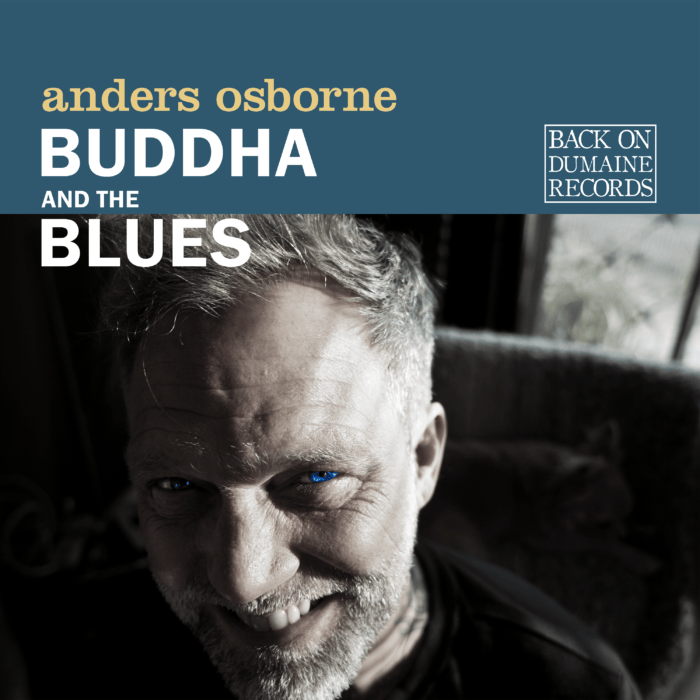
When describing the title and corresponding titular track from his new album, Buddha and the Blues, singer-songwriter and guitarist Anders Osborne references the duality of existence. His own existence, one that began in Sweden and migrated to the U.S. in his teenage years, has been one of creative success, personal struggles with addiction, and a nearly uninterrupted cycle of albums and tours. Having taken up residence in New Orleans for over three decades, Osborne has become a fixture of the Crescent City’s musical community, regularly performing at Jazz Fest, both properly and in late-night appearances, including for several years ongoing with Dead Feat. Yet, Osborne’s latest recording effort takes him further back to the roots of his musical inspirations- the singer-songwriter era of Southern California in the 1970s- and to a recording studio in a small arts village of Ojai, north of Los Angeles, working with session vets such as Waddy Wachtel (Warren Zevon, Keith Richards), Benmont Tench (Tom Petty), and Bob Glaub (Jackson Browne, Bonnie Raitt), as well as producer (and drummer) Chad Cromwell (Neil Young, Mark Knopfler).
Buddha and the Blues is now streaming on Relix.com
What impact didworking in Ojai, California have on the album?
I think it had a big effect. Mostly, it was a combination of things; with Bob (Glaub) and Waddy(Wachtel)- those classic West Coast sessions guys on all those records- andChad (Cromwell), who’s amazing at stripping it down to the things that need tobe played; no more, no less. The idea ofcutting it out there was something I thought about for a good part of a year ortwo. I told Chad I’d never done a recordthat is trying to reflect some of my first inspirations, which was ‘70s WestCoast stuff; California rock-songwriter music like Jackson Browne; and Joni(Mitchell); James Taylor. All that stuffthat came out of there. It was time toconnect the dots.
Was it also the righttime to make a record away from New Orleans?
Since I got sober, a lot of stuff has been aboutconfession. My thought process haschanged. I don’t think as much aboutthat. Also, the importance of NewOrleans feels second nature to me after 35 years. It isn’t as crucial for me to be here to dowhat I do. When we got out there, tothat dry Southern California hill country- the rolling, beautiful beige andyellow and orange; dried out green; blue sky. It is different. I wrote withthat in mind. It was wonderful.
You have spoken ofduality when describing the title song. I inferred several instances of other dualities throughout the album. One example is a frailty that is suggested attimes, and how acknowledging it becomes a source of strength.
You’re spot-on. That’s exactly what it is. It’sinteresting to hear the reaction. Mythought was that it is a strong album; that I was confident and strong. But, your reaction of frailty, and moreintimacy, has come from a few people very close to me as well. I think the discovery has been that this partof me is something I feel strong about; that I feel full strength from beingthat person; admitting it and being okay with it.
I can hear, again aduality, an assuredness that emerges from uncertainty. Like, even when things aren’t okay, they areokay.
There were some quotes floating around as we prepared tospread the word about the record. Oneis, there is a sense of a battle between ‘I don’t care anymore,’ about mycareer, and ‘I give up,’ about my career. There is a sense that I’ve reached my final destination within myself,and I have just begun my true journey. That duality has been really up front for a year now. Maybe two. My internal discussion, constantly, even musically, has a lot less toprove, a lot less to show people. Or I’mtrying to connect to myself and other people; almost like a diary, lately. I want it to be honest and I want it to bebeautiful.
Does that account fora lot of the album being written in first person? Are you using that but inhabiting a characteror is this truly autobiographical?
I’d say the latter. What I debate as I write is playing with third person- talking tosomeone- like on “Escape,” there was a mistake we left on. I start out (singing) something like, ‘Youshouldn’t go too far into your mind. You’ll get lost.’ It was supposedto stay that way, but in the pre-chorus, I accidently sing ‘I’ve seen what I’veseen. I’ve been where I’ve been.’ I slipped, and it became first personagain. As a craftsman, I wanted to fixit, but Chad said it was good; to keep it. Sometimes I like to yell at someone, even if it is to myself, and I’lluse third person. And sometimes you justwant to confess to people. You findwhatever voice works to feel good singing it.
Another instance ofduality is in the instrumentation of the songs; it seems simultaneously quietand intimate, but still aggressive and guitar-driven. How did you achieve that?
I think it’s a team effort. Waddy may do something with a straight-up, classic rock-and-roll, Gibson(guitar) approach, where I’m doing a small-bodied acoustic guitar. All of the sudden it creates somethinginteresting. That wasn’t really a plan,but as you start cutting stuff, everybody is so involved and creative, it movesso fast as soon as you hit on something good. Plus, it goes to the mastering. (Richard Dodd) mastered it much more rock-and-roll; much tougher;punchier; more compressed; just jacked-up good. That pulled up stuff we didn’t actually realize was in there. So, it was, like I said, a total team effort;not my big vision. The only thing I knewwas that I wanted it tracked in Southern California. A lot of these songs werewritten very folky; fingerpicking; mellow; in a much lower key. When we got in the studio we jacked it up.
Why have twodifferent versions of “Alone” bookend the record?
It was Chad’s idea. It was the first song that he truly fell in love with and said, “I knowthe record. I get it now.”
You mentioned avariety of Southern California influences, but at times I hear some others,like George Harrison on “Traveling with Friends.”
I’ll tell you an influence that sometimes gets overlooked isCat Stevens. If you think of that you’llhear something in there. There’s adialogue with one’s self. I am, but whatam I? What do I want? These existential questions. You’re no longer thinking of picking upchicks or becoming famous. You’re notdiscussing life on the road. You’rediscussing your actual existence. That(informs) a different cadence.
One of things I’veunderstood about addiction is the idea that an addiction makes choices for you,and that breaking an addiction means regaining ownership of your choices. I sense that a lot in these songs.
Absolutely. It’s abit of awakening. I’m realizing that I’mfree. It’s daunting. I have two teenage kids, mortgages, careers,employees, addiction, AA meetings; there’s a lot. Every minute of the day there issomething. I got to my age and it’s,‘Oh, shit. I’m one-hundred percentfree.’ I was born free and I’ll alwaysbe free. I can choose to not do any ofit. I might look like a (jerk), but Ican. (Laughs.) It was a turning pointfor me. Okay, so what are the thingsI’ve committed to, the responsibilities that I have to continue, and what arethe things I enjoy? And on the otherside, what is not a commitment? Can Idrop something? Can I make a change? I felt like I needed to make a change and Istarted to make those changes.
At your show thispast November at the Troubadour in Los Angeles, you spoke about being a recentrecipient of U.S. citizenship. What didthat mean to you?
It was a really powerful moment. I don’t think I anticipated how strongly Iwas going to feel when I got the papers back saying I was accepted. I literally fell on my knees crying. I sat and thought about it. The ceremony was really, really special. It felt like I understood theresponsibilities- not only the opportunities- in protecting the wonderful ideathis nation is: a beacon of hope for the whole world.
You also seemed tojoke about what you may do as a songwriter now that you were entitled to freespeech.
The fundamental idea of this country is that you cannot becondemned for your opinion. I realizedat that moment that I had censored a lot of my thoughts because I’d beenworried about my (citizenship) situation. I don’t think that will change a lot, but certain issues that areimportant to me, that I don’t want confused with politics, I may be engaged inthose. Something I feel strongly aboutis that a lot of people waste a lot of time and energy on being intoxicatedinstead of being spiritually fit. Youmay see me do some more work there. But,basically, (I know) I have a responsibility to uphold and protect (that right),and that feels good.





