


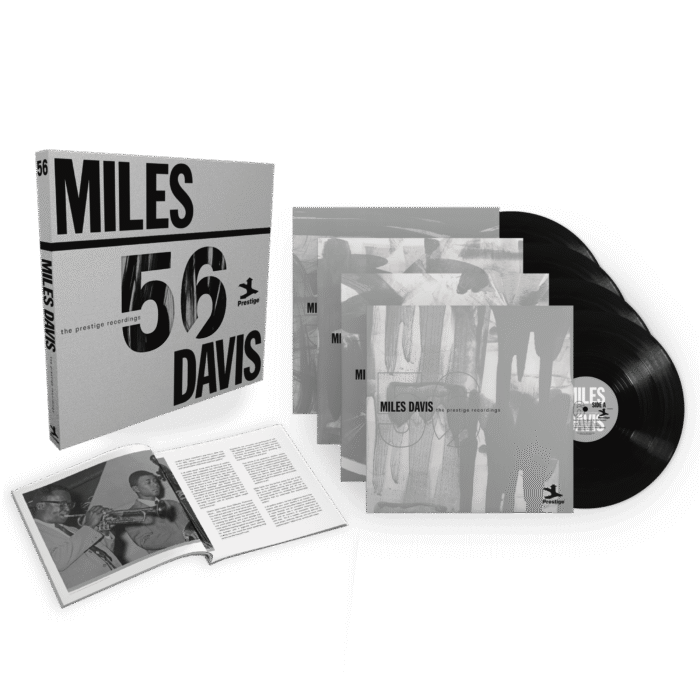
Ashley Kahn is a foremost authority on the musical artistry of jazz legends, Miles Davis and John Coltrane. His album liner notes have been nominated five times for a Grammy, with two wins: for the Miles Davis set, Miles ’55: The Prestige Recordings, and for Coltrane’s live LP, Offering: Live at Temple University. Kahn’s illuminating insight returns in his essay for Miles ’56: The Prestige Recordings, a newly-released collection from Craft Recordings, that celebrates a series of sessions featuring Miles and Coltrane at an historically pivotal, mid-century moment.
As well, Kahn is an acclaimed author of books detailing the creation of two monumental albums from the icons, Miles’ Kind of Blue and Coltrane’s A Love Supreme, not to mention penning a George Harrison retrospective and co-writing Carlos Santana’s autobiography. Too, the former college DJ just as easily confesses to enthusiastic late-night debates with friends in the 1970s about the better songs and sides of Grateful Dead classics, such as Wake of the Flood and Blues for Allah. Currently a professor at New York University’s Clive Davis Institute for Recorded Music, Kahn is widely considered the preeminent historian of the art form.
The writer joined us for a closer look at Miles Davis and John Coltrane in 1956, as well as the vital role New York City played in fostering a culture and environment essential for such artistic creation.
Why, 70 years later, should we care about these recordings, about what Miles Davis was doing in 1956?
That’s exactly the question I ask the students to consider whenever they take one of my courses. I say, I want you guys to question this. I don’t want you to take it on total faith that when one generation hands you their cultural treasures or icons, or passes the legend on, that it is something you take without question. I call it questioning the crown. As the cliché goes, time always tells. The fact is, this music continues to be, to many people, the foundation. An education on improvised music. A path forward for players. This is Bible material. It’s music you have to learn, consider, dive into. This is the sound of what we consider to be modern jazz, small-group jazz. On a Tuesday night in Tulsa, or a Friday night in New York, if it’s a quintet, or a sextet, or a quartet, whatever, there’s a really good chance it might be doing one of the tunes that was in Miles’ setlist in 1956. This has defined the kind of onstage communication that is expected of any improviser who is creating music in the moment. Which is another way of saying jazz. You still hear the echoes of what Miles laid out as being step-one for many groups. Step-one for many improvisers.
Is it simply the high quality of the music that allows it to endure, or is there something intrinsically special about Miles, as well?
There are other things I can unpack, such as Miles’ own stature, and his image, that continue to be incredibly strong and meaningful for us as a culture. This is kind of the starting point, ’55, ’56, when he gets his sonic identity together, and we get to know the trumpeter with the sound that is so different from everyone else. You could identify him with one note.
Your liner notes make clear that New York City in 1956 was the ideal incubator for Miles and his music. Why?
For the idea of a scene, what is needed for any kind of a culturally rich area to survive, there has to be audiences that are willing to help deal with the monetization of culture. Culture cannot live in a vacuum. It’s real people with real needs, and jobs, who need to be supported. And New York, obviously, was that in a big way. As a player you could get work anywhere and everywhere. The other thing is educated audiences. Audiences that knew the distinction between different styles of music, and different levels of musical skill. And would necessarily support those who were showing the most promise, and had a way of reading that audience. And, finally, the idea that people who arrive into that scene are given a chance to benefit from it, develop their craft, develop their voice, develop their musical vision. That’s really what New York was all about.
How did that benefit Miles?
If you compare what he was doing on the trumpet in 1945 with where he finally gets to by ’55, that maturing process is a huge reflection of the benefits of being in an environment that’s going to support you. That you can pay the rent. That you can keep food in the fridge. That you can make mistakes, and figure stuff out. Build your community. Build your audience. That’s exactly what any professional musician would need if they’re going to pursue their own music. It’s important that there’s a scene to support visionaries who are going to go out and do their own music that is not just the status quo.
It reminds me, a bit, of the jamband scene in New York in the mid-1990s, when artists had smaller clubs to play, hoping to move up to the Wetlands, and then to Roseland, and so on.
Dan Wakefield wrote a great book called New York in the Fifties. He has this great chapter in it, called “Graduating to The Five Spot.” He talks about the kind of hierarchy of jazz clubs in New York in the 1950s. How, if you were hip, you were, at least, aware of the more commercial places like Birdland. But, if you were truly hip, you made it to where The Five Spot was. That’s where (Thelonious) Monk played with Coltrane. Where Ornette (Coleman) had his coming out on the East Coast.
Your notes also explore Miles’ desire for his music to be inclusive, if not, dare I say, populist, rather than for small, elite audiences. Am I inferring that correctly?
How I look at that is that Miles was as creative with how he spoke about the music as he was with the music. Sometimes, it wasn’t so much the words he was using, but the spirit to which he was speaking. And you have to figure that out. He was also a man of very economic statements. If he could say it in two words, he would try and figure out how to say it in one word. He was very proud of the fact that by the mid-‘50s the world is catching up with him. And that he is establishing himself as a star. First, within his own scene. And then growing out of it. Inclusive? Heck, yeah.
Yet, he’s often considered in opposition to the status quo, yes?
He doesn’t want to create music that is going to force him to go to little places in the East Village for the rest of his career. He very gladly embraced the opportunity to start touring with his own band. To put on the tuxedo, or the nice Italian suit. And, then, in in the ‘60s, play places like the Fillmore. Nothing is ever one way and not another with Miles. He was very proud of the fact that he was doing his own music. And willing to take chances. Hence, Bitches Brew. He took such a chance doing that album. He was more interested in pursuing his musical vision than he was in audience-building.
It’s long been discussed what Miles did for Coltrane, in terms of the latter’s artistic evolution. What did Coltrane do for Miles, if anything?
The word foil is used a lot. The idea of contrasting voices. It becomes a signature aspect of Miles’ groups, starting with him and Coltrane. That he is able to include very opposing ideas within a group. Out of that opposition, out of that apparent incongruity, you would find treasure in the cracks, between all that. It starts with that intuitive idea. That, okay, I’m not able to get Sonny Rollins. But, this other guy, who’s been highly recommended, who I knew about on the fringes of the scene, primarily based in Philly, is worthy of a chance, even though Trane’s first audition with Miles was not a good one.
Yet, Miles goes with it anyway. And the contrast works.
It was this idea that here’s the canvas, and we’re all attacking it at the same time. That kind of freedom that he allowed for, the challenges that he demanded of his sidemen. That would never change. Coltrane was a brilliant example of someone who just needed that one spark to get started. By the middle of ’56, which is when the tour is happening that would be reflected [in these Prestige recording sessions], Coltrane has matured immeasurably. He has leapt to the front, and people really start to hear him. Miles had proof-positive of his approach to leading a band.
You worked with Carlos Santana on his memoir, The Universal Tone: Bringing My Story To Light. I know he’s a huge fan of Miles and Coltrane. Was it that appreciation that drew him to you as an ideal collaborator?
Carlos speaks Carlos-talk. He’s someone who talks in very much a spiritual way, on a spiritual level. And, more generally about things. I cannot remember him ever telling me exactly why I was chosen. But, I do know that when my writings first started getting out there, especially the Love Supreme book, he saw how I employed the stories he shared with me. I heard that he really liked the way I maintained a certain level of respect and reverence for what it is I’m writing about.
When you work on liner notes, such as these, who are you writing for?
I can tell you what the community of liner note writers, music journalists, whatever you want to call us, have to say. We write with the idea that it may be the first and last time that this music is ever talked about. Therefore, we have to provide, at least, a sketch of who the participants are, what their credit is, et cetera. How you weave it in, that’s your craft. That’s the art of your writing. I do think that there is certain foundational information that needs to be in each and every essay. At the same time, I am extremely focused on the idea that liner notes should be primarily about the music that is inside the package, You have to tell the story of not just the artist, but the music.
Is there any dream project out there you hope to undertake?
I have a new book about Graceland coming out in August. On Paul Simon and that album. It looks at the album from a variety of perspectives, including the social and political situation in the 1980s. It looks at the controversial aspects of the album, straight on. I have other book ideas in me. I like working in book-length format. I appreciate the question. And, I feel like I should have an answer. It kind of indicates to me that I really love what I have achieved. I’m very comfortable with where I am right now.

No Comments comments associated with this post